Algebra 43 - Types of Linear Systems in Three Variables
TL;DR
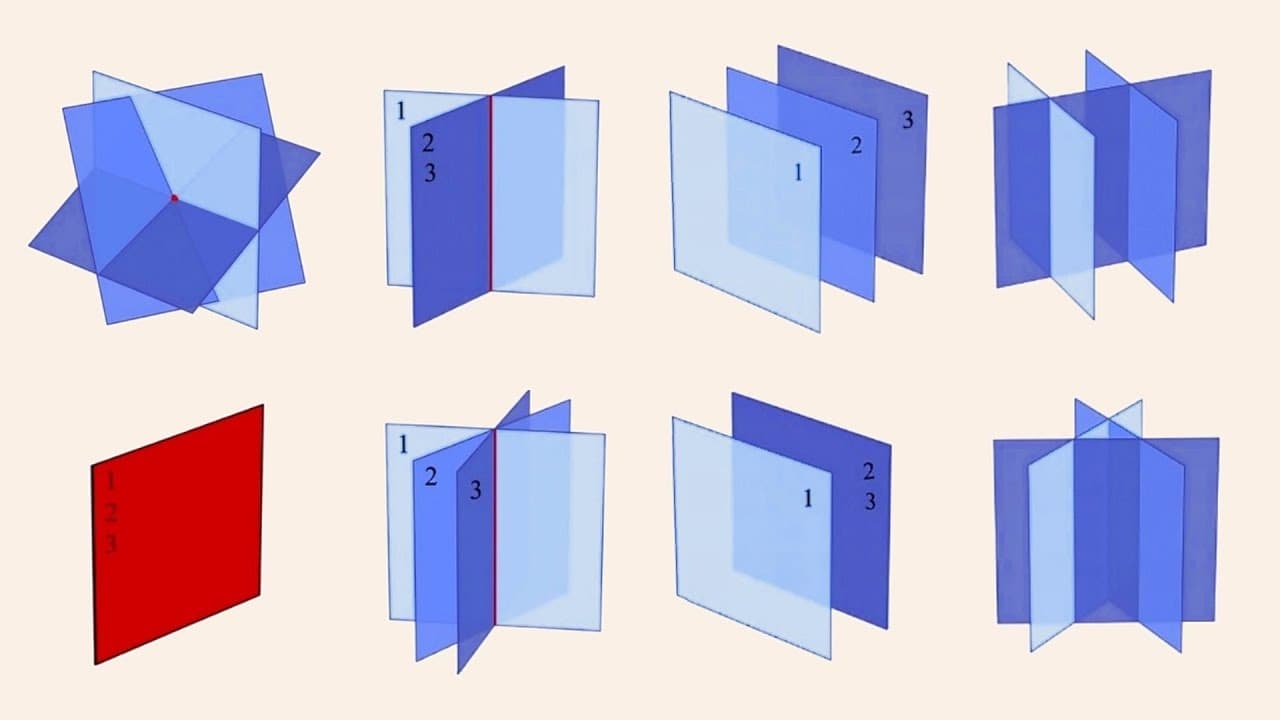
Different orientations of three planes in 3D space can result in systems with one unique solution, an infinite number of solutions, or no solutions.
Transcript
Hello. I'm Professor Von Schmohawk and welcome to Why U. In the last lecture, we saw that just as the graph of a linear equation in two variables creates a line which extends infinitely in both directions the graph of a linear equation in three variables creates a plane which extends infinitely in all directions Since the graph of a linear equation... Read More
Key Insights
- ✈️ The graph of a linear equation in three variables is a plane.
- #️⃣ Systems of three linear equations in three variables can have one unique solution, an infinite number of solutions, or no solutions.
- 😫 The orientation of the three planes determines the type of solution set.
- 🫥 Two distinct parallel planes or three distinct parallel lines result in no solutions.
- ✈️ Identical planes or a line of intersection between two planes can result in an infinite number of solutions.
- ❓ Consistent systems have one or more solutions, while inconsistent systems have no solutions.
Install to Summarize YouTube Videos and Get Transcripts
Explore YouTube Video Summarizer or Get YouTube Transcript Extractor
Questions & Answers
Q: How is a system of three linear equations in three variables represented graphically?
A system of three linear equations in three variables can be represented as a group of three planes in 3D space. Each plane corresponds to one of the equations.
Q: What determines the type of solution set for a system of three linear equations in three variables?
The orientation of the three planes determines the type of solution set. If the planes intersect at a single point, there is a unique solution. If they intersect along a line, there are an infinite number of solutions. If the planes are parallel or intersect along three distinct parallel lines, there are no solutions.
Q: Can a system of three linear equations in three variables have more than one unique solution?
No, a system of three linear equations in three variables can only have one unique solution if the three planes intersect at a single point. Any additional points of intersection would result in an infinite number of solutions.
Q: Can a system of three linear equations in three variables have no solutions?
Yes, a system of three linear equations in three variables can have no solutions if the planes are parallel or intersect along three distinct parallel lines. In these cases, there are no points that satisfy all three equations simultaneously.
Summary & Key Takeaways
-
Systems of three linear equations in three variables can be represented as a group of three planes in 3D space.
-
The orientation of the planes determines the type of solution set: one unique solution, an infinite number of solutions, or no solutions.
-
If the planes intersect at a single point, the system has a unique solution. If they intersect along a line, the system has an infinite number of solutions. If the planes are parallel or intersect along three distinct parallel lines, the system has no solutions.
Read in Other Languages (beta)
Share This Summary 📚
Summarize YouTube Videos and Get Video Transcripts with 1-Click
Try YouTube Summary with ChatGPT & Claude or YouTube Transcript Generator
Explore More Summaries from MyWhyU 📚

Summarize YouTube Videos and Get Video Transcripts with 1-Click
Try YouTube Summary with ChatGPT & Claude or YouTube Transcript Generator