Topology - Part 2
TL;DR
The video discusses different ways to visualize and understand space, including 2-dimensional cylindrical and toroidal spaces, as well as 3-dimensional curved spaces.
Transcript
Professor Dreamy ... I mean Schmohawk. Adrian Scienstein, do you have a question? I’ve been wondering professor, what exactly is space? Well Adrian, nobody actually knows what space is. On the smallest scales space may have very different properties than what it appears to have on the scales that we can measure with today’s technology. One way we c... Read More
Key Insights
- 😥 Space is a way of connecting points, but its properties may vary on different scales.
- 👾 Visualizing space can be done through connecting boundaries in different ways: cylindrical space, toroidal space, and curved space.
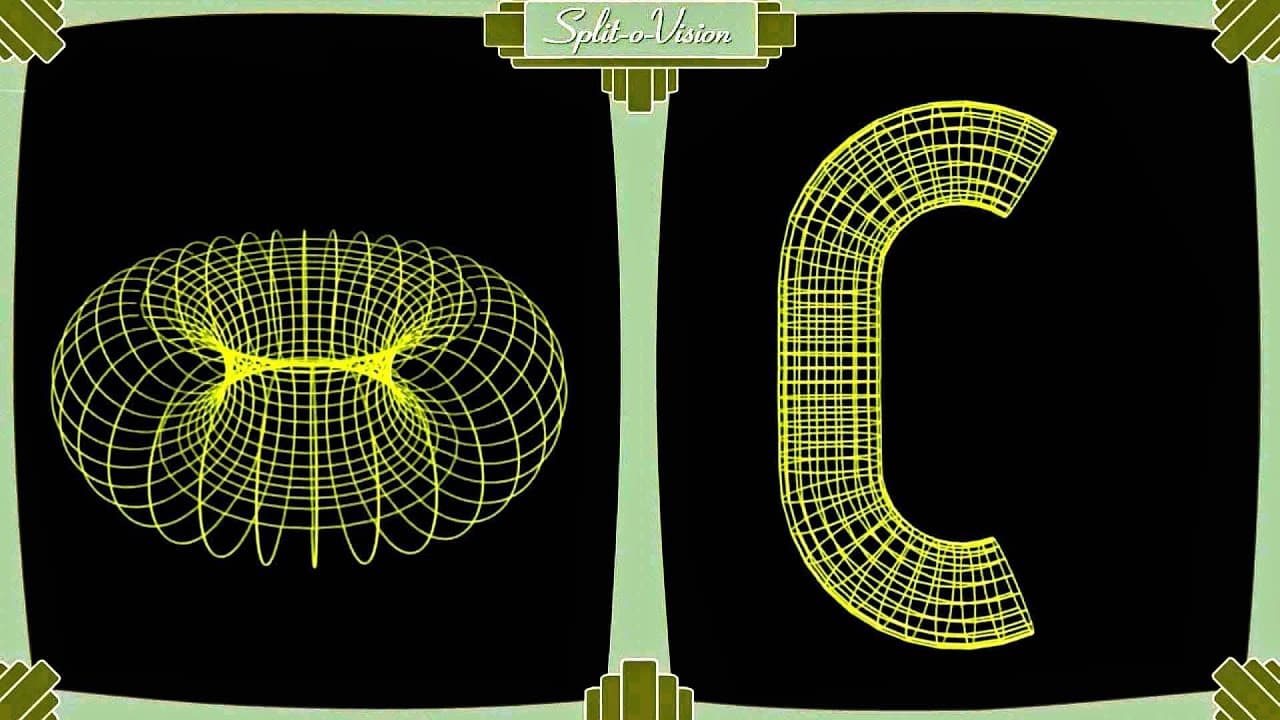
- 👾 Cylindrical space is like a flat sheet rolled into a cylinder, while toroidal space resembles a donut shape.
- 👾 Toroidal space can be visualized in different ways, but it still results in a torus.
Install to Summarize YouTube Videos and Get Transcripts
Explore YouTube Video Summarizer or Get YouTube Transcript Extractor
Questions & Answers
Q: What is space and how is it different on smaller scales?
Space is a way to connect points, but its properties may vary on different scales that are not measurable with our current technology. On smaller scales, quantum effects may come into play, causing space to have different properties.
Q: How are cylindrical and toroidal spaces created?
Cylindrical space is created by connecting points on the top and bottom boundaries, visualized as a flat sheet rolled up into a cylinder. Toroidal space is created by connecting points on both the top and bottom and left and right boundaries, visualized as a torus or donut shape.
Q: Can toroidal space be visualized differently?
Yes, toroidal space can also be visualized by stretching the cylinder and connecting the top and bottom boundaries like a garden hose. However, in both visualizations, the resulting shape is still a torus.
Q: How does curved space fit into the discussion?
Curved space is a concept in Einstein's theory of general relativity. It allows for different topologies of space, including unbounded, curved spaces. In the video, a 3-dimensional spherically curved space is mentioned as an example.
Summary & Key Takeaways
-
Space can be thought of as a way of connecting points, and on smaller scales, it may have different properties than what we perceive.
-
By connecting points on the top and bottom boundaries, a 2-dimensional cylindrical space is created, which can also be visualized as a flat sheet rolled up into a cylinder.
-
By connecting points on both the top and bottom and left and right boundaries, a 2-dimensional torus (donut shape) is created.
Read in Other Languages (beta)
Share This Summary 📚
Summarize YouTube Videos and Get Video Transcripts with 1-Click
Try YouTube Summary with ChatGPT & Claude or YouTube Transcript Generator
Explore More Summaries from MyWhyU 📚
Summarize YouTube Videos and Get Video Transcripts with 1-Click
Try YouTube Summary with ChatGPT & Claude or YouTube Transcript Generator