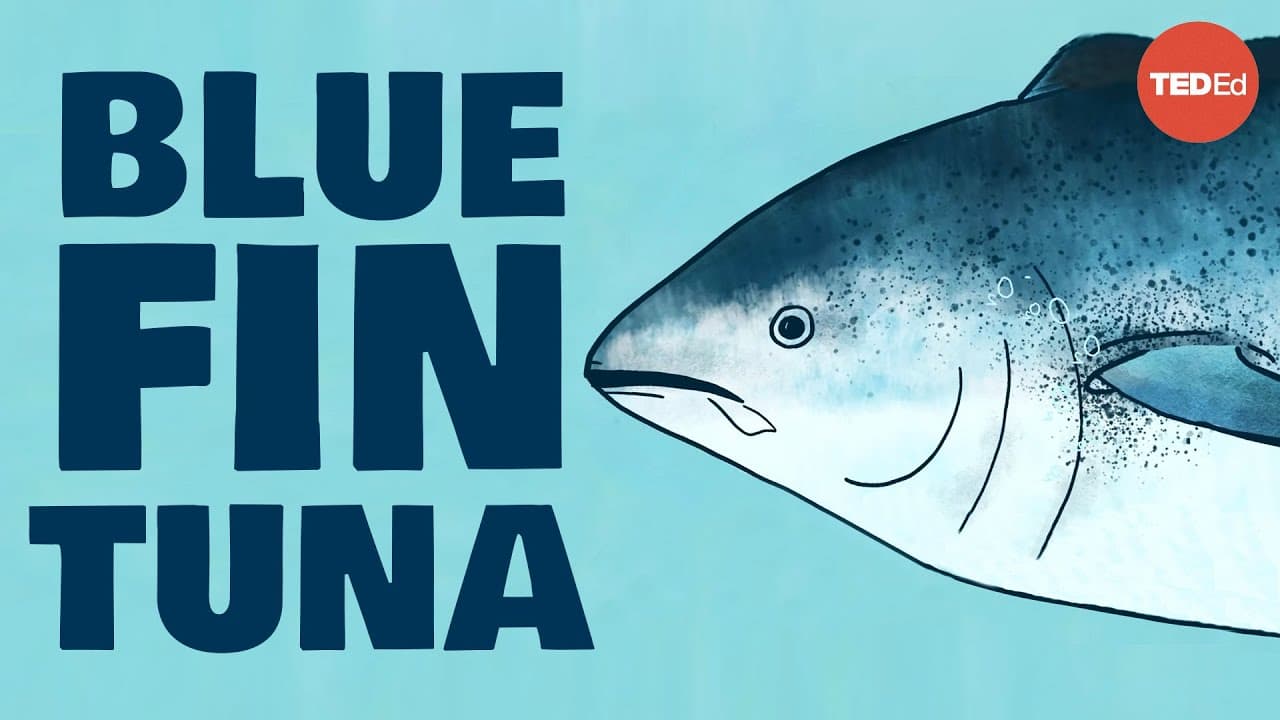
Meet the bluefin tuna, the toughest fish in the sea - Grantly Galland and Raiana McKinney
TL;DR
Atlantic bluefin tuna, a formidable predator with unique adaptations, faces threats from overfishing but can recover with conservation efforts.
Transcript
What’s as big as a polar bear, swallows its prey whole, and swims at 40 miles an hour? It’s not a shark or a killer whale. It’s the Atlantic bluefin tuna. The largest and longest-lived of the 15 tuna species, the Atlantic bluefin has a unique set of adaptations that make it one of the most dominant predators in the ocean. It starts as a tiny hatc... Read More
Key Insights
- 🏊 Atlantic bluefin tuna possesses regional endothermy, facilitating better hunting and swimming abilities.
- 👻 Their warm-bloodedness allows them to maintain sharp vision and process information efficiently.
- 🇼🇫 Conservation efforts are crucial to prevent overfishing and protect the vulnerable bluefin tuna population.
- 😀 Bluefin tuna can swim at speeds of 40 miles per hour, surpassing great white sharks and orca whales.
- 🚄 The tuna's ability to suck in oxygen-rich water while swimming at high speeds enables its exceptional hunting capabilities.
- 🥺 Overfishing due to high demand for bluefin tuna meat has led to a decline in their population.
- 🤢 The Atlantic bluefin tuna migrates between feeding and spawning grounds annually, reproducing in their sea of origin.
Install to Summarize YouTube Videos and Get Transcripts
Explore YouTube Video Summarizer or Get YouTube Transcript Extractor
Questions & Answers
Q: What unique adaptation does the Atlantic bluefin tuna have that sets it apart from other fish species?
The Atlantic bluefin tuna has the ability of regional endothermy, allowing it to regulate its body temperature, which gives it advantages in hunting and swimming compared to other cold-blooded fish.
Q: How do Atlantic bluefin tuna maintain their high-speed swimming capabilities?
Atlantic bluefin tuna are streamlined with powerful muscles and warm-bloodedness, allowing them to generate heat while swimming, maintain sharp vision, and process information efficiently.
Q: What are some threats faced by the Atlantic bluefin tuna population?
Atlantic bluefin tuna face threats from overfishing and illegal fishing due to high demand for their meat, resulting in a decline in their population.
Q: How can conservation efforts help in the recovery of Atlantic bluefin tuna?
By enforcing quotas, reducing overfishing, and implementing stricter regulations, conservation efforts can help restore and protect the declining population of Atlantic bluefin tuna.
Summary & Key Takeaways
-
The Atlantic bluefin tuna, starting as a tiny hatchling, develops regional endothermy, allowing it to regulate body temperature.
-
Its ability to keep warm gives the bluefin sharper vision, faster swimming speed, and an advantage in the marine environment.
-
Overfishing and illegal fishing threaten the bluefin population, but with conservation efforts, their numbers can recover.
Read in Other Languages (beta)
Share This Summary 📚
Summarize YouTube Videos and Get Video Transcripts with 1-Click
Try YouTube Summary with ChatGPT & Claude or YouTube Transcript Generator
Explore More Summaries from TED-Ed 📚






Summarize YouTube Videos and Get Video Transcripts with 1-Click
Try YouTube Summary with ChatGPT & Claude or YouTube Transcript Generator