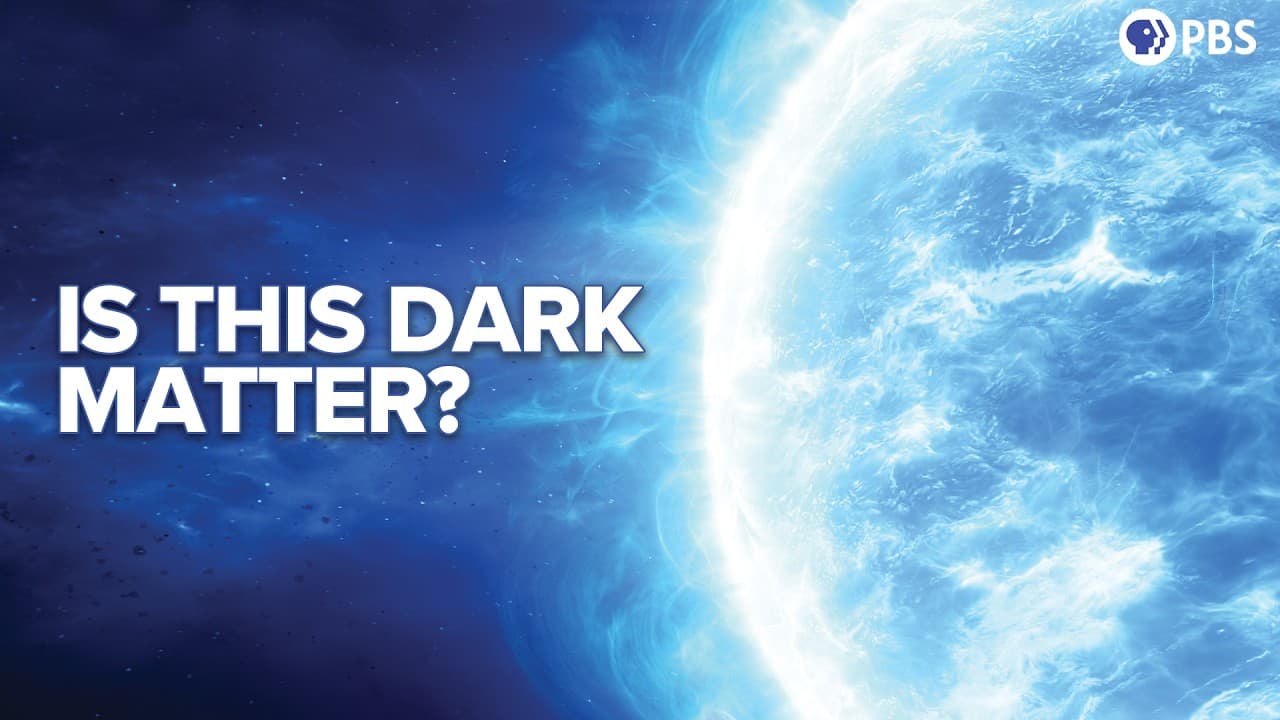
Do Neutron Stars Shine In Dark Matter?
TL;DR
Neutron stars may produce axions, potential dark matter candidates.
Transcript
Thank you to Brilliant for supporting PBS. Neutron stars aren't dark matter--we figured that out a while ago. But new research is telling us that they may be dark matter factories. They may produce the exotic axion, one of the most popular dark matter candidates. To understand reality we need to understand its building blocks. The standard mode... Read More
Key Insights
- Neutron stars are not dark matter themselves, but they might produce axions, a potential dark matter candidate, through complex processes involving strong magnetic fields.
- The standard model of particle physics has gaps, one of which is the strong CP problem, potentially solvable by introducing axions, particles that could also account for dark matter.
- Axions might be produced in neutron stars under specific conditions, such as strong magnetic fields and time-varying electric fields parallel to magnetic fields.
- Nature resists axion production by neutralizing parallel electric fields through charge rearrangement and vacuum breakdown, yet neutron stars might overcome these obstacles.
- Neutron stars could produce axions that escape into space or form dense clouds around the stars, possibly explaining phenomena like pulsar nulling and fast radio bursts.
- Current radio observations have not detected axions, but they may still be present, necessitating more sensitive future radio facilities like the Square Kilometer Array.
- The production of axions in neutron stars, if proven, could provide a significant component of dark matter, offering insights beyond the standard model of particle physics.
- Neutron stars offer a promising avenue for studying axions, potentially explaining mysterious astrophysical phenomena and contributing to our understanding of dark matter.
Install to Summarize YouTube Videos and Get Transcripts
Explore YouTube Video Summarizer or Get YouTube Transcript Extractor
Questions & Answers
Q: What is the strong CP problem in physics?
The strong CP problem is a gap in the standard model of particle physics. It involves the expected violation of charge-parity (CP) symmetry by the strong force, which is not observed in quantum chromodynamics. Introducing a new quantum field that includes axions could potentially resolve this issue, offering a solution to this abstract and complex problem.
Q: How might neutron stars produce axions?
Neutron stars might produce axions through interactions involving strong magnetic fields and time-varying electric fields that are parallel to these magnetic fields. Despite nature's tendency to neutralize such fields, neutron stars' extreme environments may facilitate axion production, potentially making them significant sources of these elusive particles.
Q: Why are axions considered good dark matter candidates?
Axions are considered good dark matter candidates because they are extremely elusive and weakly interact with electromagnetic fields, making them difficult to detect. Their theoretical properties align with what is expected of dark matter, which constitutes a significant portion of the universe's mass yet remains largely undetectable by conventional means.
Q: What challenges exist in detecting axions from neutron stars?
Detecting axions from neutron stars is challenging due to their weak electromagnetic interactions and the need for strong magnetic fields to facilitate their conversion into detectable photons. Current experiments have not found axions, possibly due to insufficient magnetic field strengths, but future radio facilities may improve detection capabilities.
Q: How could axion production explain pulsar radio emissions?
Axion production in neutron stars could explain pulsar radio emissions by converting axions back into radio waves in random directions, not just along the standard pulsar beam. This could lead to a continuous glow over a wide spectrum of radio frequencies, potentially accounting for observed phenomena like pulsar nulling and fast radio bursts.
Q: What are the implications of axion clouds around neutron stars?
Axion clouds around neutron stars could have several observable effects, such as explaining pulsar nulling or leading to bursts of radio emissions when a neutron star's magnetic field fades. These clouds might also contribute to fast radio bursts, offering a new perspective on these mysterious astrophysical phenomena and their origins.
Q: Can neutron stars alone account for all dark matter through axion production?
Neutron stars alone cannot account for all dark matter through axion production. While they may produce axions in significant quantities, the majority of dark matter would still need to originate from axions produced in the early universe. However, neutron stars could provide valuable insights into the nature and behavior of dark matter components.
Q: What future developments could enhance our understanding of axions?
Future developments, such as more sensitive radio facilities like the Square Kilometer Array, could enhance our understanding of axions by improving detection capabilities. Advanced simulations and modeling of neutron star processes might also provide insights into axion production and its implications for dark matter and astrophysical phenomena.
Summary & Key Takeaways
-
Neutron stars may act as factories for axions, a potential dark matter candidate, through interactions involving strong magnetic and electric fields. Understanding axion production could help solve the strong CP problem and provide insights into dark matter.
-
Despite nature's resistance to axion production, neutron stars might overcome these barriers, potentially explaining phenomena like pulsar nulling and fast radio bursts. Axions produced in neutron stars could form dense clouds, affecting radio emissions.
-
Current radio observations have not detected axions, but future facilities could improve detection. Neutron stars producing axions could be crucial for understanding dark matter, offering a glimpse beyond the standard model of particle physics.
Read in Other Languages (beta)
Share This Summary 📚
Summarize YouTube Videos and Get Video Transcripts with 1-Click
Try YouTube Summary with ChatGPT & Claude or YouTube Transcript Generator
Explore More Summaries from PBS Space Time 📚
Summarize YouTube Videos and Get Video Transcripts with 1-Click
Try YouTube Summary with ChatGPT & Claude or YouTube Transcript Generator