Related Rates - The Ladder Problem
TL;DR
The video explains how to calculate the rate at which the top of a ladder is sliding down a building and the rate at which the area formed by the ladder is changing.
Transcript
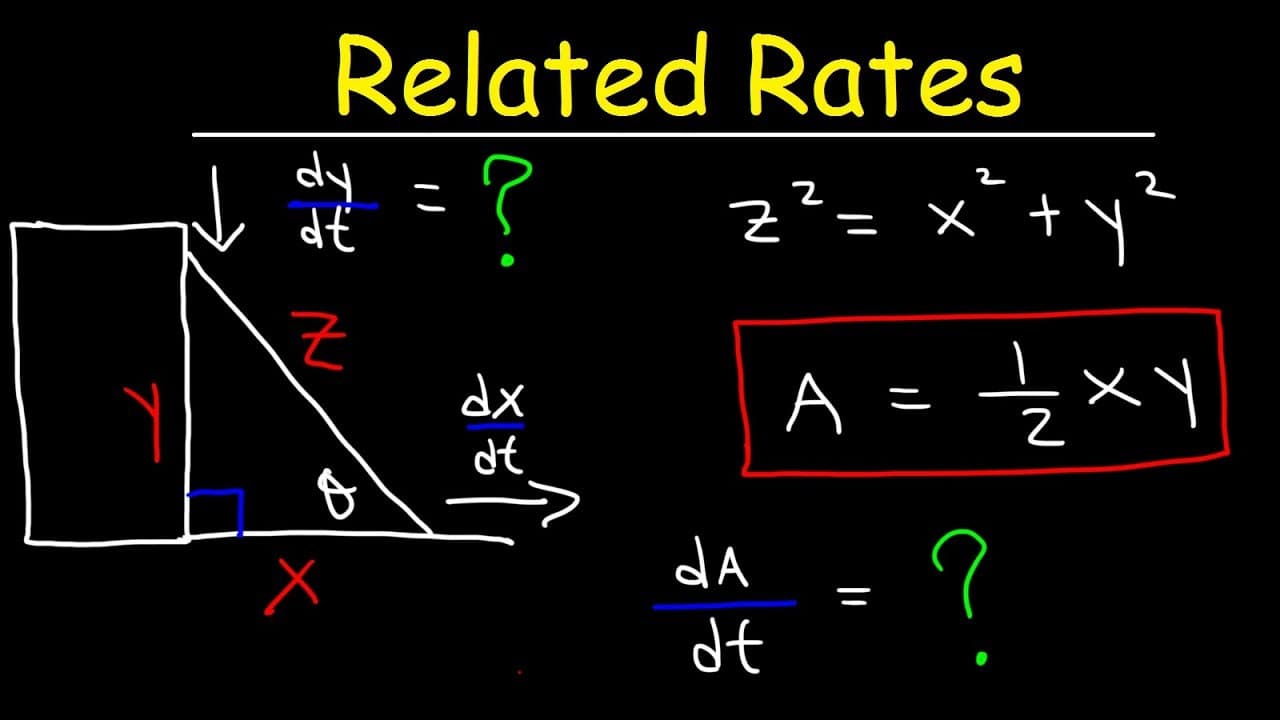
number one a 17-foot ladder is leaning against a building the foot of the ladder is eight feet from the base of the building and it's sliding away from the building at three feet per second how fast is the top of the ladder sliding down the wall of the building well let's find out so let's start with the picture so let's say that's the building thi... Read More
Key Insights
- 🦶 The length of the ladder (z) is 17 feet, with the foot of the ladder (x) 8 feet from the base of the building.
- 🏉 The top of the ladder (y) is calculated to be 15 feet using the Pythagorean theorem.
- ☠️ The rate at which the top of the ladder is sliding down the wall is -8/5 feet per second.
- ☠️ The rate at which the area formed by the ladder is changing is 161/10 square feet per second.
- 📏 Differentiation techniques, such as the chain rule and product rule, are used to find the rates of change.
- 👨💼 Trigonometric functions, such as sine and cosine, are used to relate variables in the calculations.
- 🇦🇪 Units of measurement, such as feet, seconds, and radians, are considered in the rate of change calculations.
Install to Summarize YouTube Videos and Get Transcripts
Explore YouTube Video Summarizer or Get YouTube Transcript Extractor
Questions & Answers
Q: How can we calculate the rate at which the top of the ladder is sliding down the wall?
We can use the Pythagorean theorem to relate the changing variables of x, y, and z (length of the ladder) and differentiate the equation over time to find the rate of change. The calculation gives us a rate of -8/5 feet per second.
Q: What is the formula for calculating the area of a right triangle?
The formula for the area of a right triangle is (1/2) * base * height. In this case, the base is x and the height is y.
Q: How can we determine the rate at which the area formed by the ladder is changing?
By differentiating the area formula with respect to time and using the product rule, we can calculate the rate of change. The result is 161/10 square feet per second.
Q: How can we find the rate at which the angle between the ladder and the ground is changing?
We can use the trigonometric function sine theta, as it relates the opposite side (y) to the hypotenuse (z). By differentiating the equation and substituting the given values, we can find that the rate of change of the angle is -1/5 radians per second.
Summary & Key Takeaways
-
A 17-foot ladder is leaning against a building, with the foot of the ladder 8 feet from the base. The ladder is sliding away from the building at a rate of 3 feet per second.
-
The rate at which the top of the ladder is sliding down the wall of the building is calculated to be -8/5 feet per second.
-
The rate at which the area formed by the ladder is changing is calculated to be 161/10 square feet per second.
Read in Other Languages (beta)
Share This Summary 📚
Summarize YouTube Videos and Get Video Transcripts with 1-Click
Try YouTube Summary with ChatGPT & Claude or YouTube Transcript Generator
Explore More Summaries from The Organic Chemistry Tutor 📚




Summarize YouTube Videos and Get Video Transcripts with 1-Click
Try YouTube Summary with ChatGPT & Claude or YouTube Transcript Generator