Flow Cytometry Introduction - Malte Paulsen (EMBL)
TL;DR
Introduction to flow cytometry principles and techniques.
Transcript
Hi there. Welcome to iBiology. My name is Malte Paulsen. I'm taking care of the flow cytometry facility here at EMBL in Heidelberg. It's my pleasure today to give you an introduction into flow cytometry, which will be a brief introduction: how this actually works in terms of what the machine reads of it, and what kind of data we'll get from these k... Read More
Key Insights
- Flow cytometry is a crucial technology for analyzing multiple parameters of individual cells rapidly and simultaneously, making it essential in biomedical research.
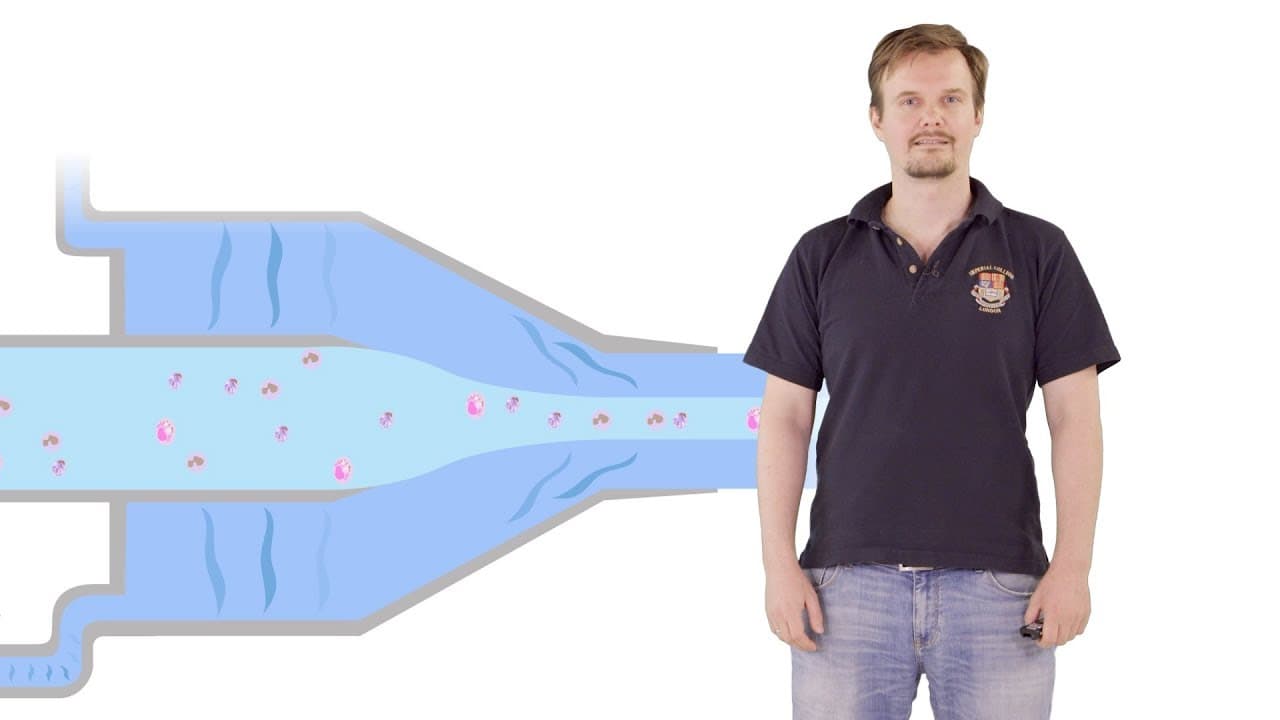
- The fluidics system in flow cytometry uses hydrodynamic focusing to align cells in a single file for analysis, similar to a laminar flow in a river.
- Optics in flow cytometry involve lasers exciting fluorescent dyes, with detectors capturing scattered light to provide information about cell characteristics.
- Scattering of light provides data on a cell's optical density and structure, while fluorescence offers insights into biochemical properties and phenotypes.
- Compensation is necessary to correct for spectral overlap in fluorescence, ensuring accurate data interpretation and minimizing data spread.
- Flow cytometry allows for multidimensional analysis, enabling detailed phenotyping of cells using multiple fluorescent markers simultaneously.
- Advancements in technology have led to flow cytometers with multiple lasers and detectors, increasing the specificity and dimensionality of data analysis.
- The future of flow cytometry involves integrating imaging and genomic technologies, enhancing the dimensionality and depth of cellular analysis.
Install to Summarize YouTube Videos and Get Transcripts
Explore YouTube Video Summarizer or Get YouTube Transcript Extractor
Questions & Answers
Q: How does flow cytometry utilize fluidics?
Flow cytometry uses fluidics to align cells in a single file within a laminar flow system. This is achieved by introducing a sample into a sheath fluid, which focuses the cells at a constant speed. The fluidic system ensures that cells are properly aligned for accurate optical analysis, similar to how a river flows steadily.
Q: What role do optics play in flow cytometry?
Optics in flow cytometry involve the use of lasers to excite fluorescent dyes attached to cells. The scattered light and emitted fluorescence are detected by photodiodes or PMTs, converting them into electrical signals. These signals provide critical information about the cell's properties, such as optical density and biochemical characteristics.
Q: Why is compensation necessary in flow cytometry?
Compensation is necessary to correct for spectral overlap in fluorescence signals. Different dyes may emit photons in overlapping wavelength ranges, leading to inaccurate data. Compensation involves mathematically adjusting the detected signals to account for this overlap, ensuring that each dye's fluorescence is accurately represented in the data.
Q: What is the significance of multidimensional analysis in flow cytometry?
Multidimensional analysis in flow cytometry allows researchers to examine multiple cell properties simultaneously using various fluorescent markers. This capability enables detailed phenotyping and functional analysis of cells, making flow cytometry a versatile tool for complex biological studies, such as identifying different immune cell subtypes in a sample.
Q: How has flow cytometry technology advanced over time?
Flow cytometry technology has advanced significantly, with modern instruments featuring multiple lasers and detectors. This allows for higher specificity and the ability to analyze more parameters simultaneously. The increase in laser and detector options has expanded the dimensionality of data analysis, improving the accuracy and depth of cellular studies.
Q: What future developments are expected in flow cytometry?
Future developments in flow cytometry are expected to focus on integrating imaging and genomic technologies, enhancing the dimensionality and depth of cellular analysis. This integration will provide more comprehensive insights into cellular functions and interactions, advancing fields such as personalized medicine and complex disease research.
Q: How does flow cytometry handle spectral overlap?
Flow cytometry handles spectral overlap by using compensation techniques to adjust for the emission of photons in overlapping wavelength ranges by different dyes. This involves calculating and applying compensation values to ensure that each dye's fluorescence is accurately measured, allowing for precise data interpretation.
Q: What are some key resources for learning more about flow cytometry?
Key resources for learning more about flow cytometry include Howard Shapiro's book, which explains the principles of flow cytometry, and the Hawleys' book for protocols. Additionally, recent papers in journals like the European Journal of Immunology provide updated guidelines and insights into experimental design and data analysis in flow cytometry.
Summary & Key Takeaways
-
Flow cytometry is a powerful tool used in biomedical research for analyzing multiple parameters of individual cells. It employs fluidics, optics, and data display systems to gather and interpret data efficiently.
-
The technique involves hydrodynamic focusing, where cells are aligned in a laminar flow, and lasers excite fluorescent dyes to provide information about cell characteristics through light scattering and fluorescence.
-
Advancements in flow cytometry technology include multiple lasers and detectors, allowing for high-dimensional analysis and integration with other technologies like imaging and genomics for comprehensive cellular analysis.
Read in Other Languages (beta)
Share This Summary 📚
Summarize YouTube Videos and Get Video Transcripts with 1-Click
Try YouTube Summary with ChatGPT & Claude or YouTube Transcript Generator
Explore More Summaries from iBiology Techniques 📚
Summarize YouTube Videos and Get Video Transcripts with 1-Click
Try YouTube Summary with ChatGPT & Claude or YouTube Transcript Generator