What Is Light? Understanding Its Nature and Properties
TL;DR
Light can be understood as rays, waves, or particles, each providing unique insights into its behavior. Rays help explain optics and ray tracing, waves describe phenomena like diffraction and interference, and particles account for the photoelectric effect. These perspectives reveal light's dual wave-particle nature, essential for understanding optics and microscopy.
Transcript
This time we're going to discuss about what light is. It's an interesting question and it's an important question because this is what the entirety of light microscopy is based on. But it also seems to be straightforwardly answered because since we were very young we know that light comes in straight lines, straight rays -- they don't make turns --... Read More
Key Insights
- Light can be described as rays, which is useful for understanding optics and ray tracing.
- Waves describe light's oscillating nature, with wavelength and frequency determining its speed.
- Refraction occurs when light changes speed in different media, described by Snell's law.
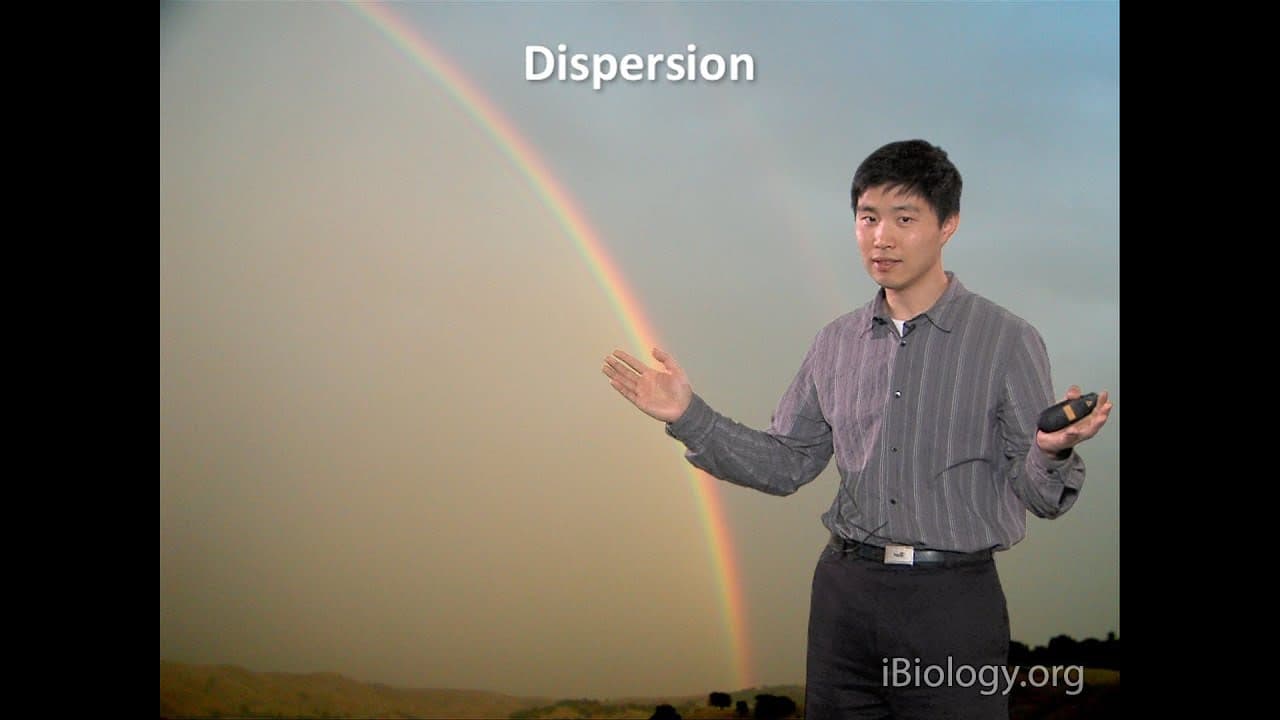
- Dispersion is the separation of light into colors due to varying refractive indices.
- Diffraction involves light waves bending around obstacles, forming spherical wave fronts.
- Interference results from multiple waves overlapping, creating patterns of constructive and destructive interference.
- The photoelectric effect demonstrates light's particle nature, where photons eject electrons from metals.
- Light exhibits dual wave-particle behavior, explained by quantum mechanics and experiments like double-slit interference.
Install to Summarize YouTube Videos and Get Transcripts
Explore YouTube Video Summarizer or Get YouTube Transcript Extractor
Questions & Answers
Q: How does light behave as rays?
Light can be described as rays, which travel in straight lines and are useful for understanding optics. This model helps explain how lenses focus light and how images are formed. Ray tracing, a method used in designing optical systems, utilizes this concept to predict the path of light through different media and surfaces.
Q: What is the wave nature of light?
The wave nature of light is characterized by its oscillating properties, defined by wavelength and frequency. This model explains phenomena such as diffraction, where light bends around obstacles, and interference, where overlapping waves create patterns. The wave model is crucial for understanding how light propagates through space and interacts with various materials.
Q: What is refraction and how is it described?
Refraction is the bending of light as it passes from one medium to another, changing speed due to differing refractive indices. This behavior is described by Snell's law, which relates the angles of incidence and refraction to the refractive indices of the media. Refraction is essential for understanding lenses, prisms, and optical systems.
Q: How does dispersion occur in light?
Dispersion occurs when different wavelengths of light are refracted by varying amounts as they pass through a medium. This results in the separation of light into its constituent colors, as seen in prisms and rainbows. Dispersion is caused by the frequency-dependent refractive index, where each color bends at a different angle.
Q: What is the photoelectric effect?
The photoelectric effect is a phenomenon where light, when shone on a metal, ejects electrons from its surface. This effect demonstrates the particle nature of light, with photons transferring energy to electrons. The energy of the emitted electrons depends on the frequency of the light, not its intensity, supporting the concept of quantized light energy.
Q: How does light exhibit wave-particle duality?
Light exhibits wave-particle duality, behaving as both waves and particles. This dual nature is demonstrated in experiments like double-slit interference, where light creates interference patterns as waves, yet impacts as discrete particles. Quantum mechanics reconciles this duality, explaining light's behavior in terms of probabilities and interactions with matter.
Q: What is interference in the context of light waves?
Interference occurs when two or more light waves overlap, resulting in patterns of constructive and destructive interference. Constructive interference amplifies light where wave peaks align, while destructive interference cancels light where peaks and troughs meet. This phenomenon is observable in thin films, diffraction gratings, and various optical experiments.
Q: How is the speed of light related to its wave properties?
The speed of light is determined by its wave properties, specifically the product of its wavelength and frequency. In a vacuum, light travels at a constant speed of approximately 299,792,458 meters per second. This speed can change when light enters different media, affecting its wavelength while maintaining constant frequency, leading to refraction.
Summary & Key Takeaways
-
Light is a complex phenomenon that can be understood through various models: rays, waves, and particles. Rays provide a straightforward way to understand optics, allowing for calculations like those involving lenses and ray tracing. Waves account for diffraction and interference, where light bends around obstacles and overlaps to create interference patterns.
-
As particles, light is quantized into photons, which explains the photoelectric effect where photons eject electrons from metals. This particle nature is essential for understanding phenomena like blackbody radiation and the energy interactions between light and matter. The dual wave-particle nature of light is a cornerstone of quantum mechanics.
-
Refraction and dispersion are key concepts in optics, where light changes speed and bends when passing through different media. This is described by Snell's law and results in phenomena like rainbows. Understanding these properties is crucial for applications in microscopy and other optical technologies.
Read in Other Languages (beta)
Share This Summary 📚
Summarize YouTube Videos and Get Video Transcripts with 1-Click
Try YouTube Summary with ChatGPT & Claude or YouTube Transcript Generator
Explore More Summaries from iBiology Techniques 📚
Summarize YouTube Videos and Get Video Transcripts with 1-Click
Try YouTube Summary with ChatGPT & Claude or YouTube Transcript Generator