End behavior of rational functions | Mathematics III | High School Math | Khan Academy
TL;DR
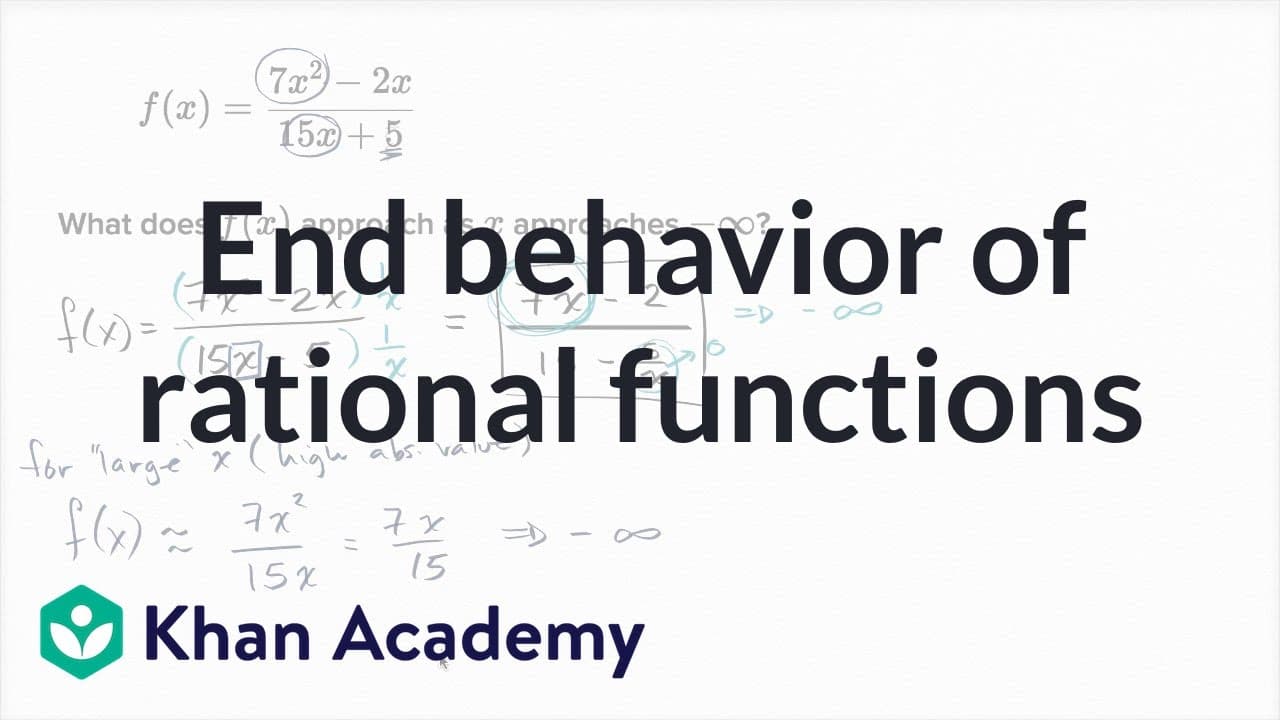
As x approaches negative infinity, the function f(x) approaches negative infinity.
Transcript
- [Voiceover] So, we're given this function, f of x, and it equals this rational expression over here and we're asked "What does f of x approach "as x approaches negative infinity?" So, as x becomes more and more and more and more negative, what does f of x approach? And, like always, pause the video and see if you can think about that on your own.... Read More
Key Insights
- ❤️🩹 Rewriting a rational function can simplify the analysis of its end behavior.
- 🍉 Dividing the terms of a rational function by the highest degree term in the denominator helps identify dominant terms.
- ☺️ The highest degree terms in the numerator and denominator determine the behavior as x approaches positive or negative infinity.
- ❤️🩹 The end behavior of a rational function can be determined by examining the coefficients and powers of the highest degree terms.
- ☺️ The concept of a horizontal asymptote helps understand the behavior of a function as x becomes very positive or very negative.
- ☺️ The behavior of a rational function as x approaches negative infinity can also be approximated by focusing solely on the highest degree terms.
- 🗂️ Dividing terms by x to the highest degree simplifies the function and reveals its end behavior.
Install to Summarize YouTube Videos and Get Transcripts
Explore YouTube Video Summarizer or Get YouTube Transcript Extractor
Questions & Answers
Q: How can rewriting the rational function make it easier to analyze the behavior as x approaches negative infinity?
Rewriting the rational function allows for a clearer understanding of what happens to each term as x becomes more negative. It simplifies the function and makes it easier to isolate the terms that dominate the behavior.
Q: Why does the function f(x) approach negative infinity as x goes to negative infinity?
When x becomes very negative, the expression in the numerator with the highest degree term dominates the function. This term, 7x, will continue to decrease as x becomes more negative, resulting in a value approaching negative infinity.
Q: Does subtracting 2 and dividing by 15 change the behavior of the function as x approaches negative infinity?
Subtracting 2 and dividing by 15 do not significantly affect the behavior of the function because they become negligible compared to the term that approaches negative infinity. The result is still negative infinity.
Q: How can we determine the horizontal asymptote of a rational function?
To find the horizontal asymptote, we divide all the terms by the highest degree term in the denominator. If the degrees are the same, the ratio of the coefficients of the highest degree terms represents the horizontal asymptote. In this case, the function approaches a horizontal asymptote at y = 0.
Summary & Key Takeaways
-
The video explains how to determine the end behavior of a given rational function as x approaches negative infinity.
-
The rational function is rewritten to make it easier to analyze the behavior as x becomes very negative.
-
By dividing the terms by the highest degree term in the denominator, it is determined that the function approaches negative infinity as x approaches negative infinity.
Read in Other Languages (beta)
Share This Summary 📚
Summarize YouTube Videos and Get Video Transcripts with 1-Click
Try YouTube Summary with ChatGPT & Claude or YouTube Transcript Generator
Explore More Summaries from Khan Academy 📚




Summarize YouTube Videos and Get Video Transcripts with 1-Click
Try YouTube Summary with ChatGPT & Claude or YouTube Transcript Generator