Can Climate Change Make Lightning… Supercharged?
TL;DR
Ocean acidification caused by CO2 absorption leads to stronger lightning strikes, with a potential 30% increase in intensity by the end of the century.
Transcript
[♪ INTRO] Carbon dioxide isn’t just a greenhouse gas, warming the planet by trapping heat in the atmosphere. According to the US National Oceanic and Atmospheric Administration, one third of our estimated CO2 emissions end up in the ocean. This leads to ocean acidification, which is harmful to marine life. But ocean acidification might also trigger... Read More
Key Insights
- 🌊 One-third of CO2 emissions end up in the ocean, causing ocean acidification and harmful effects on marine life.
- 🌊 Ocean acidification leads to a higher concentration of hydrogen ions in the water, increasing its electrical conductivity.
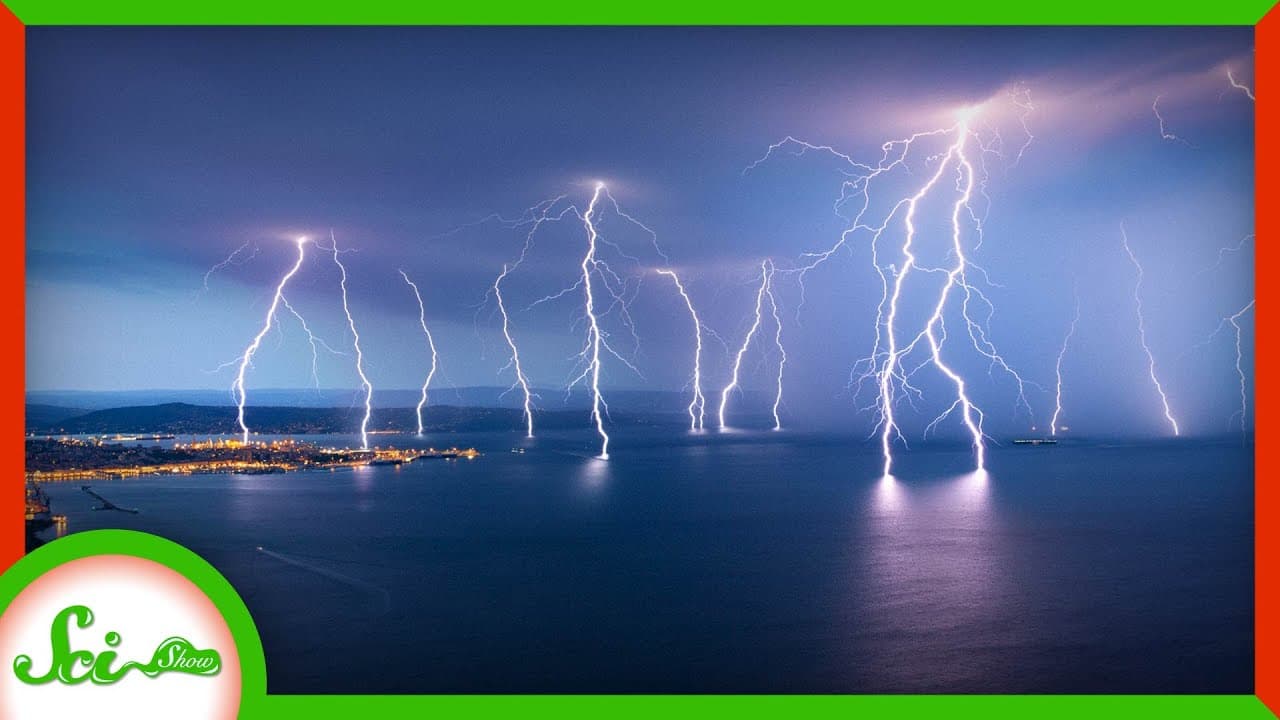
- 🌊 Increasing ocean acidity could make lightning strikes over the ocean more intense.
- 🌊 Ocean acidification and stronger lightning strikes could pose a risk to ocean infrastructure.
- 😒 Animals that use sound for navigation, such as whales and dolphins, may face challenges if lightning strikes become stronger.
- 👨🔬 The study's experiment provides valuable insights for future research on the relationship between ocean acidification and lightning.
- 💖 Real-world lightning strikes over the ocean may behave differently than small sparks generated in controlled laboratory environments.
Install to Summarize YouTube Videos and Get Transcripts
Explore YouTube Video Summarizer or Get YouTube Transcript Extractor
Questions & Answers
Q: How does ocean acidification occur and what are its effects on marine life?
Ocean acidification is caused by the absorption of CO2 by the ocean, which forms carbonic acid. This increased acidity dissolves minerals like calcium carbonate, affecting shell-forming marine organisms like corals.
Q: How does ocean acidification affect lightning strikes?
The higher acidity of the ocean increases the concentration of hydrogen ions, making the seawater more conductive. This leads to stronger lightning strikes, potentially affecting ocean infrastructure and animals that use sound for navigation.
Q: Can ocean acidification predictions be applied to real-world lightning strikes over the ocean?
While the study's method of measuring sparks in a beaker may not directly translate to real-world lightning strikes, it provides valuable insights for future experiments and research on the relationship between ocean acidification and lightning.
Q: Should we be concerned about the potential increase in lightning intensity caused by ocean acidification?
The increasing intensity of lightning strikes could pose a risk to ocean infrastructure and animals that rely on sound for navigation. Thus, it is important to consider potential upgrades to lightning protection systems.
Summary & Key Takeaways
-
One-third of CO2 emissions end up in the ocean, causing ocean acidification, which is harmful to marine life.
-
Increasing ocean acidity due to CO2 absorption leads to a higher concentration of hydrogen ions, making the ocean more conductive to electricity.
-
In an experiment, researchers found that as seawater became more acidic, the intensity of sparks between electrodes increased, indicating that ocean acidification could increase lightning intensity.
Read in Other Languages (beta)
Share This Summary 📚
Summarize YouTube Videos and Get Video Transcripts with 1-Click
Try YouTube Summary with ChatGPT & Claude or YouTube Transcript Generator
Explore More Summaries from SciShow 📚



Summarize YouTube Videos and Get Video Transcripts with 1-Click
Try YouTube Summary with ChatGPT & Claude or YouTube Transcript Generator