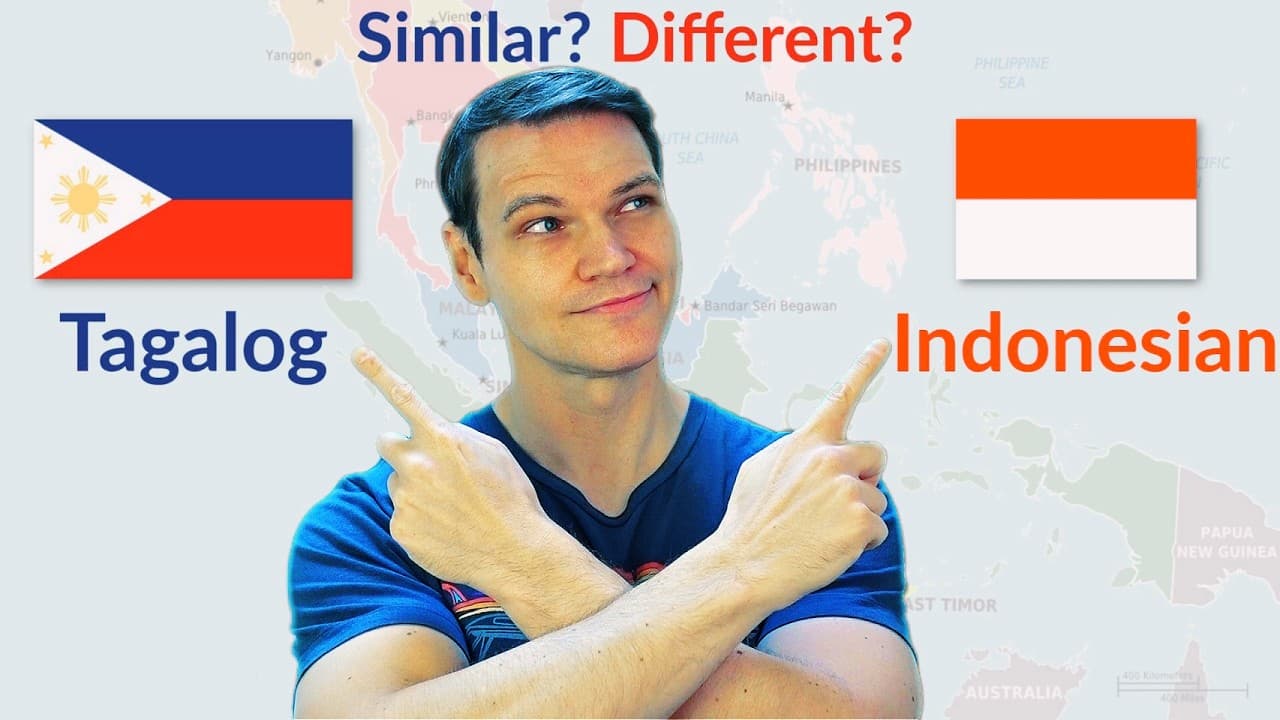
How Similar are Tagalog and Indonesian?
TL;DR
Tagalog and Indonesian share origins but aren't mutually intelligible.
Transcript
hello everyone welcome to the Lang Focus Channel and my name is Paul today we're going to compare to gallog otherwise known as Filipino the lingua franka of the Philippines and Indonesian the lingua franka of Indonesia the most widely spoken variety of Malay basically everything I say about Indonesian in this video will also apply to Malay because ... Read More
Key Insights
- Tagalog and Indonesian are both part of the Malayo-Polynesian branch of the Austronesian language family, sharing ancient origins.
- The languages have diverged significantly, with Tagalog influenced by Spanish and English, while Indonesian has influences from Dutch and Arabic.
- Tagalog and Indonesian have similar pronunciation and some shared vocabulary, but the majority of their words differ.
- Indonesian primarily follows a Subject-Verb-Object sentence structure, while Tagalog primarily uses Verb-Subject-Object.
- Tagalog uses focus markers to indicate the focus of a sentence, a feature not present in Indonesian.
- Indonesian verbs do not conjugate for tense or aspect, whereas Tagalog verbs are conjugated for aspect.
- Tagalog features more function words and particles compared to Indonesian, creating a richer sentence structure.
- Both languages have similar vowel sounds, but differ in consonant sounds and the presence of loanwords.
Install to Summarize YouTube Videos and Get Transcripts
Explore YouTube Video Summarizer or Get YouTube Transcript Extractor
Questions & Answers
Q: What are the historical influences on Tagalog and Indonesian?
Tagalog has been influenced by Spanish due to colonial rule, resulting in a significant number of Spanish loanwords. English has also impacted Tagalog due to American colonization. Indonesian, on the other hand, has been influenced by Dutch from colonial times and Arabic due to the spread of Islam. These influences have shaped the vocabulary and grammar of both languages.
Q: How do Tagalog and Indonesian differ in sentence structure?
Indonesian primarily uses a Subject-Verb-Object (SVO) sentence structure, which is straightforward and similar to English. Tagalog, however, generally uses a Verb-Subject-Object (VSO) structure, which can also be seen as predicate-subject. This structure is more complex due to the presence of focus markers that indicate the focus of the sentence, whether it is the subject or the object.
Q: What role do focus markers play in Tagalog grammar?
Focus markers in Tagalog are used to highlight the focus of a sentence, whether it is the subject or the object. These markers, such as 'ang' for focus and 'ng' for non-focus, help to clarify the roles of different sentence elements. This system adds complexity to Tagalog grammar, distinguishing it from Indonesian, which lacks such markers.
Q: Are there any similarities in pronunciation between Tagalog and Indonesian?
Yes, Tagalog and Indonesian share similar pronunciation characteristics. Both languages have unaspirated stop consonants and similar vowel sounds. However, they differ in some consonant sounds, such as the presence of 'v' and 'f' sounds in loanwords, which are often pronounced as 'b' and 'p' in both languages. These similarities and differences contribute to the overall phonetic relationship between the two languages.
Q: How do verb conjugations differ between Tagalog and Indonesian?
Indonesian verbs do not conjugate for tense or aspect, relying on context or additional aspect markers to indicate time. In contrast, Tagalog verbs are conjugated for aspect, with infixes and prefixes indicating whether an action is completed, ongoing, or yet to occur. This difference highlights the complexity of Tagalog verb conjugation compared to the simpler structure of Indonesian verbs.
Q: What are some examples of shared vocabulary between Tagalog and Indonesian?
Tagalog and Indonesian share some basic vocabulary due to their common linguistic ancestry. Examples include personal pronouns like 'aku' (I) and 'anak' (child), as well as everyday words like 'batu' (rock) and 'bulan' (moon). However, these shared words are in the minority, with most vocabulary differing due to historical influences and language evolution.
Q: How have historical colonizers influenced the vocabulary of Tagalog and Indonesian?
Spanish colonization introduced a significant number of loanwords into Tagalog, affecting everyday vocabulary, while American influence added English terms. Indonesian vocabulary has been shaped by Dutch colonization, with many Dutch loanwords, and Arabic influence due to Islam. These colonial and cultural contacts have left lasting impacts on both languages' lexicons.
Q: Why are Tagalog and Indonesian not mutually intelligible despite their shared origins?
Despite sharing a common origin in the Proto-Malayo-Polynesian language, Tagalog and Indonesian have diverged significantly over thousands of years. Influences from different colonizers, distinct grammatical structures, and largely different vocabularies have contributed to their lack of mutual intelligibility. These factors have led to the development of unique linguistic identities for each language.
Summary & Key Takeaways
-
Tagalog and Indonesian are both derived from the Proto-Malayo-Polynesian language, but have evolved separately for thousands of years. Influences from different colonizers and trade languages have shaped their vocabularies and grammar.
-
While both languages share some core vocabulary and pronunciation characteristics, they differ significantly in grammar and sentence structure. Indonesian follows a simpler Subject-Verb-Object structure, whereas Tagalog employs a Verb-Subject-Object order with focus markers.
-
The languages are not mutually intelligible due to these differences, despite their shared origins. Each language has been shaped by historical influences, such as Spanish and English in Tagalog, and Dutch and Arabic in Indonesian.
Read in Other Languages (beta)
Share This Summary 📚
Summarize YouTube Videos and Get Video Transcripts with 1-Click
Try YouTube Summary with ChatGPT & Claude or YouTube Transcript Generator
Explore More Summaries from Langfocus 📚
Summarize YouTube Videos and Get Video Transcripts with 1-Click
Try YouTube Summary with ChatGPT & Claude or YouTube Transcript Generator