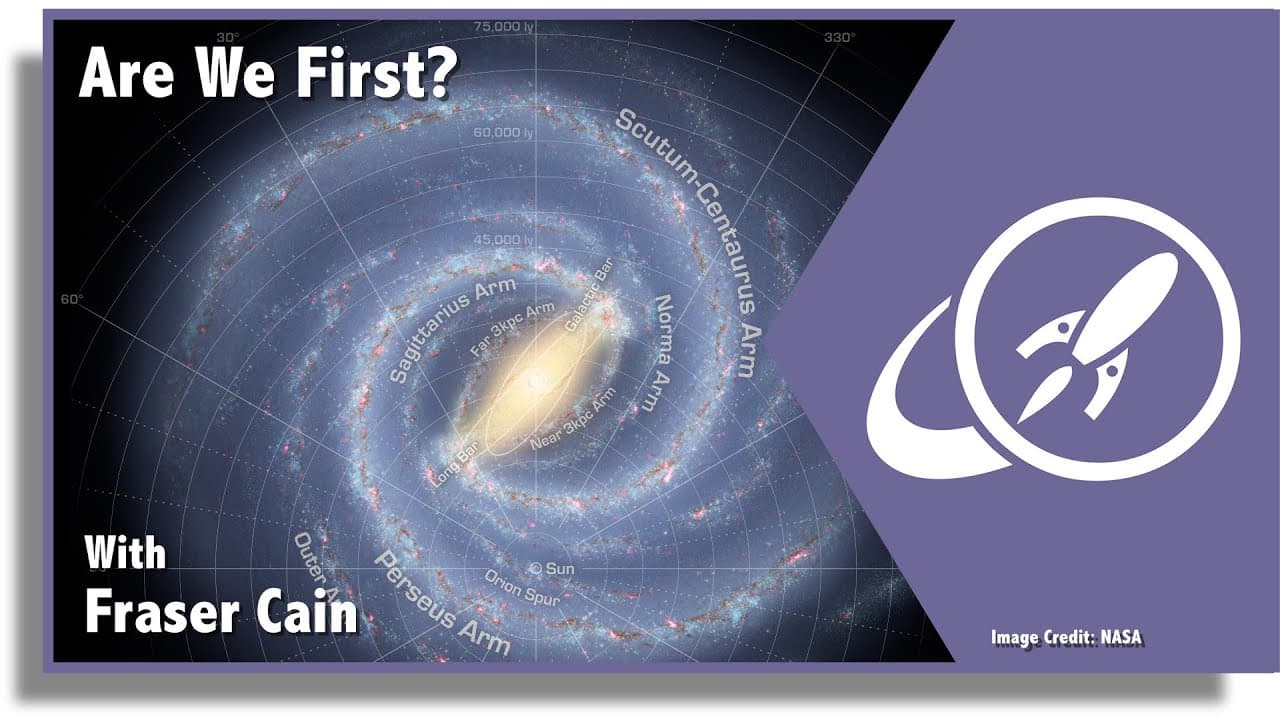
Q&A 144: Are We First in the Universe?
TL;DR
Exploring enigmatic phenomena from the Fermi Paradox to Mars colonies and astronomy careers without strong mathematics.
Transcript
hey everyone welcome to the question show your questions my answers as always wherever you are across my channel if a question pops into your brain just write it down i'll gather them up and i will answer them here um now i am recording this show on april 19th it's also my sister's birthday happy birthday heisler um and uh so i don't know what's go... Read More
Key Insights
- 🤩 Galactic disc formation due to spinning stars reflects frisbee-like rotational patterns.
- ❓ Career paths in astronomy are inclusive, prioritizing observational skills over advanced mathematics.
- 😀 Mars colonization faces hurdles related to its weak gravity, radiation levels, and harsh environment.
- 🤨 The absence of evidence for extraterrestrial intelligence raises questions of the Fermi Paradox.
- 👾 Novel concepts like space elevators and Mars colonization necessitate robust scientific and engineering feasibility studies for long-term sustainability.
- ❓ Overcoming perceived math challenges in astronomy careers emphasizes practice and experience over innate ability.
- 👾 NASA's Artemis program showcases evolving space exploration strategies like integrating Starship lunar landers.
Install to Summarize YouTube Videos and Get Transcripts
Explore YouTube Video Summarizer or Get YouTube Transcript Extractor
Questions & Answers
Q: What is the Fermi Paradox, and how does it challenge the existence of extraterrestrial intelligence?
The Fermi Paradox questions the absence of alien civilizations despite the vastness of habitable space, proposing various theories like humans being the sole intelligent species.
Q: How do galaxies form into disc-like structures, and is this pivotal for understanding their rotation?
Galaxies evolve into discs due to spinning motions forming compact structures, reflecting their axes of rotation in symmetry similar to frisbees.
Q: Why are potential astronomy career paths viable even without advanced mathematical expertise?
Astronomy roles focus more on observational and interpretive skills, with math playing a supportive rather than mandatory role, allowing professionals to thrive through experience and practice.
Q: What implications does Mars' lower gravity pose for human habitation, and are there feasible solutions for long-term survival?
Mars' lower gravity presents challenges for extended human stays, especially concerning childbirth and health effects, prompting novel ideas like artificial gravity setups to address these issues.
Summary & Key Takeaways
-
The Fermi Paradox contemplates the apparent absence of alien life despite universe ideal for habitation.
-
Galaxies spin on an axis akin to frisbees due to galactic discs formed by spinning stars.
-
Astronomy careers don't necessitate strong math skills, as practice improves computational abilities.
Read in Other Languages (beta)
Share This Summary 📚
Summarize YouTube Videos and Get Video Transcripts with 1-Click
Try YouTube Summary with ChatGPT & Claude or YouTube Transcript Generator
Explore More Summaries from Fraser Cain 📚
Summarize YouTube Videos and Get Video Transcripts with 1-Click
Try YouTube Summary with ChatGPT & Claude or YouTube Transcript Generator