Products
Features
YouTube Video Summarizer
Summarize YouTube videos
Web & PDF Highlighter
Highlight web pages & PDFs
Chat with PDF
Ask any PDF questions with AI
Ask AI Clone
Chat with your highlights & memories
Audio Transcriber
Transcribe audio files to text
Glasp Reader
Read and highlight articles
Kindle Highlight Export
Export your Kindle highlights
Idea Hatch
Hatch ideas from your highlights
Integrations
Obsidian Plugin
Notion Integration
Pocket Integration
Instapaper Integration
Medium Integration
Readwise Integration
Snipd Integration
Hypothesis Integration
Apps & Extensions
Chrome Extension
Safari Extension
Edge Add-ons
Firefox Add-ons
iOS App
Android App
Discover
Discover
Ideas
Discover new ideas and insights
Articles
Curated articles and insights
Books
Book recommendations by great minds
Posts
Essays and notes from readers
Quotes
Inspiring quotes collection
Videos
Curated videos and summaries
Explore Glasp
Glasp Newsletter
Weekly insights and updates
Glasp Talk
Interview series with great minds
Glasp Blog
Latest news and articles
Glasp Use Cases
Learn how others use Glasp
Build & Support
Glasp API
Access Glasp's API for developers
MCP Connector
Connect Glasp to Claude & ChatGPT
Community
Glasp Reddit Community
Students
Student discount and benefits
FAQs
Frequently Asked Questions
AboutPricing
DashboardLog inSign up

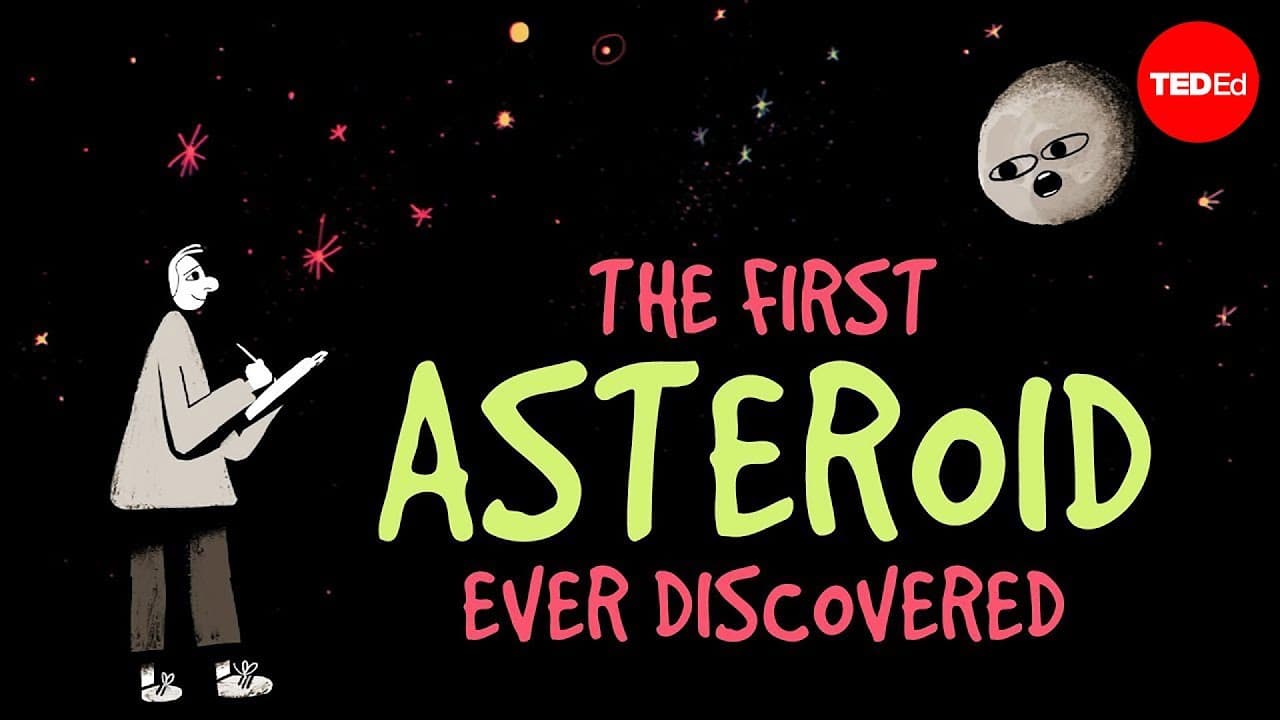
The first asteroid ever discovered - Carrie Nugent
291.7K views
•
October 16, 2017
by
TED-Ed
YouTube video player
The first asteroid ever discovered - Carrie Nugent

TL;DR

Giuseppe Piazzi discovers the first asteroid, Ceres, in 1801, leading to modern-day asteroid hunting and exploration.

Transcript

On the night of January 1, 1801, Giuseppe Piazzi, a priest in Palermo, Italy, was mapping the stars in the sky. Over three nights, he'd look at and draw the same set of stars, carefully measuring their relative positions. That night, he measured the stars. The next night, he measured them again. To his surprise, one had moved. The third night, th... Read More

Key Insights

  • ❓ Giuseppe Piazzi discovered the first asteroid, Ceres, in 1801.
  • 👶 Astronomers like Carl Friedrich Gauss invented new mathematical methods to predict asteroid orbits.
  • 💯 Today, hundreds of thousands of asteroids are discovered using modern technology.
  • 🛄 Asteroid hunters aim to monitor and predict asteroid trajectories to prevent potential Earth impacts.
  • 💁 Besides hunting asteroids, astronomers study them to learn about solar system formation and composition.
  • 😚 Spacecraft like Dawn have provided up-close views of asteroids like Ceres and Vesta.
  • 👾 Understanding asteroids is crucial for space exploration and Earth defense strategies.

Install to Summarize YouTube Videos and Get Transcripts

Explore YouTube Video Summarizer or Get YouTube Transcript Extractor

Questions & Answers

Q: How did Giuseppe Piazzi discover the first asteroid, Ceres?

Giuseppe Piazzi discovered Ceres in 1801 while mapping stars when he noticed its movement over consecutive nights, unlike stars.

Q: How did astronomers track Ceres's orbit after its discovery?

Astronomers like Carl Friedrich Gauss calculated new orbits and predictions to locate Ceres, leading to successful sightings by Baron Franz Xaver von Zach.

Q: Why is it important to study asteroids besides hunting for them?

Astronomers study asteroids to understand solar system formation, composition, and potential impact risks on Earth, besides exploring them up close with spacecraft.

Q: How do modern asteroid hunters locate and track asteroids today?

Modern asteroid hunters use advanced telescopes, computer analysis, and human verification to observe, report, and predict asteroid orbits for future monitoring.

Summary & Key Takeaways

  • Giuseppe Piazzi discovered the first asteroid, Ceres, while mapping stars in 1801.

  • The discovery led to advancements in tracking asteroid orbits and modern asteroid hunting techniques.

  • Today, astronomers study asteroids for insights into solar system formation and send spacecraft for close-up exploration.


Read in Other Languages (beta)

English

Share This Summary 📚

Summarize YouTube Videos and Get Video Transcripts with 1-Click

Download browser extensions on:

Try YouTube Summary with ChatGPT & Claude or YouTube Transcript Generator

Explore More Summaries from TED-Ed 📚
What happens to our bodies after we die? - Farnaz Khatibi Jafari thumbnail
What happens to our bodies after we die? - Farnaz Khatibi Jafari
TED-Ed
Why do we cry? The three types of tears - Alex Gendler thumbnail
Why do we cry? The three types of tears - Alex Gendler
TED-Ed
Four sisters in Ancient Rome - Ray Laurence thumbnail
Four sisters in Ancient Rome - Ray Laurence
TED-Ed
Can you solve the three gods riddle? - Alex Gendler thumbnail
Can you solve the three gods riddle? - Alex Gendler
TED-Ed
How to practice effectively...for just about anything - Annie Bosler and Don Greene thumbnail
How to practice effectively...for just about anything - Annie Bosler and Don Greene
TED-Ed
The language of lying — Noah Zandan thumbnail
The language of lying — Noah Zandan
TED-Ed

Summarize YouTube Videos and Get Video Transcripts with 1-Click

Download browser extensions on:

Try YouTube Summary with ChatGPT & Claude or YouTube Transcript Generator

Apps & Extensions

  • Chrome Extension
  • Safari Extension
  • Edge Add-ons
  • Firefox Add-ons
  • iOS App
  • Android App

Key Features

  • YouTube Video Summarizer
  • Web & PDF Summarizer
  • Web & PDF Highlighter
  • Chat with PDF
  • Ask AI Clone
  • Audio Transcriber
  • Glasp Reader
  • Kindle Highlight Export
  • Idea Hatch

Integrations

  • Obsidian Plugin
  • Notion Integration
  • Pocket Integration
  • Instapaper Integration
  • Medium Integration
  • Readwise Integration
  • Snipd Integration
  • Hypothesis Integration

More Features

  • APIs
  • MCP Connector
  • Blog & Post
  • Embed Links
  • Image Highlight
  • Personality Test
  • Quote Shots

Company

  • About us
  • Blog
  • Community
  • FAQs
  • Job Board
  • Newsletter
  • Pricing
Terms

•

Privacy

•

Guidelines

© 2026 Glasp Inc. All rights reserved.