How to Understand GNN Transferability Concepts
TL;DR
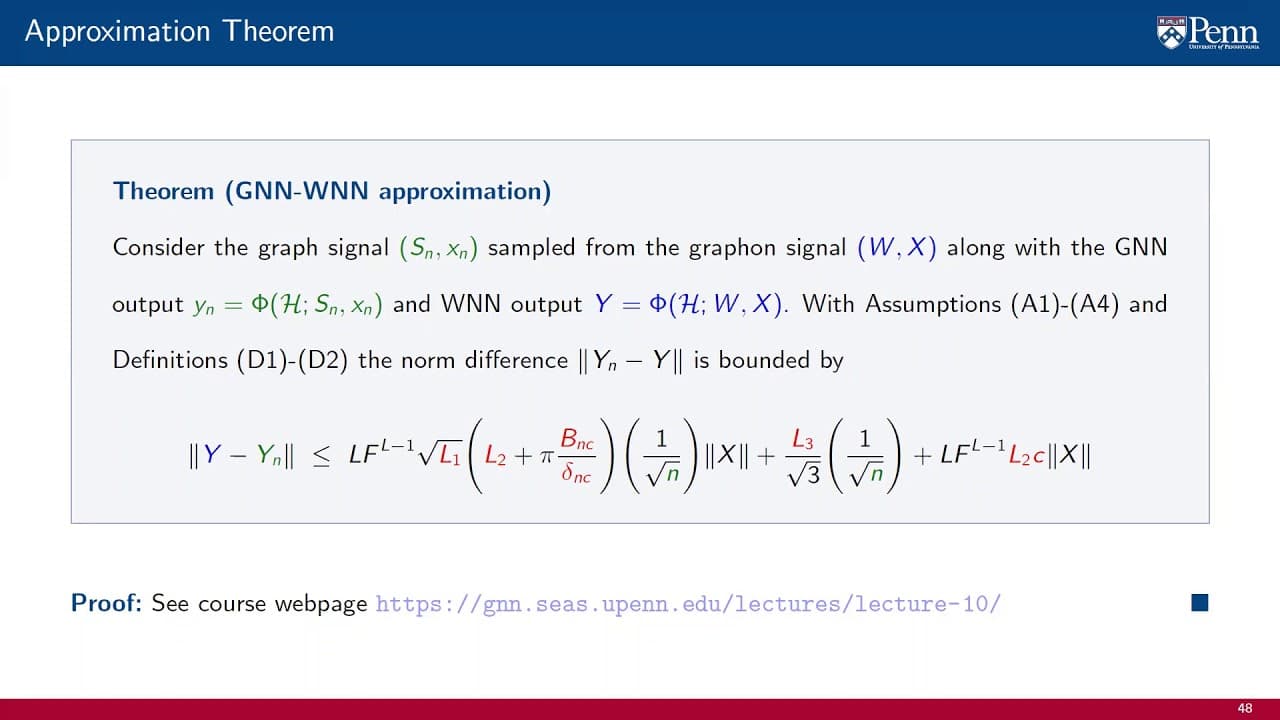
GNNs inherit the transferability properties of graph filters, making them applicable across different graph sizes within the same graphon family. Using graphon neural networks (WNNs) as a generative model, the GNN-WNN approximation theorem provides a bound on the error when approximating WNNs with GNNs, demonstrating their scalability and robustness.
Transcript
in this part of the lecture we defined graphing neural networks and discussed their interpretation as generative models for graph neural networks we then use graphonior networks to show that gnns inherit the transferability properties of graph filters have already seen that ref filters are transferable between weighted graphs associated with the gi... Read More
Key Insights
- Graph neural networks (GNNs) inherit transferability properties from graph filters, making them versatile across different graph structures.
- Graphon neural networks (WNNs) serve as generative models for GNNs, allowing for parameter sharing and model instantiation.
- The GNN-WNN approximation theorem provides a bound on the error when approximating WNNs with GNNs, which is crucial for transferability analysis.
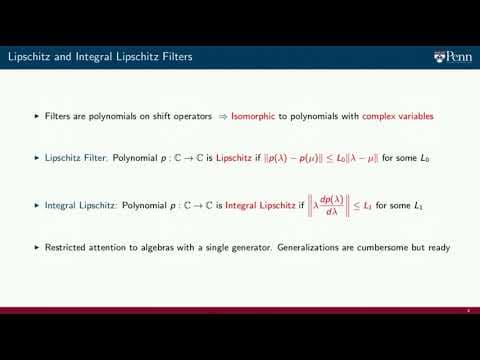
- Lipschitz continuity of the frequency response of filters is fundamental for ensuring the transferability of GNNs.
- Nonlinear activation functions like ReLU and sigmoid are essential for GNNs, helping to alleviate the discriminability-transferability trade-off.
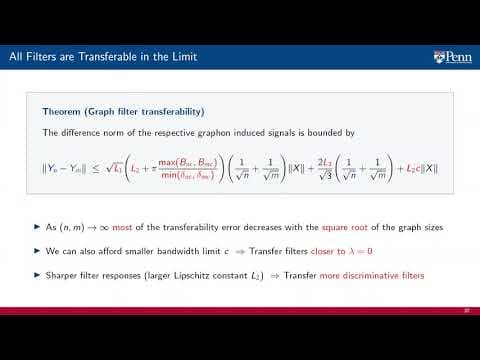
- The transferability theorem for GNNs shows that they can process signals on graphs of different sizes while maintaining performance.
- Eigenvalue scattering by nonlinearities allows GNNs to improve transferability by enabling better discriminability across layers.
- The bound on transferability error decreases as the graph size increases, highlighting the scalability of GNNs.
Install to Summarize YouTube Videos and Get Transcripts
Explore YouTube Video Summarizer or Get YouTube Transcript Extractor
Questions & Answers
Q: How do GNNs inherit transferability properties?
GNNs inherit transferability properties from graph filters due to their ability to process graph signals in a manner that is invariant to the specific graph structure. This is achieved through shared learnable coefficients and the use of graphon neural networks (WNNs) as generative models, which facilitate parameter sharing and model instantiation across different graph sizes.
Q: What role do WNNs play in GNN transferability?
WNNs serve as generative models for GNNs, allowing them to share learnable parameters and instantiate models across various graph structures. This generative approach ensures that GNNs maintain their functionality and performance when applied to different graphs, thus enhancing their transferability across graph sizes within the same graphon family.
Q: What is the GNN-WNN approximation theorem?
The GNN-WNN approximation theorem provides a bound on the error incurred when using a GNN to approximate a WNN. This theorem is critical for analyzing the transferability of GNNs, as it shows that the error decreases asymptotically with increasing graph size, ensuring that GNNs remain robust and scalable when applied to larger graphs.
Q: Why are Lipschitz assumptions important for GNNs?
Lipschitz assumptions are crucial for GNNs because they ensure that the frequency response of filters is continuous and stable, which is fundamental for transferability. These assumptions help maintain the performance of GNNs across different graph structures by providing a mathematical framework that bounds the error in signal processing.
Q: How do nonlinearities affect GNN transferability?
Nonlinear activation functions, such as ReLU and sigmoid, are vital for GNNs as they help scatter the eigenvalues of the graph across the spectrum. This scattering improves the discriminability of GNNs, allowing them to better differentiate between graph signals, which in turn enhances transferability by reducing the trade-off between discriminability and transferability.
Q: What is the significance of the transferability theorem for GNNs?
The transferability theorem for GNNs demonstrates that these networks can effectively process signals on graphs of different sizes while maintaining performance. By providing a bound on the error between GNN outputs on different graphs, the theorem highlights the robustness and scalability of GNNs, ensuring that they can be applied to a wide range of graph structures.
Q: How does eigenvalue scattering improve GNN performance?
Eigenvalue scattering, facilitated by nonlinear activation functions in GNNs, allows the eigenvalues of the graph to be distributed across the spectrum. This distribution enhances the network's ability to discriminate between different graph signals, thereby improving the overall performance and transferability of GNNs across various graph structures.
Q: Why is scalability important for GNNs?
Scalability is crucial for GNNs because it ensures that the networks can handle larger graphs without a loss in performance. The ability to maintain low error bounds as graph size increases allows GNNs to be applied to real-world applications where graph sizes can vary significantly, making them versatile and practical for various tasks.
Summary & Key Takeaways
-
GNNs are capable of transferring learned features across graphs of varying sizes, inheriting properties from graph filters. The GNN-WNN approximation theorem provides an error bound that decreases with graph size, ensuring scalability.
-
Using WNNs as generative models, GNNs can share parameters and instantiate models effectively. This setup supports their robustness and adaptability to different graph structures.
-
Nonlinear activation functions play a critical role in GNNs, helping to scatter eigenvalues and improve discriminability, which in turn enhances transferability without increasing error bounds.
Read in Other Languages (beta)
Share This Summary 📚
Summarize YouTube Videos and Get Video Transcripts with 1-Click
Try YouTube Summary with ChatGPT & Claude or YouTube Transcript Generator
Explore More Summaries from Alelab Alelab 📚
Summarize YouTube Videos and Get Video Transcripts with 1-Click
Try YouTube Summary with ChatGPT & Claude or YouTube Transcript Generator