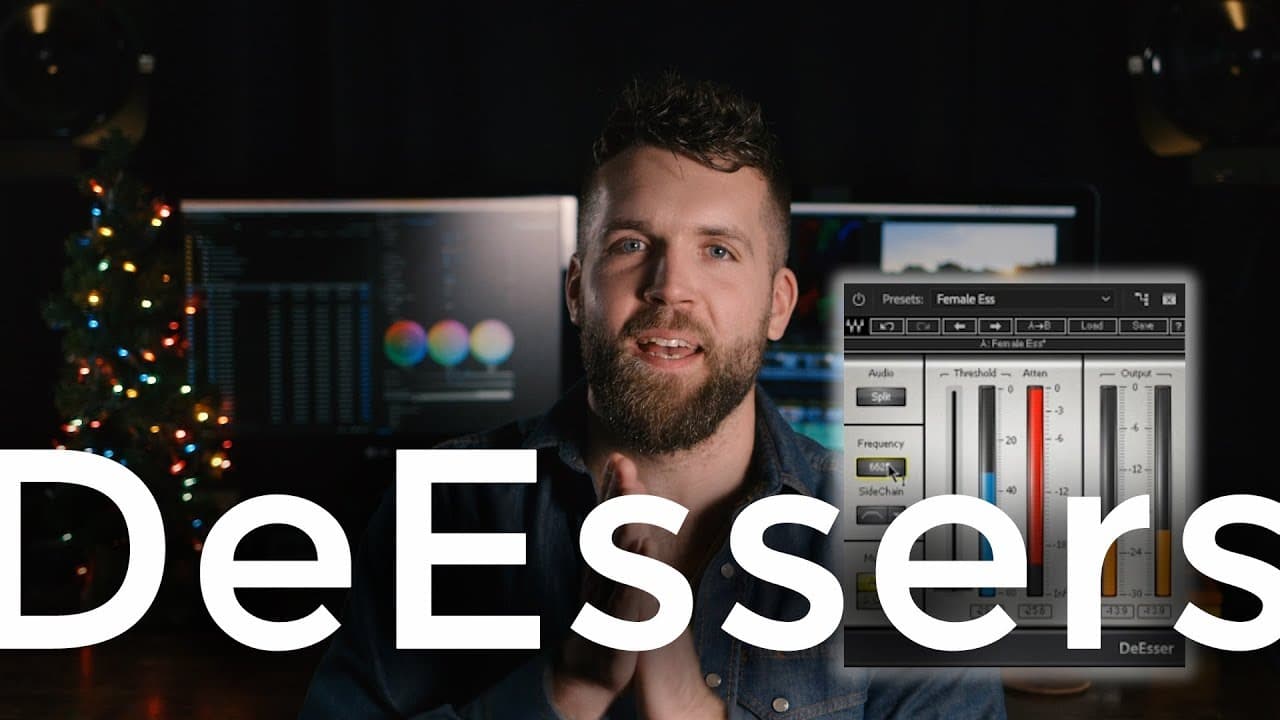
What is a DeEsser? // AUDIO Production Tools Part III of V // How to use a DeEsser tutorial
TL;DR
De-Essers are dynamics processors that reduce sibilant frequencies in vocal recordings to prevent them from standing out too much.
Transcript
five weeks in a row talking about audio tools this week is week three of five and we're talking about des errs what is the DES er how do you use it and why would you use it welcome back to week 3 Amati of course I'm really excited that each and every one of you have tuned in this channel I talked about gear and audio and filmmaking and all things c... Read More
Key Insights
- 🍰 A de-esser is a dynamics processor that reduces the amplitude of sibilant frequencies in vocal recordings.
- 🧍 De-essers are used to prevent sibilant frequencies from standing out too much after compression.
- 🍰 It is important to set the threshold and center frequency correctly to effectively use a de-esser.
- 🍰 De-essers can be used independently or in conjunction with compressors.
- 🍰 Understanding the behavior of sibilant frequencies based on vocal characteristics and using an analyzer tool can help adjust the settings of a de-esser.
- 🍰 Pre and post examples of de-essing can demonstrate the effectiveness of using a de-esser.
- 🙃 De-essing is part of a series of audio processing techniques, including compression and EQ, to improve the quality of vocal recordings.
Install to Summarize YouTube Videos and Get Transcripts
Explore YouTube Video Summarizer or Get YouTube Transcript Extractor
Questions & Answers
Q: What is a de-esser?
A de-esser is a dynamics processor that controls and reduces the amplitude of sibilant frequencies in vocal recordings, such as "s" and "t" sounds.
Q: Why do sibilant frequencies need to be reduced?
Sibilant frequencies can become more noticeable and problematic after compression, and using a de-esser helps prevent them from standing out too much in the mix.
Q: Can de-essers be used without compressors?
Yes, de-essers can be used independently without compressors, as sibilant frequencies can be problematic based on factors such as the microphone used, the room acoustics, and the vocalist's voice.
Q: What are the main parameters to be aware of when using a de-esser?
The threshold and the center frequency are the main parameters to set in a de-esser. The threshold determines when the de-esser engages, and the center frequency designates the range of frequencies to be compressed.
Key Insights:
- A de-esser is a dynamics processor that reduces the amplitude of sibilant frequencies in vocal recordings.
- De-essers are used to prevent sibilant frequencies from standing out too much after compression.
- It is important to set the threshold and center frequency correctly to effectively use a de-esser.
- De-essers can be used independently or in conjunction with compressors.
- Understanding the behavior of sibilant frequencies based on vocal characteristics and using an analyzer tool can help adjust the settings of a de-esser.
- Pre and post examples of de-essing can demonstrate the effectiveness of using a de-esser.
- De-essing is part of a series of audio processing techniques, including compression and EQ, to improve the quality of vocal recordings.
- The next topic in the series is gates, which are used to control the presence of audio signals.
Summary & Key Takeaways
-
De-Essers are tools used in audio production to control the amplitude of sibilant frequencies (such as "s" and "t" sounds) in vocal recordings.
-
The use of de-essers is important because sibilant frequencies can become more noticeable and problematic after compression.
-
De-essers can be used with or without compressors, and they help bring down the amplitude of sibilant frequencies.
Read in Other Languages (beta)
Share This Summary 📚
Summarize YouTube Videos and Get Video Transcripts with 1-Click
Try YouTube Summary with ChatGPT & Claude or YouTube Transcript Generator
Explore More Summaries from Oliver J Hughes 📚
Summarize YouTube Videos and Get Video Transcripts with 1-Click
Try YouTube Summary with ChatGPT & Claude or YouTube Transcript Generator