GNN Short Course Chapter 10 - Why Graph Neural Networks?
TL;DR
Graph Neural Networks are stable and discriminative, outperforming graph convolutions.
Transcript
so we know that graph neural networks are permutation equivalent but so are graph convolutions okay we know that graph neural networks are stable to relative perturbations but so are graph convolutions then why should we choose graph neural networks instead of being satisfied with just graph convolutions in this segment we will show that the answer... Read More
Key Insights
- Graph Neural Networks (GNNs) are both stable and discriminative, unlike graph convolutions which lack this dual capability.
- GNNs incorporate pointwise nonlinearities that enhance stability to graph perturbations while retaining discriminative power.
- Graph convolutions, while permutation equivalent and stable, can become unstable under graph perturbations if pushed for discriminative power.
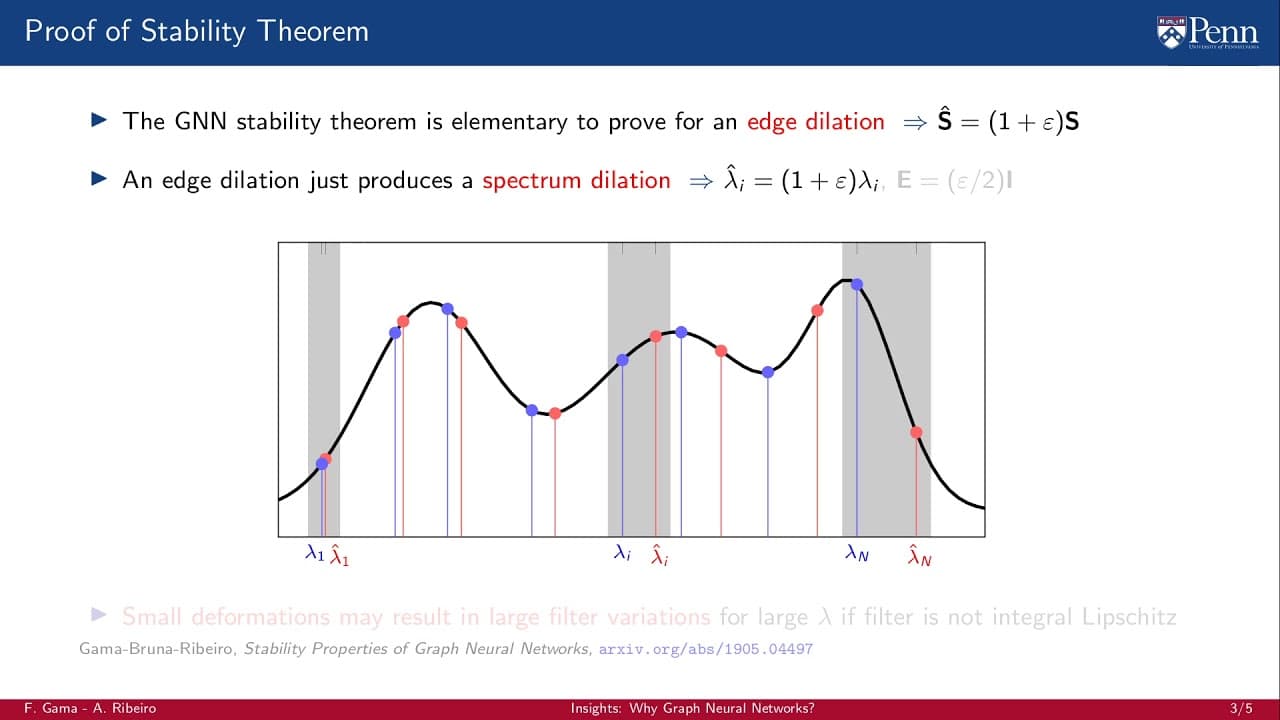
- The spectral domain analysis highlights the stability theorem, showing GNNs' robustness under edge dilation perturbations.
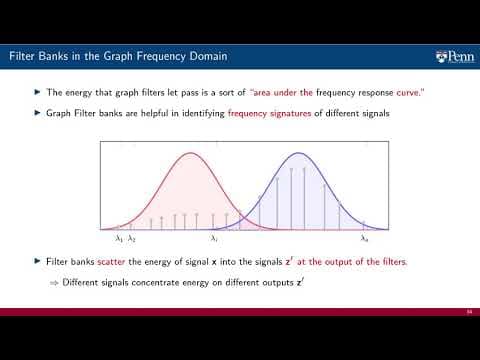
- Internal Lipschitz filters, used in GNNs, ensure stability by maintaining flatness at large eigenvalues, unlike integral Lipschitz filters.
- Linear graph convolutions struggle to discriminate features at large eigenvalues due to stability issues with integral Lipschitz filters.
- Pointwise nonlinearities in GNNs create low-frequency content that can be discriminated with stable internal Lipschitz filters.
- GNNs' architecture allows for stable and selective information processing, outperforming linear graph filters especially in machine learning applications.
Install to Summarize YouTube Videos and Get Transcripts
Explore YouTube Video Summarizer or Get YouTube Transcript Extractor
Questions & Answers
Q: Why are Graph Neural Networks preferred over graph convolutions?
Graph Neural Networks (GNNs) are preferred over graph convolutions because they offer a unique combination of stability and discriminative power. While graph convolutions are permutation equivalent and stable, they can become unstable under graph perturbations if pushed for discriminative power. GNNs incorporate pointwise nonlinearities that enhance stability while retaining discriminative capabilities, making them more effective in handling high-frequency information.
Q: How do pointwise nonlinearities contribute to GNNs' effectiveness?
Pointwise nonlinearities in Graph Neural Networks (GNNs) contribute to their effectiveness by creating low-frequency content that can be discriminated with stable internal Lipschitz filters. These nonlinearities preserve permutation invariance while generating discriminable low graph frequency components. This allows GNNs to maintain stability to perturbations while effectively distinguishing between different signals, enhancing their performance in machine learning applications.
Q: What role does the spectral domain analysis play in understanding GNNs?
The spectral domain analysis plays a crucial role in understanding Graph Neural Networks (GNNs) by illustrating their stability under perturbations. It highlights the stability theorem, showing how GNNs remain robust under edge dilation perturbations. The analysis demonstrates how internal Lipschitz filters used in GNNs ensure stability by maintaining flatness at large eigenvalues, unlike integral Lipschitz filters, which struggle with stability at large eigenvalues.
Q: What are internal Lipschitz filters, and why are they important in GNNs?
Internal Lipschitz filters are crucial in Graph Neural Networks (GNNs) because they ensure stability by maintaining flatness at large eigenvalues. Unlike integral Lipschitz filters, which can become unstable when distinguishing features at large eigenvalues, internal Lipschitz filters remain stable under graph perturbations. This stability allows GNNs to effectively process and discriminate between different signals, making them superior in machine learning contexts.
Q: Why do linear graph convolutions struggle with discriminating features?
Linear graph convolutions struggle with discriminating features because they rely on integral Lipschitz filters, which are stable but cannot effectively separate features at large eigenvalues. When pushed for discriminative power, these filters can become unstable under graph perturbations, limiting their ability to distinguish between signals with high-frequency information. This is where Graph Neural Networks, with their pointwise nonlinearities, outperform linear graph convolutions.
Q: How do GNNs handle high-frequency information content effectively?
Graph Neural Networks (GNNs) handle high-frequency information content effectively by incorporating pointwise nonlinearities that generate low-frequency content. This content can be discriminated with stable internal Lipschitz filters, allowing GNNs to maintain stability while distinguishing between signals with high-frequency components. This capability makes GNNs particularly adept at processing complex data in machine learning applications, outperforming linear graph convolutions.
Q: What is the significance of edge dilation in the context of GNNs?
Edge dilation is significant in the context of Graph Neural Networks (GNNs) as it is used to demonstrate the stability of GNNs under perturbations. When edges are multiplied by a small factor, it results in spectrum dilation. GNNs, with their internal Lipschitz filters, remain stable under such perturbations, ensuring that the output does not change significantly. This robustness is a key advantage of GNNs over traditional graph convolutions.
Q: In what way do GNNs outperform linear graph filters in machine learning?
Graph Neural Networks (GNNs) outperform linear graph filters in machine learning by offering a stable and selective information processing architecture. While linear graph filters struggle to discriminate features at large eigenvalues due to stability issues, GNNs incorporate pointwise nonlinearities that generate discriminable low-frequency content. This allows GNNs to effectively process and distinguish between complex signals, making them more suitable for machine learning tasks involving high-frequency information.
Summary & Key Takeaways
-
Graph Neural Networks (GNNs) are highlighted for their stability and discriminative power, outperforming graph convolutions. The inclusion of pointwise nonlinearities in GNNs enhances their stability to graph perturbations while maintaining the ability to discriminate between different signals, making them superior in handling high-frequency information content.
-
The spectral domain analysis reveals that GNNs are robust under edge dilation perturbations. Internal Lipschitz filters, used in GNNs, ensure stability by maintaining flatness at large eigenvalues, unlike integral Lipschitz filters, which struggle with stability when distinguishing features at large eigenvalues.
-
Pointwise nonlinearities in GNNs generate low-frequency content that can be discriminated with stable internal Lipschitz filters. This capability allows GNNs to leverage new low eigenvalue content to discriminate between signals effectively, making them a stable and selective information processing architecture in machine learning.
Read in Other Languages (beta)
Share This Summary 📚
Summarize YouTube Videos and Get Video Transcripts with 1-Click
Try YouTube Summary with ChatGPT & Claude or YouTube Transcript Generator
Explore More Summaries from Alelab Alelab 📚
Summarize YouTube Videos and Get Video Transcripts with 1-Click
Try YouTube Summary with ChatGPT & Claude or YouTube Transcript Generator