Products
Features
YouTube Video Summarizer
Summarize YouTube videos
Web & PDF Highlighter
Highlight web pages & PDFs
Chat with PDF
Ask any PDF questions with AI
Ask AI Clone
Chat with your highlights & memories
Audio Transcriber
Transcribe audio files to text
Glasp Reader
Read and highlight articles
Kindle Highlight Export
Export your Kindle highlights
Idea Hatch
Hatch ideas from your highlights
Integrations
Obsidian Plugin
Notion Integration
Pocket Integration
Instapaper Integration
Medium Integration
Readwise Integration
Snipd Integration
Hypothesis Integration
Apps & Extensions
Chrome Extension
Safari Extension
Edge Add-ons
Firefox Add-ons
iOS App
Android App
Discover
Discover
Ideas
Discover new ideas and insights
Articles
Curated articles and insights
Books
Book recommendations by great minds
Posts
Essays and notes from readers
Quotes
Inspiring quotes collection
Videos
Curated videos and summaries
Explore Glasp
Glasp Newsletter
Weekly insights and updates
Glasp Talk
Interview series with great minds
Glasp Blog
Latest news and articles
Glasp Use Cases
Learn how others use Glasp
Build & Support
Glasp API
Access Glasp's API for developers
MCP Connector
Connect Glasp to Claude & ChatGPT
Community
Glasp Reddit Community
Students
Student discount and benefits
FAQs
Frequently Asked Questions
AboutPricing
DashboardLog inSign up

Triangle Subdivision - Numberphile
171.2K views
•
February 9, 2023
by
Numberphile
YouTube video player
Triangle Subdivision - Numberphile

TL;DR

Learn about barycentric and edgewise subdivision methods in triangles and their applications in mathematics.

Transcript

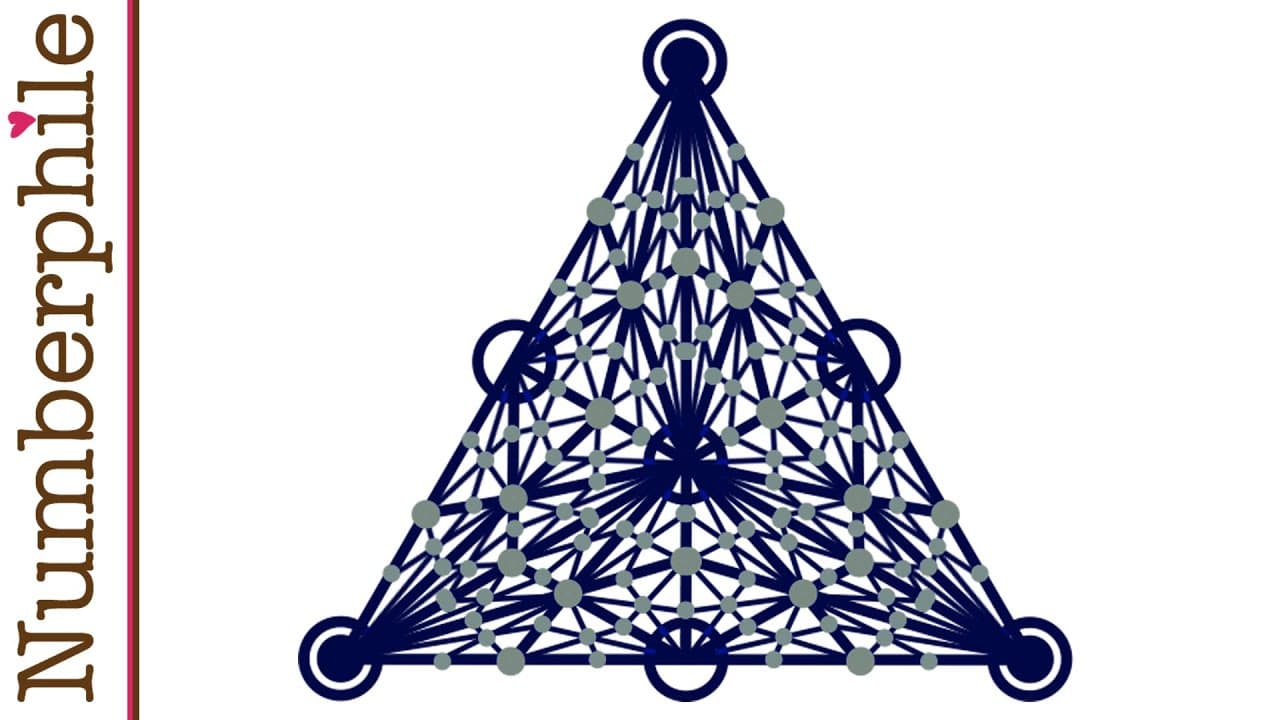
Today's video is about subdividing  triangles and possibly indications   of how such subdivisions happen  in higher dimensional analogues   of triangles. So we start with a triangle  and we use a subdivision that is classic   in mathematics, the Barycentric subdivision.

  • (Brady: This could be any triangle, basically?) This could be any triangle, b... Read More

Key Insights

  • 🌚 Barycentric subdivision involves creating new vertices based on triangle faces for a finer subdivision.
  • 📏 Edgewise subdivision focuses on dilating triangles and connecting vertices following specific rules.
  • 🉐 Both methods offer distinct advantages and applications in mathematical analysis and modeling.
  • 🔺 Subdividing triangles can lead to different shapes and angles, affecting their properties and applications.
  • 👨‍🔬 Understanding different methods of triangle subdivision can have implications for research and problem-solving in mathematics.
  • ✋ Subdividing higher-dimensional objects like tetrahedra using similar principles enhances geometric analysis.
  • 🈸 Mathematical rigor ensures accurate triangle subdivisions and shapes in various applications.

Install to Summarize YouTube Videos and Get Transcripts

Explore YouTube Video Summarizer or Get YouTube Transcript Extractor

Questions & Answers

Q: What is the barycentric subdivision method in triangle analysis?

The barycentric method involves adding vertices based on faces to subdivide triangles, enabling finer analysis.

Q: How does the edgewise subdivision method differ from the barycentric method?

Edgewise subdivision involves dilating triangles and connecting vertices based on specific rules to achieve balanced subdivisions with explicit criteria.

Q: What are the advantages and disadvantages of barycentric subdivision in mathematical modeling?

Barycentric subdivision is precise for mathematical purposes but can lead to uneven triangles and angles in practical applications like 3D modeling.

Q: Are there alternative methods to subdivide triangles apart from barycentric and edgewise methods?

Yes, various methods exist, and new subdivision techniques may arise to address different mathematical or practical questions.

Summary & Key Takeaways

  • Barycentric subdivision method involves dividing triangles by creating new vertices based on faces.

  • Edgewise subdivision focuses on dilating triangles and connecting vertices with specific rules.

  • Both methods provide ways to subdivide triangles for mathematical analysis and model refinement.


Read in Other Languages (beta)

English

Share This Summary 📚

Summarize YouTube Videos and Get Video Transcripts with 1-Click

Download browser extensions on:

Try YouTube Summary with ChatGPT & Claude or YouTube Transcript Generator

Explore More Summaries from Numberphile 📚

Brown Numbers - Numberphile thumbnail
Brown Numbers - Numberphile
Numberphile
Statistics, Storks, and Babies - Numberphile thumbnail
Statistics, Storks, and Babies - Numberphile
Numberphile
29 and Leap Years - Numberphile thumbnail
29 and Leap Years - Numberphile
Numberphile
Professors React to 2048 - Numberphile thumbnail
Professors React to 2048 - Numberphile
Numberphile
What Is Pascal's Triangle and Its Mathematical Patterns? thumbnail
What Is Pascal's Triangle and Its Mathematical Patterns?
Numberphile
What Is the 10,958 Problem in Mathematics? thumbnail
What Is the 10,958 Problem in Mathematics?
Numberphile

Summarize YouTube Videos and Get Video Transcripts with 1-Click

Download browser extensions on:

Try YouTube Summary with ChatGPT & Claude or YouTube Transcript Generator

Apps & Extensions

  • Chrome Extension
  • Safari Extension
  • Edge Add-ons
  • Firefox Add-ons
  • iOS App
  • Android App

Key Features

  • YouTube Video Summarizer
  • Web & PDF Summarizer
  • Web & PDF Highlighter
  • Chat with PDF
  • Ask AI Clone
  • Audio Transcriber
  • Glasp Reader
  • Kindle Highlight Export
  • Idea Hatch

Integrations

  • Obsidian Plugin
  • Notion Integration
  • Pocket Integration
  • Instapaper Integration
  • Medium Integration
  • Readwise Integration
  • Snipd Integration
  • Hypothesis Integration

More Features

  • APIs
  • MCP Connector
  • Blog & Post
  • Embed Links
  • Image Highlight
  • Personality Test
  • Quote Shots

Company

  • About us
  • Blog
  • Community
  • FAQs
  • Job Board
  • Newsletter
  • Pricing
Terms

•

Privacy

•

Guidelines

© 2026 Glasp Inc. All rights reserved.