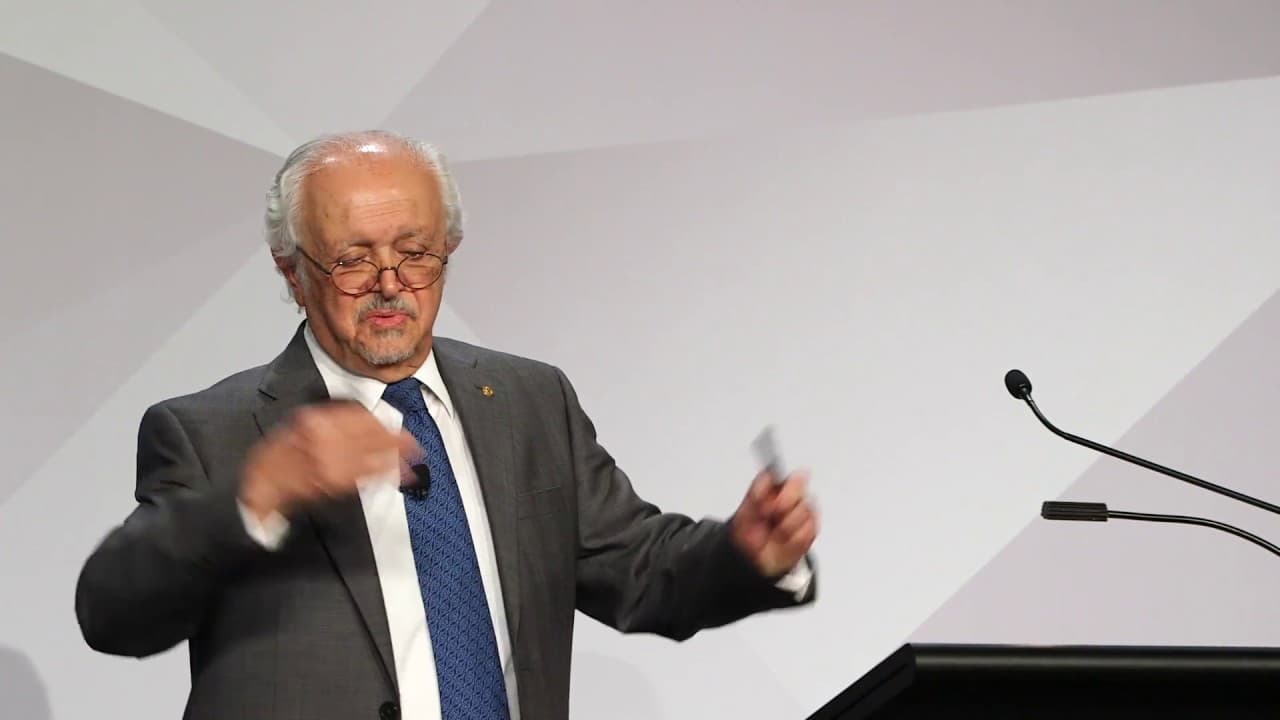
‘Climate Change: Science and Policy’ Lecture by Mario Molina, Nobel Prize in Chemistry
TL;DR
CFCs release chlorine atoms in the stratosphere, where a catalytic cycle allows one chlorine atom to destroy tens of thousands of ozone molecules. Molina and fellow scientists communicated this threat to governments, the public, and diplomats, helping secure the Montreal Protocol. Nations stopped manufacturing the chemicals, replacement refrigerants became available, and measurements indicate that the ozone layer is slowly recovering.
Transcript
thank you very much for your kind introduction I'll be talking about climate change science and policy aspects of it but I will spend a few minutes first just talking about stratospheric ozone what led to the Nobel Prize that I was rewarded with it was of course a huge honour to to receive it I I should just say I gave a similar lecture yesterday I... Read More
Key Insights
- CFCs are highly stable chemicals that replaced dangerous refrigerants such as sulfur dioxide and ammonia because they could evaporate effectively without poisoning people during ordinary exposure.
- Atmospheric measurements showed that CFCs had reached both hemispheres, including the southern hemisphere where they were not produced, demonstrating that their emissions created a global environmental problem.
- CFCs reach the stratosphere because their chemical stability allows them to persist while gradually diffusing above the troposphere, where short-wavelength solar radiation eventually breaks them apart.
- Chlorine atoms destroy ozone through a catalytic cycle in which chlorine reacts with ozone and is later recovered, enabling a single chlorine atom to eliminate tens of thousands of ozone molecules.
- The ozone layer shields living organisms from harmful short-wavelength solar radiation, which can break down DNA and contribute to skin cancer when cellular repair mechanisms fail.
- The Antarctic ozone hole is a strongly nonlinear seasonal phenomenon because its chemistry involves two chlorine monoxide molecules, making the effect proportional to the square of the chlorine concentration.
- Antarctica experiences more dramatic ozone loss than the Arctic because its polar vortex is more stable and its stratosphere becomes extremely cold, allowing ice particles to accelerate the destructive chemistry.
- The Montreal Protocol is a successful example of scientists communicating established evidence to society, governments, and diplomats, leading nearly all nations to stop manufacturing CFCs and enabling gradual ozone recovery.
Install to Summarize YouTube Videos and Get Transcripts
Explore YouTube Video Summarizer or Get YouTube Transcript Extractor
Questions & Answers
Q: How do CFCs damage the ozone layer?
CFCs remain stable in the lower atmosphere and eventually diffuse into the stratosphere. At sufficiently high altitudes, short-wavelength solar radiation breaks the molecules apart and releases chlorine atoms. Chlorine reacts rapidly with ozone, then is recovered through another reaction. This catalytic cycle lets one chlorine atom destroy tens of thousands of ozone molecules.
Q: Why were CFCs originally considered useful chemicals?
CFCs were developed as alternatives to refrigerants such as sulfur dioxide and ammonia, which could cause harmful accidents when household refrigerators leaked. CFCs were very inert, stable, and capable of evaporating, making them effective refrigerants. Their apparent safety also encouraged their use as propellants in spray cans for products including cleaners and toothpaste.
Q: What does the ozone layer protect living organisms from?
The ozone layer, located mainly in the stratosphere about 30 to 50 kilometers above the surface, shields living organisms from short-wavelength radiation coming from the Sun. If that radiation reaches human skin, it can break down DNA. Repair mechanisms sometimes correct the damage, but failures can lead to skin cancer.
Q: Why can one chlorine atom destroy many ozone molecules?
A chlorine atom reacts quickly with ozone and forms chlorine oxide. A subsequent reaction recovers the original chlorine atom, allowing it to react again rather than being permanently consumed. Because chlorine is repeatedly regenerated through this catalytic mechanism, one atom can continue destroying ozone and eliminate tens of thousands of ozone molecules.
Q: Why is Antarctic ozone depletion especially severe?
Antarctica has a more stable polar vortex than the Arctic because a high-altitude continent is surrounded by relatively flat oceans. Its stratosphere also reaches temperatures near minus 80 degrees Celsius. Ice particles form under these conditions and accelerate the relevant chemistry, producing exceptionally rapid ozone destruction during the southern hemisphere's spring months.
Q: What is the Antarctic ozone hole?
The Antarctic ozone hole is the rapid seasonal disappearance of stratospheric ozone over Antarctica during the southern spring, particularly September and October. Beginning in the 1980s, ozone loss became extremely severe at altitudes where ozone is normally most abundant. In those regions, more than 98 to 99 percent of the ozone reacted away.
Q: How did scientific communication contribute to the Montreal Protocol?
Molina and Rowland decided that identifying the chemical threat was not sufficient, so they communicated their findings beyond the scientific community. They addressed government decision makers, the general public, and diplomats. Their efforts, alongside increasingly strong measurements and scientific understanding, helped convince heads of state to support a United Nations agreement restricting the responsible chemicals.
Q: Why is ozone-layer recovery a slow process?
The Montreal Protocol led nations to stop manufacturing CFCs, and the chemical industry developed other refrigerants. However, CFCs emitted during the twentieth century remain in the atmosphere for many decades and continue damaging the stratosphere. Recovery is therefore gradual, although measurements already indicate that the ozone layer is improving.
Summary
In this video about climate change science and policy, the speaker discusses the background and research that led to the understanding of stratospheric ozone depletion that won him a Nobel Prize. He also addresses three common myths about climate change, including the belief that climate change is natural and not caused by human activities, the idea that climate change is slow and not a concern for current generations, and the notion that transitioning away from fossil fuels would be detrimental to the economy. The speaker explains the scientific consensus on climate change, the increasing frequency of extreme weather events, and the potential consequences of inaction.
Questions & Answers
Q: How did the research on stratospheric ozone depletion lead to a Nobel Prize?
The speaker and his colleague, Sherry Rowland, conducted research in the early 1970s on the potential environmental impact of chlorofluorocarbons (CFCs), which were commonly used as refrigerants and propellants. They discovered that CFCs, when released into the atmosphere, could break down and release chlorine atoms that were capable of destroying ozone molecules in the stratosphere. Their research was based on understanding the chemical reactions and properties of the atmosphere, and their findings were later confirmed through measurements of CFCs in the atmosphere. Their work brought attention to the issue and ultimately led to the signing of the Montreal Protocol, an international agreement to phase out the production and use of CFCs.
Q: How did electric refrigeration become common before the use of CFCs?
Before electric refrigerators became common, people used to import large chunks of ice from frozen lakes in northern latitudes for refrigeration. This method was used in the 19th century, but it was mainly accessible to wealthier individuals. The use of electric refrigerators, which utilized a refrigerant fluid that could be compressed and evaporated to cool the freezer, made refrigeration more widely available. However, the original refrigerants used, such as sulfur dioxide and ammonia, were hazardous if leaked. As a solution, chemists developed chlorofluorocarbons (CFCs) as refrigerants, which were non-toxic and could be safely used in spray cans as well. The popularity of spray cans in the US, along with their use as refrigerants, contributed to the widespread use of CFCs.
Q: What are the consequences of ozone depletion?
Ozone depletion in the stratosphere, particularly the formation of an "ozone hole" over Antarctica, has significant consequences. The ozone layer in the stratosphere acts as a shield against harmful short-wavelength radiation from the sun, which can cause DNA damage and skin cancer. When the ozone layer is depleted, the earth's surface and living organisms, including humans, are more exposed to this harmful radiation. The discovery of the ozone hole led to global efforts to phase out the use of ozone-depleting substances, resulting in the recovery of the ozone layer over time.
Q: How is climate change different from natural climate variations?
Climate change refers to long-term shifts in weather patterns and average temperatures attributed to human activities, particularly the emission of greenhouse gases such as carbon dioxide (CO2). While it is true that the climate has changed naturally in the past due to factors like orbital variations and volcanic eruptions, the current changes in the climate are distinct. Surveys and consensus among climate change scientists show that the majority agree that climate change is happening and is primarily caused by human activities. The science behind climate change is well-established and supported by measurements and evidence.
Q: Is climate change a slow process or does it have immediate consequences?
Contrary to the belief that climate change is a slow process, there are already observable consequences of climate change such as melting Arctic sea ice and extreme weather events. Heatwaves, floods, droughts, wildfires, and other extreme weather events have increased in frequency and intensity, leading to economic losses and loss of life. These events are impacting societies and ecosystems in present-day, not just in the future. Climate change is a complex issue and its impacts vary across regions, but the evidence suggests that it is occurring more rapidly than previously thought.
Q: Why is it important to transition away from fossil fuels?
Transitioning away from fossil fuels is crucial for mitigating climate change for several reasons. First, the burning of fossil fuels releases carbon dioxide, a greenhouse gas that contributes to global warming. By reducing fossil fuel consumption, we can limit the amount of CO2 entering the atmosphere and slow down the pace of climate change. Second, continuing to rely heavily on fossil fuels contributes to air pollution and negative health effects. Third, renewable energy sources such as wind and solar power are now economically competitive with fossil fuels and can create new jobs and economic opportunities. Transitioning to clean energy sources not only helps combat climate change but also brings multiple environmental and economic benefits.
Q: How can renewable energy be a viable alternative to fossil fuels?
Renewable energy sources such as wind and solar power have become more economically competitive in recent years. Technological advances, increased efficiency, and government support have contributed to reduced costs and increased affordability for renewable energy. Additionally, the long-term environmental and health benefits of renewable energy sources far outweigh the short-term costs of transitioning from fossil fuels. While challenges such as intermittent energy supply and storage still exist, ongoing research and development are addressing these issues and finding viable solutions. By investing in renewable energy, countries can reduce their carbon footprint, create jobs, and advance towards a more sustainable and clean energy future.
Q: How important is international cooperation in addressing climate change?
International cooperation is crucial in addressing climate change due to its global nature and impacts. Climate change is not confined to national borders, and one country's actions or inaction can affect the global climate system. Agreements such as the Paris Agreement, where almost all nations agreed to work together to limit global warming, demonstrate the recognition of the need for collaborative action. Sharing knowledge, technologies, and resources is vital in finding effective solutions and mitigating the effects of climate change. The collective efforts of multiple nations are necessary to reduce greenhouse gas emissions, transition to cleaner energy sources, and adapt to the changing climate.
Q: What are the potential consequences of not taking action on climate change?
The consequences of not taking action on climate change are severe and far-reaching. If we continue on our current trajectory without significant efforts to reduce greenhouse gas emissions, the temperature of the planet could rise by more than five degrees Celsius. This level of warming would lead to uninhabitable areas due to extreme heatwaves and the loss of ecosystems and biodiversity. Agricultural systems would be severely impacted, leading to food shortages and increased food insecurity. There would also be increased frequency and intensity of extreme weather events, such as hurricanes, floods, and wildfires, resulting in economic losses, property damage, and loss of life. In short, failing to address climate change would have profound and irreversible consequences for both our environment and human society.
Q: Why do some people not believe in climate change?
Some people do not believe in climate change due to various reasons, including misinformation, political ideology, and vested interests. Companies and individuals who stand to lose financially from climate change mitigation efforts may fund campaigns or disseminate misinformation to sow doubt and prevent action on climate change. Political ideologies that prioritize unrestricted economic growth can also discourage acceptance of climate change science. Additionally, some individuals may deny climate change due to a lack of understanding or exposure to accurate information. However, the overwhelming scientific consensus and evidence support the reality of climate change and the need for urgent action.
Takeaways
In summary, the video highlights the research on stratospheric ozone depletion that led to the speaker's Nobel Prize and the subsequent global efforts to address this issue through the Montreal Protocol. Three common myths about climate change are addressed, including the belief that climate change is natural and not caused by human activities, the perception that climate change is slow and not a concern for current generations, and the notion that transitioning away from fossil fuels would harm the economy. The scientific consensus supports the understanding that climate change is primarily caused by human activities and is already having immediate consequences, including extreme weather events and melting of the Arctic sea ice. Transitioning to renewable energy sources is important for mitigating climate change and has become economically competitive. International cooperation and the Paris Agreement are crucial for addressing climate change on a global scale. The potential consequences of not taking action on climate change are severe, including uninhabitable areas due to extreme heatwaves, agricultural losses, and increased frequency of extreme weather events. Some people may deny climate change due to misinformation, political ideologies, or vested interests, but the scientific consensus and evidence overwhelmingly support the urgent need for action.
Summary & Key Takeaways
-
Mario Molina and Sherry Rowland shifted from fundamental chemical research toward an atmospheric problem with social relevance. They investigated chlorofluorocarbons, stable compounds widely used as safe refrigerants and spray-can propellants. Measurements showed that these chemicals spread throughout the global atmosphere, including regions where they were not produced, creating a worldwide environmental concern.
-
Their research proposed that CFCs eventually reach the stratosphere, where short-wavelength solar radiation breaks them apart and releases chlorine atoms. Chlorine reacts rapidly with ozone and is regenerated through a catalytic cycle, allowing one atom to destroy tens of thousands of ozone molecules. Depletion weakens protection against radiation that can damage DNA.
-
Scientific measurements connected CFCs to ozone depletion, while the Antarctic ozone hole demonstrated a severe nonlinear effect during southern spring. Molina and colleagues communicated the danger to governments, the public, and diplomats. The Montreal Protocol secured nearly universal agreement to stop manufacturing CFCs, and measurements now show gradual ozone-layer recovery despite persistent emissions.
Read in Other Languages (beta)
Share This Summary 📚
Summarize YouTube Videos and Get Video Transcripts with 1-Click
Try YouTube Summary with ChatGPT & Claude or YouTube Transcript Generator
Explore More Summaries from Nobel Prize 📚



Summarize YouTube Videos and Get Video Transcripts with 1-Click
Try YouTube Summary with ChatGPT & Claude or YouTube Transcript Generator