Halohydrin Formation and Epoxidation of Alkenes
TL;DR
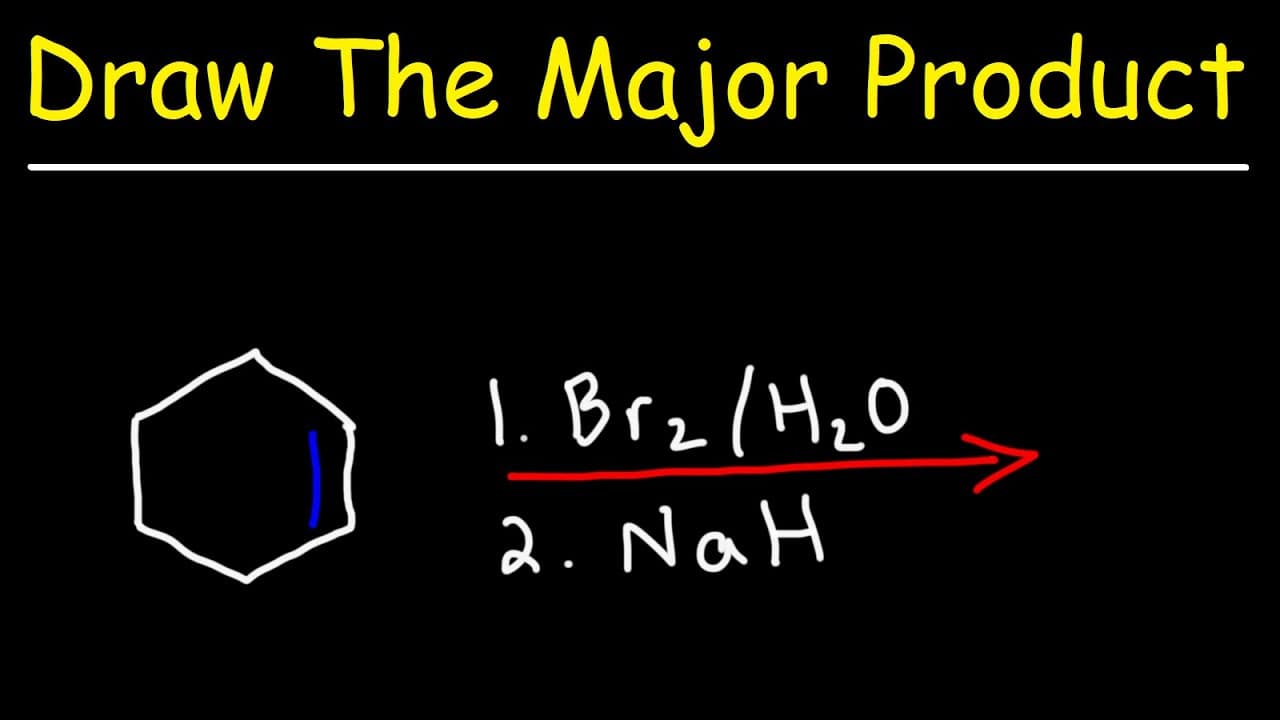
Cyclohexene reacts with bromine and water, followed by sodium hydride, to form an epoxide.
Transcript
now number 42 and what is the major product of the reaction between cyclohexene with bromine and water followed by sodium hydride here we have cyclohexene that we're going to react with bromine and water so we've seen this reaction earlier in the video we know that this reaction proceeds with anti-addition we're going to get a pair of Naturals now ... Read More
Key Insights
- 🥺 The reaction between cyclohexene, bromine, water, and sodium hydride leads to the formation of an epoxide.
- 🇦🇬 The reaction proceeds through anti-addition, resulting in two identical enantiomers due to symmetry.
- 💁 Deprotonation of the hydroxyl group by sodium hydride generates an alkoxide, which then undergoes an SN2 reaction to form the epoxide.
Install to Summarize YouTube Videos and Get Transcripts
Explore YouTube Video Summarizer or Get YouTube Transcript Extractor
Questions & Answers
Q: What is the main product formed in the reaction between cyclohexene, bromine, water, and sodium hydride?
The main product is an epoxide, formed through a series of reactions involving anti-addition, an SN2 intermolecular reaction, and deprotonation of the hydroxyl group.
Q: How does the configuration of the epoxide relate to the starting cyclohexene?
The configuration of the epoxide is inverted compared to the starting cyclohexene due to an SN2 reaction at one of the carbons. The other enantiomer can also be obtained, but these two are identical due to symmetry.
Q: What role does sodium hydride play in the reaction?
Sodium hydride acts as a strong base, deprotonating the hydroxyl group in cyclohexene to form an alkoxide. This alkoxide then undergoes further reactions to form the epoxide.
Q: Can you provide more information about the YouTube membership program mentioned in the content?
The YouTube membership program by the "Organic Chemistry Tutor" provides access to various exclusive organic chemistry videos, ranging from basic introductions to exam reviews and practice tests, covering topics such as reactions, nomenclature, and stereochemistry.
Summary & Key Takeaways
-
Cyclohexene reacts with bromine and water, undergoing anti-addition, resulting in the formation of a pair of naturals.
-
Sodium hydride is then used to deprotonate the hydroxyl group, leading to an alkoxide through an SN2 intermolecular reaction.
-
The alkoxide attacks one of the carbons in cyclohexene, resulting in an epoxide formation with inversion of configuration.
Read in Other Languages (beta)
Share This Summary 📚
Summarize YouTube Videos and Get Video Transcripts with 1-Click
Try YouTube Summary with ChatGPT & Claude or YouTube Transcript Generator
Explore More Summaries from The Organic Chemistry Tutor 📚
Summarize YouTube Videos and Get Video Transcripts with 1-Click
Try YouTube Summary with ChatGPT & Claude or YouTube Transcript Generator