How to Calculate Units of the Rate Constant K
TL;DR
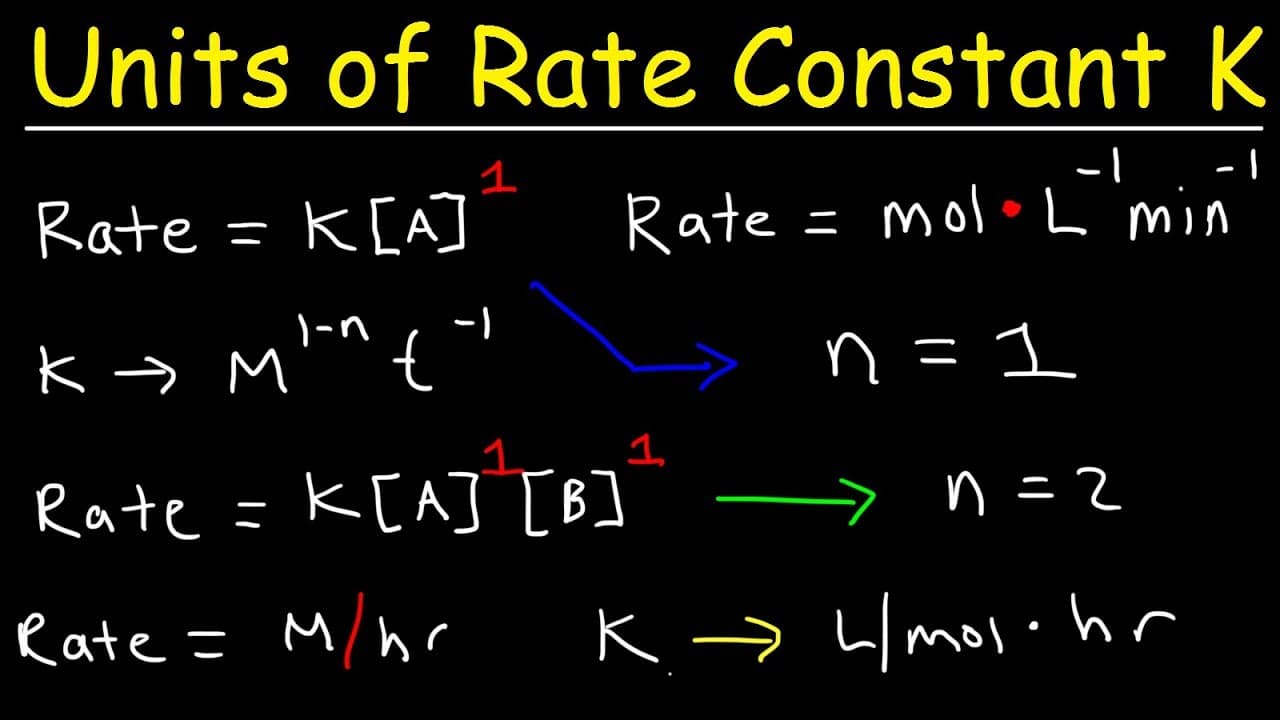
To calculate the units of the rate constant k, use the formula m^(1-n) * t^(-1), where m is molarity and t is time. The units vary based on the reaction order: for zero-order it's molarity per second, for first-order it depends on the time unit, and for second-order it's typically liters per mole per hour.
Transcript
in this lesson i'm going to explain how to calculate the units of the rate constant k so let's start with a zero order reaction so rate is equal to k now there's a formula that can help you to find units of k it's equal to m raised to the 1 minus n times t raised to the minus 1. m is for molarity t is some unit of time which could be seconds minute... Read More
Key Insights
- ☠️ The units of k for a reaction depend on the order of the reaction and the given rate expression.
- 😙 The formula m^(1-n) * t^(-1) can be used to calculate the units of k, where m represents molarity and t represents time.
- ⌛ For first-order reactions, the units of k vary depending on the given time unit (e.g., seconds, minutes, hours).
- ⏲️ In second-order overall reactions, the units of k involve molarity, liters, moles, and the given time unit.
- ☠️ Alternative methods, such as isolating k in the rate law expression, can be used to calculate the units of k.
- 😉 It's important to adjust the units of k to match the multiple-choice answer options in exams.
Install to Summarize YouTube Videos and Get Transcripts
Explore YouTube Video Summarizer or Get YouTube Transcript Extractor
Questions & Answers
Q: How do you calculate the units of k for a zero-order reaction?
In a zero-order reaction, where rate = k, the units of k are molarity per second (mol/L/s).
Q: What are the units of k for a first-order reaction with respect to a and overall?
In a first-order reaction with respect to a and overall, the units of k depend on the given time unit. For example, if the rate is given as mol/L/min, then the units of k are minutes to the negative 1 power (1/min).
Q: How do you determine the units of k for a second-order overall reaction?
In a second-order overall reaction, the units of k can be calculated using the formula. For example, if the rate is given as molarity per hour (mol/L/h), then the units of k are liters per mole per hour (L/mol/h).
Q: Is there an alternative method to calculate the units of k without using the formula?
Yes, you can isolate k in the rate law expression, divide both sides by the concentrations, and replace them with their units to determine the units of k. This method can provide the same result as using the formula.
Summary & Key Takeaways
-
For a zero-order reaction, the units of k can be calculated as molarity per second (mol/L/s).
-
In a first-order reaction, the units of k depend on the time unit given (e.g., minutes or hours).
-
For a second-order overall reaction, the units of k are liters per mole per hour (L/mol/h).
Read in Other Languages (beta)
Share This Summary 📚
Summarize YouTube Videos and Get Video Transcripts with 1-Click
Try YouTube Summary with ChatGPT & Claude or YouTube Transcript Generator
Explore More Summaries from The Organic Chemistry Tutor 📚




Summarize YouTube Videos and Get Video Transcripts with 1-Click
Try YouTube Summary with ChatGPT & Claude or YouTube Transcript Generator