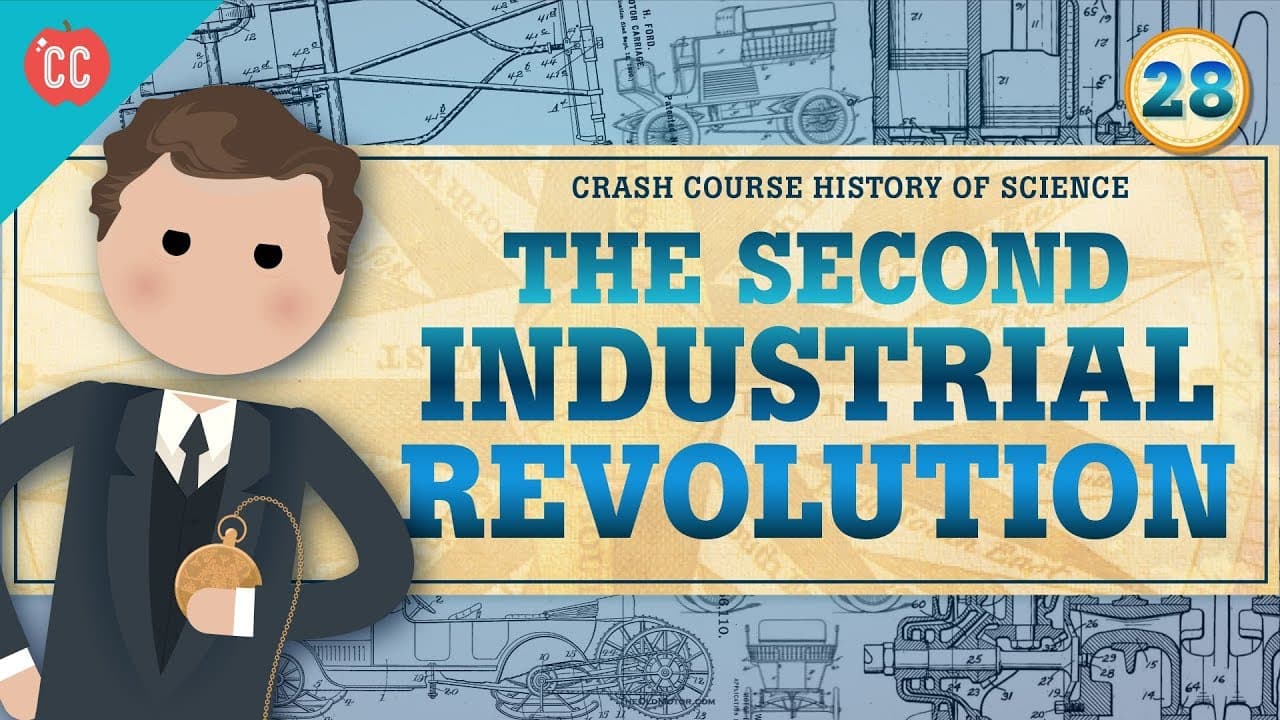
Ford, Cars, and a New Revolution: Crash Course History of Science #28
TL;DR
The Industrial Revolution transformed industry, with Ford revolutionizing car production.
Transcript
Historians looked at a bunch of changes in technical systems and called it the Industrial Revolution… But historians love to debate each other. So some of them pointed out that the first half of this revolution looks a lot different from the second. Basically, the First Industrial Revolution ramped up around 1800. It started in Britain, ran on stea... Read More
Key Insights
- The Industrial Revolution is divided into two phases: the first focused on steam and trains, while the second emphasized electricity and mass manufacturing.
- Henry Ford revolutionized the automotive industry by introducing mass production techniques, which drastically reduced the cost of cars.
- Ford's assembly line method allowed for efficient production, leading to the Model T being affordable and accessible to many Americans.
- Ford's legacy is complex, as he contributed to industrial growth but also held controversial views and practices, such as his Sociological Department.
- The rise of automobiles necessitated the development of infrastructure, including roads and gas stations, and influenced urban planning.
- The automotive industry's growth led to the dominance of major companies like Ford, GM, and Chrysler, pushing out smaller manufacturers.
- Ford's approach to labor involved high wages but also strict control over workers' lifestyles, contributing to labor tensions and unionization.
- The professionalization of scientists and engineers paralleled industrial advancements, shaping modern professions and corporate research.
Install to Summarize YouTube Videos and Get Transcripts
Explore YouTube Video Summarizer or Get YouTube Transcript Extractor
Questions & Answers
Q: What are the key differences between the First and Second Industrial Revolutions?
The First Industrial Revolution, starting around 1800, was characterized by the use of steam power, trains, and factories, leading to individual scientific discoveries. The Second Industrial Revolution, around 1900, focused on electricity, cars, and communication technologies, with technological inventions owned by corporations like Ford Motor.
Q: How did Henry Ford revolutionize the automotive industry?
Henry Ford revolutionized the automotive industry by introducing the assembly line method, which allowed for mass production of cars. This innovation significantly reduced manufacturing costs, making cars more affordable and accessible to the general public, exemplified by the success of the Model T.
Q: What was the impact of Ford's assembly line on production efficiency?
Ford's assembly line drastically increased production efficiency, enabling the manufacturing of a Model T in as little as 28 hours. This system of specialization and standardization allowed for the rapid production of cars, contributing to the widespread availability and affordability of automobiles.
Q: How did Ford's wage policy affect his workforce?
Ford's wage policy, which offered $5 a day, was revolutionary for its time and attracted a large workforce. However, it came with conditions, such as clean living and avoiding union activities, which Ford enforced through his Sociological Department, aiming to shape workers into model citizens.
Q: What were the broader societal impacts of the rise of automobiles?
The rise of automobiles led to the development of necessary infrastructure, such as roads and gas stations, and influenced urban planning. It also increased accessibility to national parks and natural spaces, fostering a new appreciation for nature and impacting the discipline of ecology.
Q: How did Ford's practices influence labor movements?
Ford's practices, including high wages with strict lifestyle controls, contributed to labor tensions. Workers sought better conditions and autonomy, leading to the formation of unions. Ford's non-unionized workforce model contrasted with growing labor movements advocating for workers' rights and better conditions.
Q: What role did Ford play in shaping modern industrial practices?
Ford played a crucial role in shaping modern industrial practices through his emphasis on mass production, standardization, and efficiency. His assembly line approach set the standard for manufacturing processes, influencing various industries and contributing to the growth of large-scale industrial operations.
Q: How did the professionalization of scientists and engineers align with industrial advancements?
The professionalization of scientists and engineers paralleled industrial advancements, as formal education, licensing, and corporate research opportunities became essential. Organizations like the American Medical Association and state licensing for engineers reflected the increasing complexity and specialization in these fields, driven by industrial needs.
Summary & Key Takeaways
-
The Industrial Revolution is characterized by two distinct phases, each marked by different technological advancements and industrial practices. The first phase focused on steam power, while the second embraced electricity and mass production, leading to significant societal changes.
-
Henry Ford's introduction of the assembly line revolutionized car manufacturing, making automobiles affordable and accessible to the masses. His methods emphasized standardization and efficiency, transforming the automotive industry and setting the stage for modern production techniques.
-
Ford's influence extended beyond manufacturing, impacting labor practices and urban development. His Sociological Department and wage policies reflected his complex legacy, as he sought to shape both his workforce and the broader American society, while also contributing to industrial growth.
Read in Other Languages (beta)
Share This Summary 📚
Summarize YouTube Videos and Get Video Transcripts with 1-Click
Try YouTube Summary with ChatGPT & Claude or YouTube Transcript Generator
Explore More Summaries from CrashCourse 📚




Summarize YouTube Videos and Get Video Transcripts with 1-Click
Try YouTube Summary with ChatGPT & Claude or YouTube Transcript Generator