How Did the Inca Empire Rise and Fall?
TL;DR
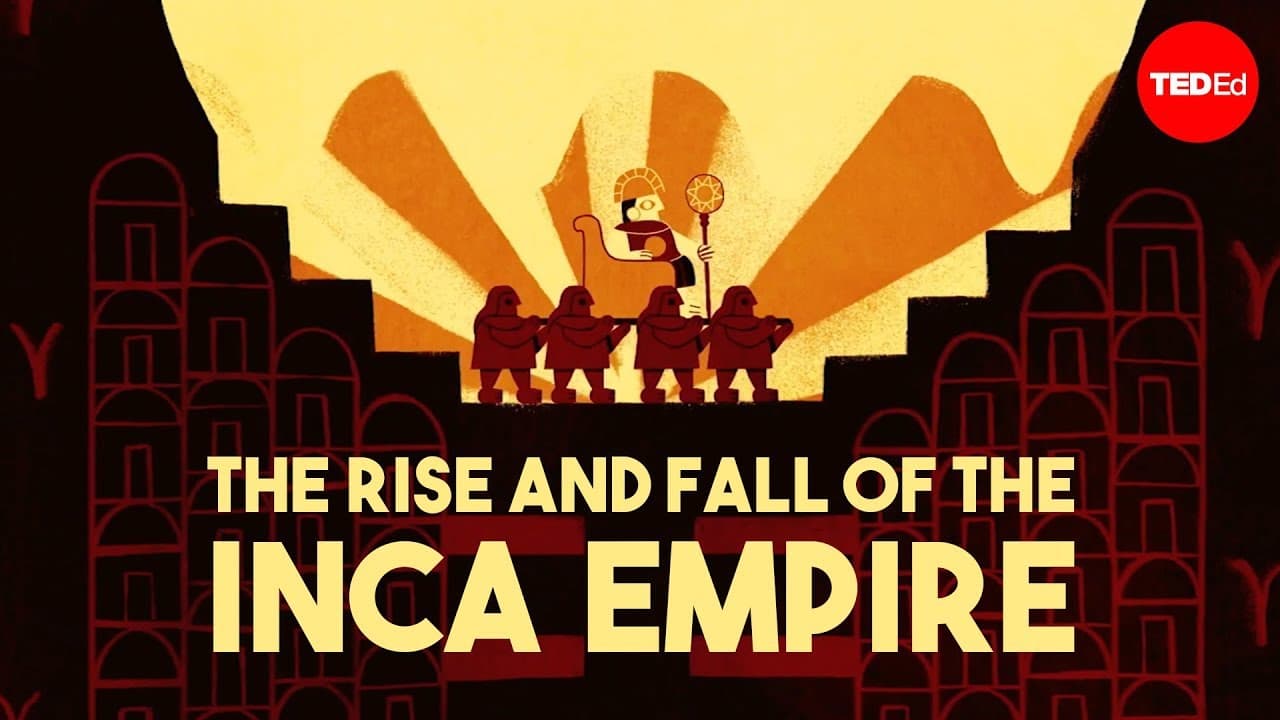
The Inca Empire rose to prominence through strong leadership, starting with Ayar Manco, who founded it in the Cuzco Valley. It expanded rapidly under Pachacuti's reforms and military successes but ultimately fell due to Spanish conquest, civil war, and disease, leading to its collapse within a century of its peak.
Transcript
It was the Western Hemisphere’s largest empire ever, with a population of nearly 10 million subjects. Over an area of more than 900,000 square kilometers, its people built massive administrative centers, temples, and extensive road and canal systems. They did so in an inhospitable, extreme terrain, all without the use of wheels, horses, iron... Read More
Key Insights
- 👯 The Inca Empire was the largest empire in the Western Hemisphere, spanning a vast territory and encompassing millions of people.
- 😮 The empire's rise to power was attributed to strong leadership, strategic military expansion, and efficient governance systems.
- 🪈 Despite the absence of a written language, the Inca Empire developed sophisticated methods of record-keeping and administration.
- 🫱 The downfall of the empire was accelerated by the arrival of Spanish conquistadors, civil war, and the devastating impact of European diseases.
Install to Summarize YouTube Videos and Get Transcripts
Explore YouTube Video Summarizer or Get YouTube Transcript Extractor
Questions & Answers
Q: How did the Inca Empire rise to become the largest empire in the Western Hemisphere?
The Inca Empire rose to power through the leadership of Ayar Manco, who founded the empire in the Cuzco Valley. It expanded significantly under the rule of Pachacuti, who implemented reforms and military strategies to create an extensive empire throughout the Andes mountains.
Q: How did the Inca Empire govern such a large territory without a written language?
Despite the lack of a written language, the Inca Empire developed a complex system of knotted strings called quipu to record numbers and possibly other information. They also established a decimal-based bureaucracy that allowed for efficient taxation and governance of their subjects.
Q: What led to the downfall of the Inca Empire?
The downfall of the Inca Empire was triggered by a combination of factors. The arrival of Spanish conquistadors brought diseases that the native population had no resistance to, resulting in a devastating outbreak and the death of key rulers. This, coupled with a civil war and the technological superiority of the Spanish, ultimately led to the empire's downfall.
Q: Did any remnants of the Inca Empire continue to resist Spanish conquest?
After the fall of the Inca capital of Cuzco, some Incas retreated to a new capital at Vilcabamba and resisted Spanish conquest for about 40 years. However, by 1572, the Spaniards had wiped out all remaining resistance and destroyed much of the Incas' cultural and physical legacy.
Key Insights:
- The Inca Empire was the largest empire in the Western Hemisphere, spanning a vast territory and encompassing millions of people.
- The empire's rise to power was attributed to strong leadership, strategic military expansion, and efficient governance systems.
- Despite the absence of a written language, the Inca Empire developed sophisticated methods of record-keeping and administration.
- The downfall of the empire was accelerated by the arrival of Spanish conquistadors, civil war, and the devastating impact of European diseases.
- The remaining Incas put up resistance for several decades but were eventually defeated by the Spanish, leading to the eradication of much of their cultural and physical heritage.
Summary & Key Takeaways
-
The Inca Empire was the largest empire in the Western Hemisphere, with a population of almost 10 million people and covering an area of over 900,000 square kilometers.
-
The empire was founded by Ayar Manco, who became the first Sapa Inca, or king of the Incas, after finding fertile soil in the Cuzco Valley.
-
Under the leadership of Pachacuti, the Inca Empire expanded its territory, implemented administrative reforms, and built remarkable infrastructure such as Machu Picchu.
Read in Other Languages (beta)
Share This Summary 📚
Summarize YouTube Videos and Get Video Transcripts with 1-Click
Try YouTube Summary with ChatGPT & Claude or YouTube Transcript Generator
Explore More Summaries from TED-Ed 📚






Summarize YouTube Videos and Get Video Transcripts with 1-Click
Try YouTube Summary with ChatGPT & Claude or YouTube Transcript Generator