What Are Prime Numbers and Composite Numbers?
TL;DR
Prime numbers are whole numbers greater than 1 that are only divisible by 1 and themselves, while composite numbers have more than two factors, including 1 and the number itself. To determine if a number is prime or composite, evaluate its factors: if it has exactly two factors, it's prime; if it has more, it's composite.
Transcript
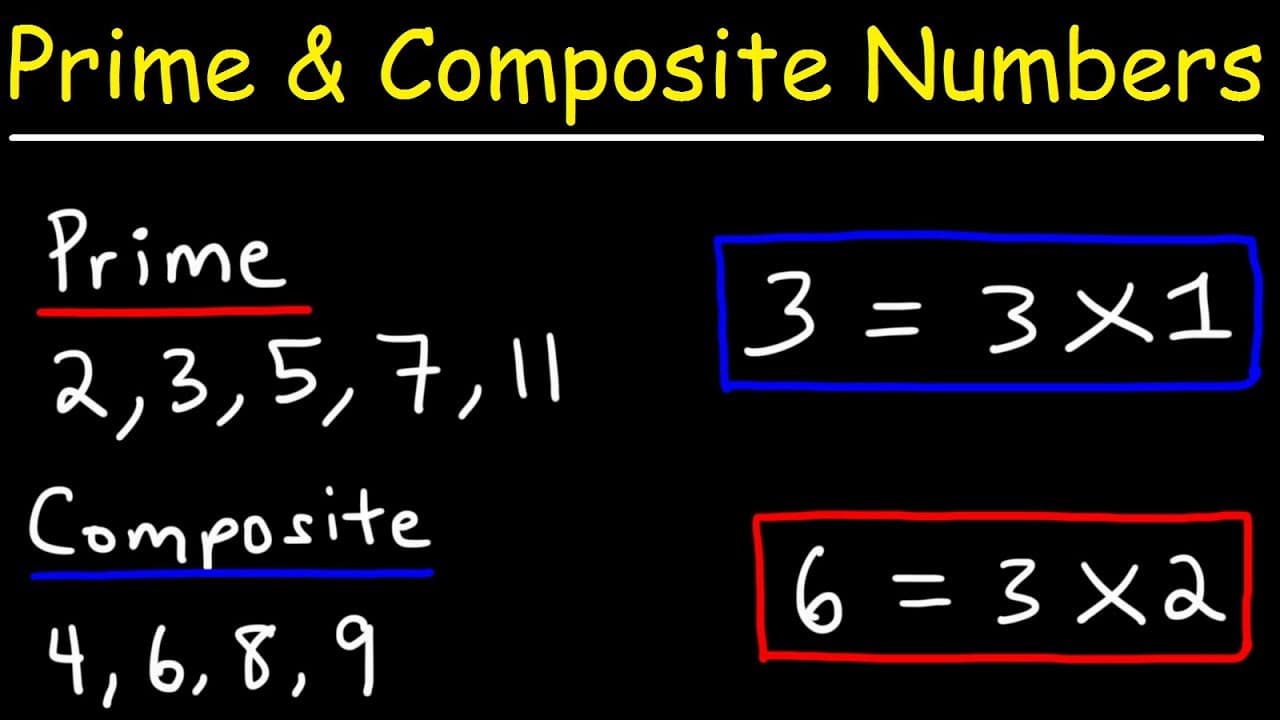
in this video i'm going to talk about prime and composite numbers so what exactly is a prime number and what is a composite number prime and composite numbers they're both whole numbers greater than 1. examples of prime numbers would be 2 3 5 7 11 and so forth example of composite numbers would be four six eight and nine now why is that the case wh... Read More
Key Insights
- #️⃣ Prime numbers are only divisible by 1 and themselves, while composite numbers have additional factors.
- #️⃣ The factors of a number are the whole numbers that can be multiplied together to get that number.
- #️⃣ A prime number can only be expressed as a product of itself and 1, while a composite number has multiple ways to be expressed as a product of two or more whole numbers.
- #️⃣ The numbers 33 and 39 are composite numbers, while 23 and 37 are prime numbers.
Install to Summarize YouTube Videos and Get Transcripts
Explore YouTube Video Summarizer or Get YouTube Transcript Extractor
Questions & Answers
Q: What is the difference between a prime number and a composite number?
A prime number is a whole number greater than 1 that can only be divided evenly by 1 and itself. A composite number, on the other hand, has more than two factors, including 1 and itself.
Q: How can we determine if a number is prime or composite?
To determine if a number is prime or composite, we can find its factors. If the number has factors other than 1 and itself, it is a composite number. If it only has factors 1 and itself, it is a prime number.
Q: Can you provide examples of prime numbers?
Some examples of prime numbers are 2, 3, 5, 7, and 11. These numbers can only be divided evenly by 1 and themselves.
Q: How about examples of composite numbers?
Examples of composite numbers include 4, 6, 8, and 9. These numbers have factors other than 1 and themselves, such as 2 and 2 for 4, and 3 and 3 for 9.
Summary & Key Takeaways
-
Prime numbers are whole numbers greater than 1 that can only be divided evenly by 1 and themselves.
-
Composite numbers are whole numbers greater than 1 that have more than two factors, including 1 and themselves.
-
To determine whether a number is prime or composite, we can find its factors and see if there are more than two factors other than 1 and the number itself.
Read in Other Languages (beta)
Share This Summary 📚
Summarize YouTube Videos and Get Video Transcripts with 1-Click
Try YouTube Summary with ChatGPT & Claude or YouTube Transcript Generator
Explore More Summaries from The Organic Chemistry Tutor 📚



Summarize YouTube Videos and Get Video Transcripts with 1-Click
Try YouTube Summary with ChatGPT & Claude or YouTube Transcript Generator