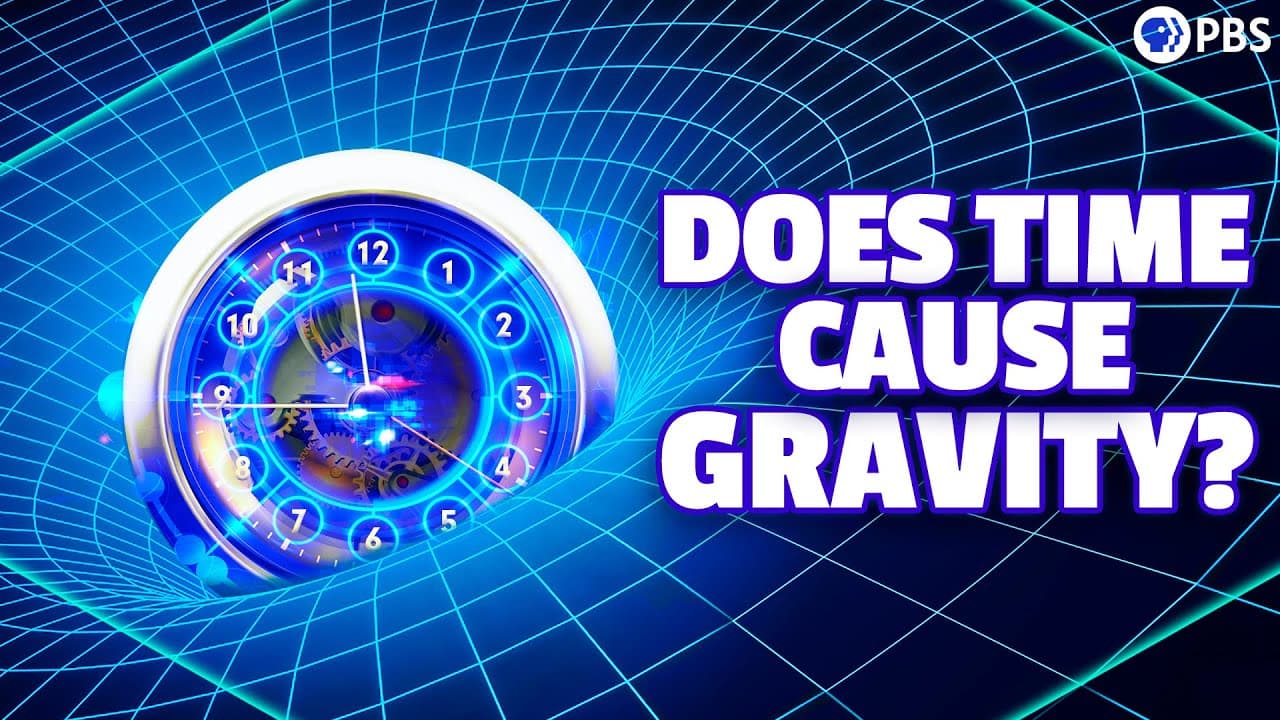
Does Time Cause Gravity?
TL;DR
Warping of time causes gravity, not the other way around.
Transcript
You are currently hurtling through time at the speed of light. But be careful. If even a tiny bit of your breakneck temporal velocity leaks into one of the dimensions of space. And you’re standing in the wrong place at the time, you will rapidly accelerate to your doom. You think I’m kidding? I just described the true source of gravity. Don’t look ... Read More
Key Insights
- The concept of gravity is redefined, suggesting that the warping of time is the cause of gravity, not its effect.
- Gravitational time dilation is a well-documented phenomenon, where clocks run slower in gravitational fields, affecting GPS satellite accuracy.
- Einstein's relativity theory plays a crucial role, with the equivalence principle stating that acceleration-induced weight is similar to gravity-induced weight.
- The 4-velocity concept illustrates how objects move through spacetime, combining velocities through time and space, affecting their motion in gravitational fields.
- A falling object loses velocity through time to gain velocity through space, explaining gravitational acceleration through a temporal-spatial trade-off.
- Light, despite having no velocity through time, is affected by gravitational fields, evident in phenomena like gravitational lensing.
- Quantum uncertainty suggests that particles never occupy a single position, experiencing time flow gradients without needing quantum mechanics to explain gravity.
- The video introduces complex ideas about time and gravity, leaving open questions about particle behavior and light's interaction with gravity.
Install to Summarize YouTube Videos and Get Transcripts
Explore YouTube Video Summarizer or Get YouTube Transcript Extractor
Questions & Answers
Q: How does the video redefine the concept of gravity?
The video redefines gravity by suggesting that it is not the warping of space by gravity that causes clocks to run slow, but rather the warping of time that causes gravity. This concept is rooted in Einstein's theory of relativity and challenges traditional views by proposing that time's flow affects spatial movement, leading to gravitational effects.
Q: What is the significance of 4-velocity in the context of gravity?
4-velocity is significant as it combines an object's velocity through time and space, illustrating how objects move through spacetime. In a gravitational field, the gradient of velocities causes an object's 4-velocity to rotate, leading to acceleration towards the mass causing the gravitational field. This concept helps explain gravitational acceleration as a trade-off between temporal and spatial velocities.
Q: How does gravitational time dilation affect GPS systems?
Gravitational time dilation affects GPS systems by causing clocks in satellites to tick faster than those on Earth, due to their position in a weaker gravitational field. This difference, although small, can lead to significant errors in position accuracy, up to 11 kilometers per day, if not corrected. This underscores the practical implications of gravitational time dilation in modern technology.
Q: Why is light affected by gravitational fields despite having no velocity through time?
Light is affected by gravitational fields due to gravitational lensing, a phenomenon where light's path is bent by gravity. Although photons have no velocity through time, their path through space is influenced by the curvature of spacetime caused by massive objects. This effect supports the idea that gravity affects light's trajectory, consistent with Einstein's theory of general relativity.
Q: What role does quantum mechanics play in the explanation of gravity?
Quantum mechanics introduces the concept of uncertainty, suggesting that particles never occupy a single, perfectly defined position in space. This means particles experience the gradient of time flow, contributing to gravitational effects. However, the video suggests that general relativity can explain gravity without needing quantum mechanics, as infinitesimally separated clocks can still account for time gradients.
Q: How does the video address the interaction between mass and energy in relation to gravity?
The video addresses the interaction between mass and energy by explaining how objects trade velocity through time for velocity through space in a gravitational field. This trade-off is analogous to converting mass into energy via Einstein's equation, E=mc^2, where the speed of light acts as the exchange rate. This concept highlights the interconnectedness of mass, energy, and gravity in relativistic physics.
Q: What are the implications of gravitational lensing in understanding gravity?
Gravitational lensing implies that light's path is curved by gravity, providing evidence that gravity affects even massless particles. This phenomenon supports the theory that gravity is a curvature of spacetime, affecting how light travels. The implications extend to astronomical observations, where gravitational lensing is used to study distant objects and test theories of gravity and relativity.
Q: What future topics does the video suggest exploring in relation to gravity?
The video suggests exploring the effects of gravity on light's path in more detail, requiring a shift in perspective to understand how time flow determines the path of timeless particles. It also hints at examining the gravitational wave background and its potential to test ideas in quantum gravity, offering new insights into the fundamental nature of gravity and spacetime.
Summary & Key Takeaways
-
The video discusses a paradigm shift in understanding gravity, proposing that the warping of time causes gravity rather than gravity affecting time. This perspective is explored through Einstein's relativity, where objects' movement through spacetime is influenced by their velocity through time and space.
-
Gravitational time dilation is explained as a logical outcome of relativity, affecting the accuracy of GPS systems. The video suggests that objects in gravitational fields experience a rotation in their 4-velocity, leading to acceleration towards the mass causing the gravitational field.
-
Light's interaction with gravity is addressed, highlighting gravitational lensing as evidence of its path being affected despite having no velocity through time. The content raises questions about quantum mechanics' role in gravity and discusses ongoing research in gravitational waves and their potential to test quantum gravity theories.
Read in Other Languages (beta)
Share This Summary 📚
Summarize YouTube Videos and Get Video Transcripts with 1-Click
Try YouTube Summary with ChatGPT & Claude or YouTube Transcript Generator
Explore More Summaries from PBS Space Time 📚
Summarize YouTube Videos and Get Video Transcripts with 1-Click
Try YouTube Summary with ChatGPT & Claude or YouTube Transcript Generator