How to Simplify Square Roots and Cube Roots
TL;DR
To simplify square roots and cube roots, break down the number into its prime factors, focusing on perfect squares for square roots and perfect cubes for cube roots. Remember to use absolute value for square roots with even indices and odd exponents. For exponents, divide by the index number to convert between radical and exponential notation.
Transcript
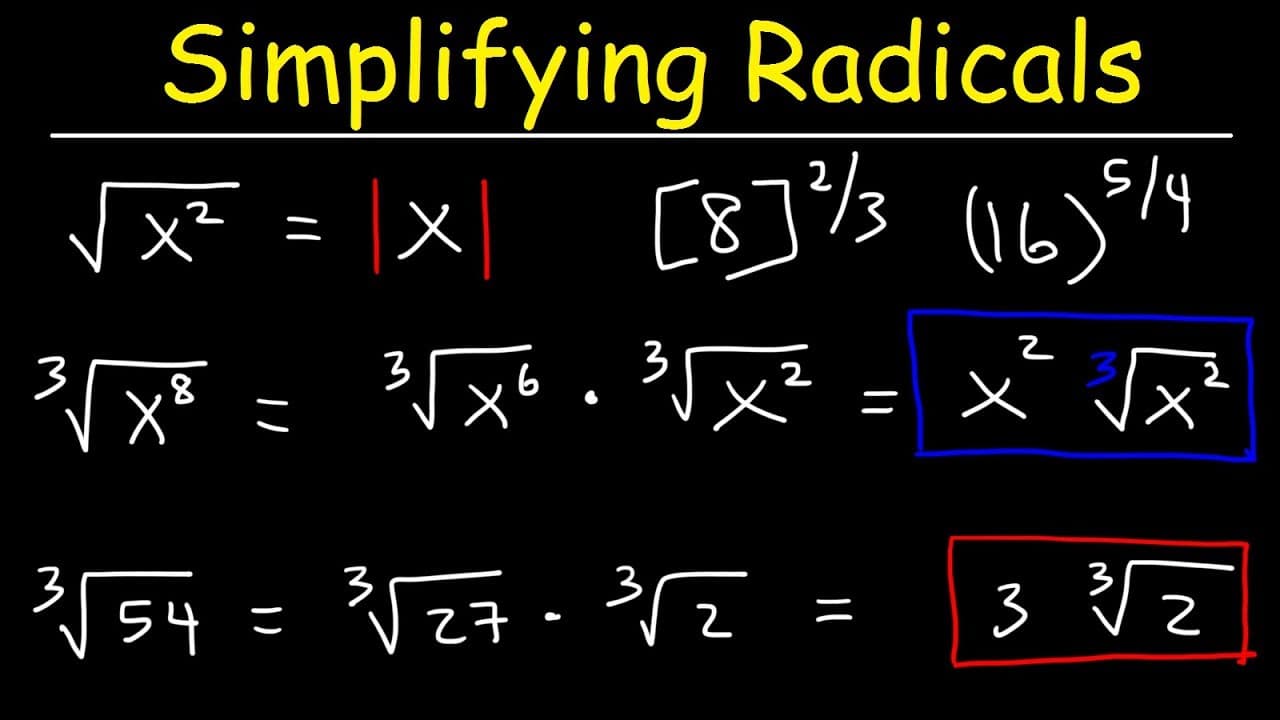
now what is the square root of x squared whenever you don't see a number here there is an invisible 2 and that's the index number this is going to be x 2 divided by the index number 2 which is basically x to the first power now turns out that the answer is really the absolute value of x anytime you take the square root or the root with an index num... Read More
Key Insights
- 🫰 Square roots with an even index number and odd exponent need absolute value notation.
- #️⃣ Cube roots can handle negative and positive numbers with odd index numbers.
- 💯 Perfect squares and perfect cubes are helpful in simplifying roots.
- 🗂️ Exponents can be simplified by dividing by the index number and adjusting the notation.
- 🧑🏭 Breaking down numbers into factors helps in simplifying roots.
- ❓ Understanding the relationship between exponential and radical notation is useful in conversions.
- 🗂️ Dividing exponents and multiplying them require different mathematical operations.
Install to Summarize YouTube Videos and Get Transcripts
Explore YouTube Video Summarizer or Get YouTube Transcript Extractor
Questions & Answers
Q: When do I need to use absolute value notation in simplifying square roots?
Absolute value notation is required when dealing with square roots with an even index number and an odd exponent. This ensures that the result is positive.
Q: Can negative numbers be used inside a root with an odd index number?
Yes, negative and positive numbers can work inside a root with an odd index number without needing absolute value notation.
Q: How can I simplify square roots if the number is not a perfect square?
You can break down the number into factors, with one being a perfect square. Simplify the perfect square separately and leave the remaining factor inside the square root.
Q: How can I simplify cube roots?
Look for a perfect cube that divides into the given number and divide accordingly. Then, simplify the perfect cube and leave any remaining factor inside the cube root.
Summary & Key Takeaways
-
Square roots with an even index number and odd exponent require using the absolute value of the result, while square roots with an even index number and even exponent do not.
-
Cube roots follow similar rules, but negative and positive numbers can work inside a root with an odd index number.
-
Simplifying square roots involves breaking down numbers into perfect squares, and simplifying cube roots involves finding perfect cubes.
-
Exponents can be simplified by dividing the exponent by the index number and adjusting the notation accordingly.
Read in Other Languages (beta)
Share This Summary 📚
Summarize YouTube Videos and Get Video Transcripts with 1-Click
Try YouTube Summary with ChatGPT & Claude or YouTube Transcript Generator
Explore More Summaries from The Organic Chemistry Tutor 📚

Summarize YouTube Videos and Get Video Transcripts with 1-Click
Try YouTube Summary with ChatGPT & Claude or YouTube Transcript Generator