How to Calculate Mechanical Advantage in Pulley Systems
TL;DR
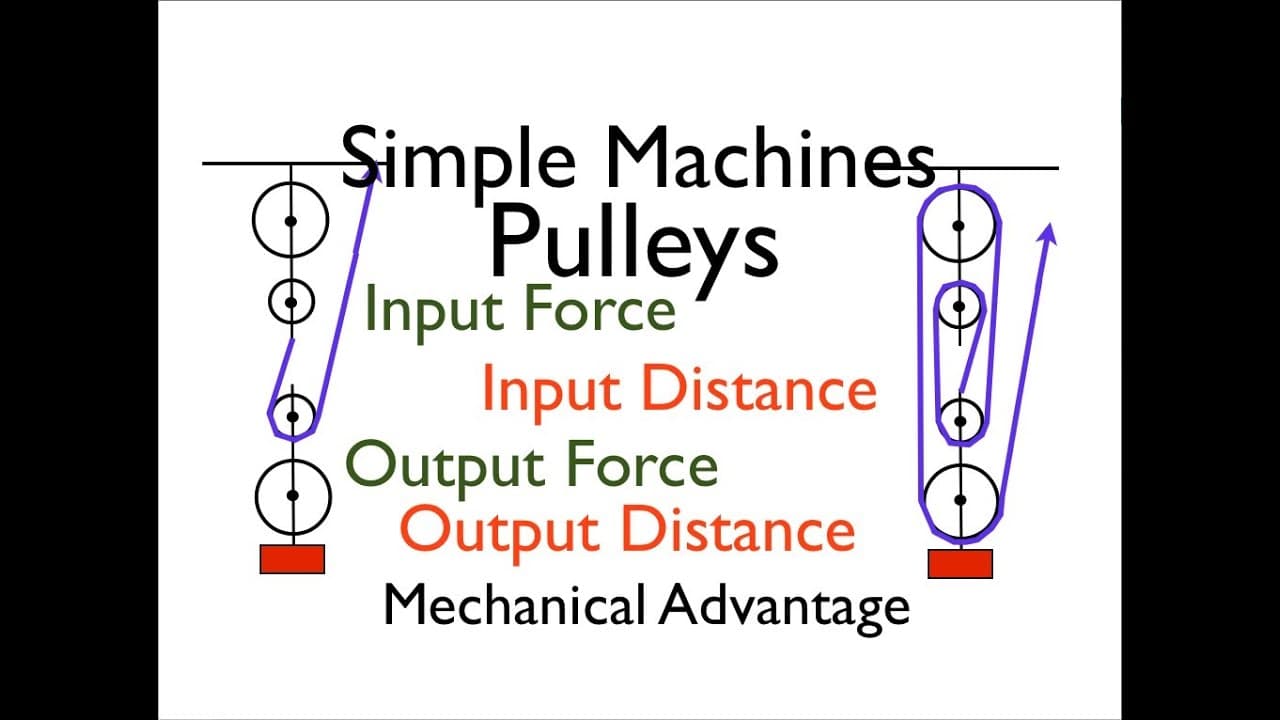
To calculate mechanical advantage in pulley systems, count the number of supporting strings. The input force is determined by dividing the output force by the mechanical advantage, while the input distance is found by multiplying the output distance by the mechanical advantage. This understanding is essential for effectively using pulleys to lift objects.
Transcript
okay in today's video I am going to go over some very simple problems using simple machines that's pulleys obviously I want to talk about input force input distance output force up with distance and mechanical advantage that we have for problems we're going to work on for each problem we have the police we have the output force this is the object w... Read More
Key Insights
- 🦾 Mechanical advantage in pulley systems is determined by counting the supporting strings.
- 🦾 Input force is calculated by dividing the output force by the mechanical advantage.
- 🦾 Input distance is obtained by multiplying the output distance by the mechanical advantage.
- 🦾 Understanding the relationship between input/output forces and distances is crucial in grasping pulley mechanics.
- 🥳 The pattern in input/output forces and distances showcases the impact of mechanical advantage on force and distance ratios.
- 🔠 Pulleys help in reducing the required input force while increasing the input distance for lifting objects.
- 🦾 The number of supporting strings in a pulley system determines the mechanical advantage.
Install to Summarize YouTube Videos and Get Transcripts
Explore YouTube Video Summarizer or Get YouTube Transcript Extractor
Questions & Answers
Q: How do you calculate the mechanical advantage of a pulley system?
To calculate mechanical advantage, simply count the number of strings supporting the weight in the system. The mechanical advantage is equal to the number of strings.
Q: How is input force determined in a pulley system?
Input force is calculated by dividing the output force (weight of the object) by the mechanical advantage, which distributes the force across the supporting strings.
Q: What is the significance of input distance in pulley systems?
Input distance is derived by multiplying the output distance by the mechanical advantage, showcasing how the input distance increases when the mechanical advantage is greater than one.
Q: How does the pattern of input/output forces and distances demonstrate the concept of mechanical advantage?
The pattern shows that when the mechanical advantage is greater than one, the input force decreases while the input distance increases in comparison to the output force and distance.
Summary & Key Takeaways
-
The video discusses how to calculate mechanical advantage in pulley systems by counting the number of strings.
-
Input force is output force divided by mechanical advantage, while input distance is output distance multiplied by mechanical advantage.
-
Understanding the relationship between input/output forces and distances helps grasp the concept of pulleys.
Read in Other Languages (beta)
Share This Summary 📚
Summarize YouTube Videos and Get Video Transcripts with 1-Click
Try YouTube Summary with ChatGPT & Claude or YouTube Transcript Generator
Explore More Summaries from Step by Step Science 📚





Summarize YouTube Videos and Get Video Transcripts with 1-Click
Try YouTube Summary with ChatGPT & Claude or YouTube Transcript Generator