M2H Foundation Yield and Limiting Reagent Concept
TL;DR
Yield is a crucial metric in chemistry, determining the efficiency of a chemical reaction and the amount of desired product obtained.
Transcript
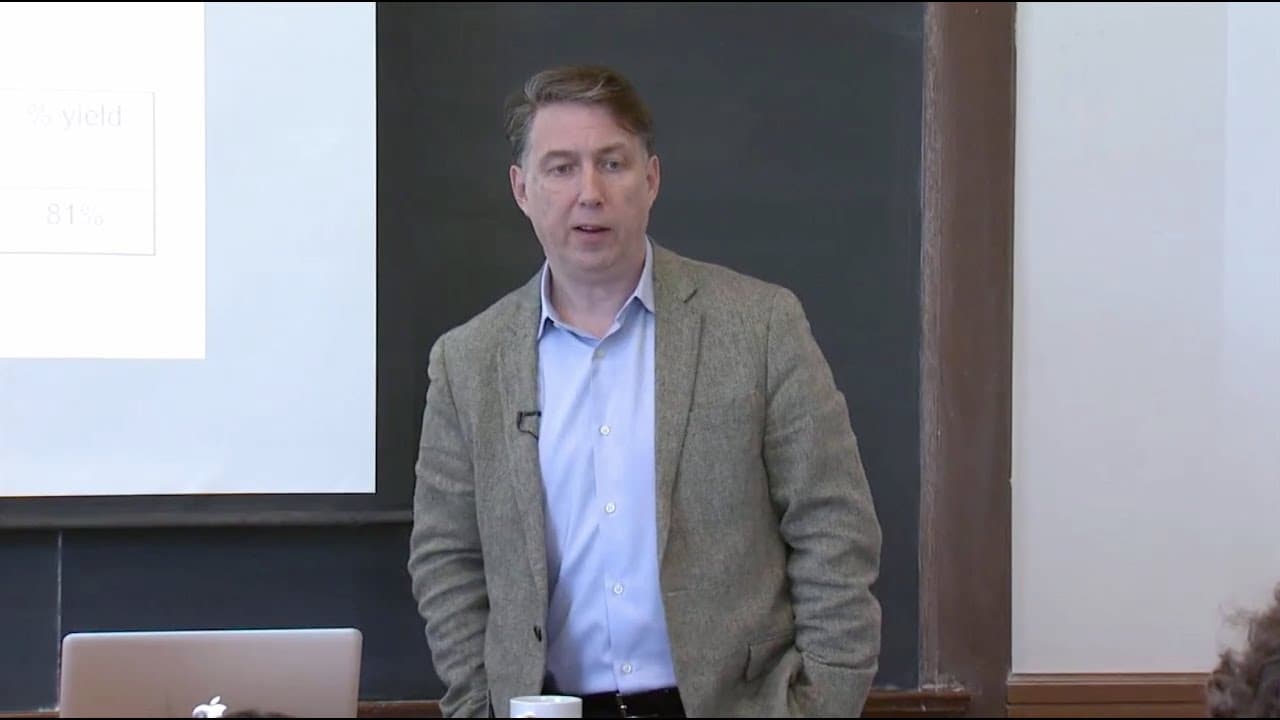
you have a certain maximum amount of stuff theoretically that you can get and then you look at the actual amount of stuff that you actually got and you compare your actual amount of stuff that you got compared to the theoretical amount and that is how you judge whether or not you are a worthy chemist let's take an example you'll have butanol you wa... Read More
Key Insights
- 📈 Yield is a crucial metric in chemistry, determining the success and efficiency of a chemical reaction.
- 🖐️ The limiting reagent plays a significant role in determining the yield of a reaction.
- 😘 A higher yield indicates a more efficient synthesis, while a lower yield may require additional purification steps.
- 🧑🏭 Yield is still widely used as the gold standard measurement in chemistry, despite its limitations in considering other factors such as waste generation and energy consumption.
- ❓ Complex syntheses often require multiple steps, with each step contributing to the overall yield.
- ✋ Higher yields may require more steps, resulting in a trade-off between efficiency and complexity.
- 🧑🏭 Yield is influenced by factors such as reactant amounts, molecular weights, and the presence of impurities.
Install to Summarize YouTube Videos and Get Transcripts
Explore YouTube Video Summarizer or Get YouTube Transcript Extractor
Questions & Answers
Q: What is yield in chemistry?
Yield refers to the amount of desired product obtained in a chemical reaction, compared to the theoretical amount that should be obtained.
Q: How is the limiting reagent determined?
The limiting reagent is determined by analyzing the amounts and molecular weights of the reactants. It is the reagent that will be completely consumed first in the reaction.
Q: Why is yield an important measure?
Yield is important as it indicates the efficiency of a synthesis, the amount of waste generated, and the purification steps required. It is used to judge the success of a chemist's work.
Q: How is yield calculated?
Yield is calculated by dividing the actual amount of product obtained by the theoretical amount and multiplying by 100. This gives the percentage yield of the reaction.
Summary & Key Takeaways
-
Yield is calculated by comparing the theoretical amount of product that should be obtained in a chemical reaction to the actual amount obtained.
-
The limiting reagent in a reaction is the one that will be completely consumed first, determining the yield of the reaction.
-
Yield is an important measure as it indicates the efficiency of a synthesis, the amount of waste generated, and the purification steps required.
Read in Other Languages (beta)
Share This Summary 📚
Summarize YouTube Videos and Get Video Transcripts with 1-Click
Try YouTube Summary with ChatGPT & Claude or YouTube Transcript Generator
Explore More Summaries from YaleCourses 📚



Summarize YouTube Videos and Get Video Transcripts with 1-Click
Try YouTube Summary with ChatGPT & Claude or YouTube Transcript Generator