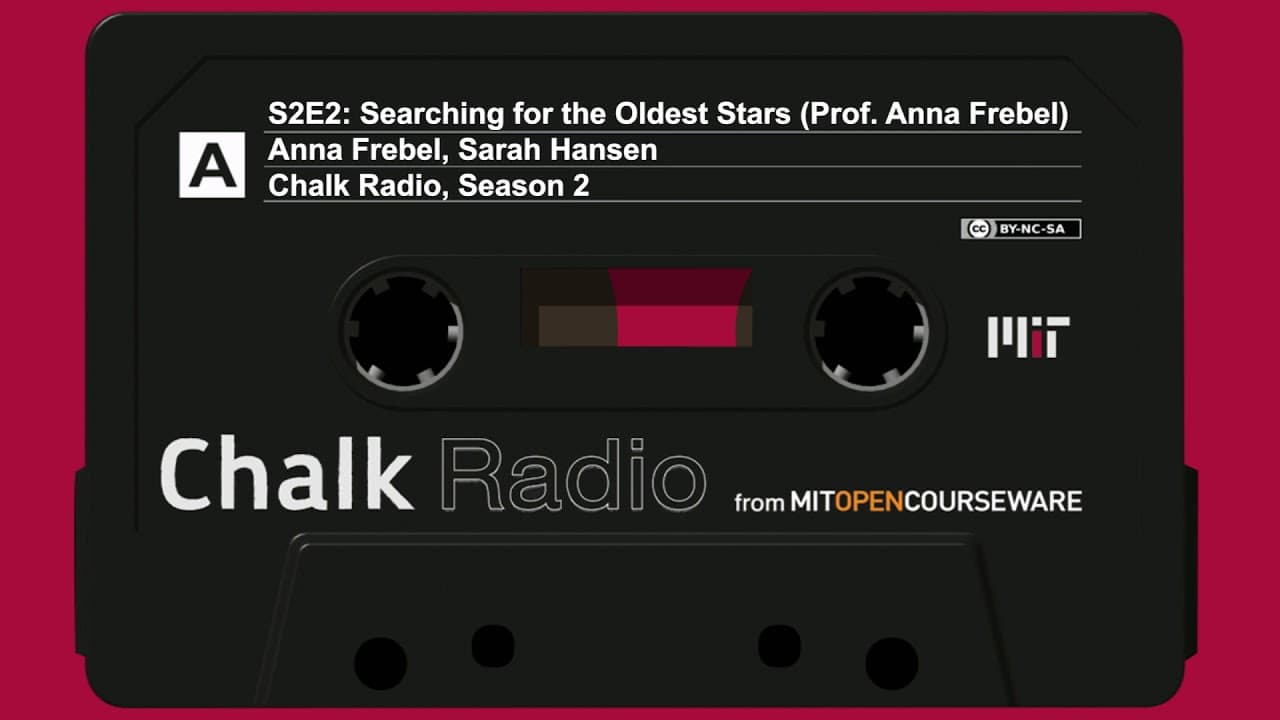
Searching for the Oldest Stars with Prof. Anna Frebel (S2:E2)
TL;DR
Astrophysicist Anna Frebel discusses the practice of stellar archaeology, which involves studying the oldest stars in the universe to understand the origins of elements.
Transcript
[MUSIC PLAYING] ANNA FREBEL: It's a very fundamental question for humanity to ask, where do we come from? And we are, in some sense, A) trying to study that, and B) trying to educate everyone about that. SARAH HANSEN: Today on Chalk Radio, we're talking star stuff. In this episode, we're going to be exploring stellar archaeology and the origins of,... Read More
Key Insights
- 🤩 Stellar archaeology involves studying the composition of the oldest stars to understand element formation in the early universe.
- 🤩 Observing ancient stars requires using advanced telescopes in locations like Chile or Hawaii.
- 🤩 The study of ancient stars provides insights into the state of the universe and the processes that created elements.
- 💍 Astrophysicists like Anna Frebel strive to make complex scientific concepts accessible to a wide audience through clear communication and engaging storytelling.
- 🌍 Scientific literacy and curiosity contribute to a sense of wonder and appreciation for the world around us.
- 💁 The future of stellar archaeology involves further exploration of the Milky Way and using simulations to better understand its formation.
- 😀 The process of scientific discovery involves perseverance and overcoming challenges, even in the face of success.
Install to Summarize YouTube Videos and Get Transcripts
Explore YouTube Video Summarizer or Get YouTube Transcript Extractor
Questions & Answers
Q: How do astronomers use the composition of old stars to understand element formation?
By analyzing the chemical makeup of ancient stars, scientists can identify the elements present and infer the processes that produced them. This helps them understand how elements formed in the early universe.
Q: Why do scientists study the oldest stars rather than more recent ones like the sun?
The oldest stars provide valuable information about the early universe as they formed soon after the Big Bang. While the sun reflects the state of the universe about 4.6 billion years ago, studying older stars offers a glimpse into the universe's early stages.
Q: What is the process of conducting stellar archaeology like?
Conducting stellar archaeology involves traveling to locations like Chile or Hawaii to use powerful telescopes. Astronomers work with telescope operators to observe ancient stars and operate instruments like spectrographs to analyze their composition.
Q: How does the location of observation affect the view of the universe?
The Northern and Southern hemispheres offer different perspectives on the night sky due to our orientation in the galaxy. The Southern hemisphere provides a brighter view of the Milky Way due to its orientation inside the galaxy, while the Northern hemisphere looks outside the galaxy.
Summary & Key Takeaways
-
Astrophysicist Anna Frebel explains that studying the oldest stars allows scientists to understand how element formation occurred in the early universe.
-
Stellar archaeology involves using telescopes in locations like Chile to observe and analyze the composition of ancient stars.
-
By studying the composition of these stars, researchers can gain insights into the state of the universe at the time of their formation and learn more about the origins of elements.
Read in Other Languages (beta)
Share This Summary 📚
Summarize YouTube Videos and Get Video Transcripts with 1-Click
Try YouTube Summary with ChatGPT & Claude or YouTube Transcript Generator
Explore More Summaries from MIT OpenCourseWare 📚

Summarize YouTube Videos and Get Video Transcripts with 1-Click
Try YouTube Summary with ChatGPT & Claude or YouTube Transcript Generator