26.2 Kinetic Energy in Collisions
TL;DR
In this video, we learn about different types of collisions and the conservation principles of momentum and kinetic energy.
Transcript
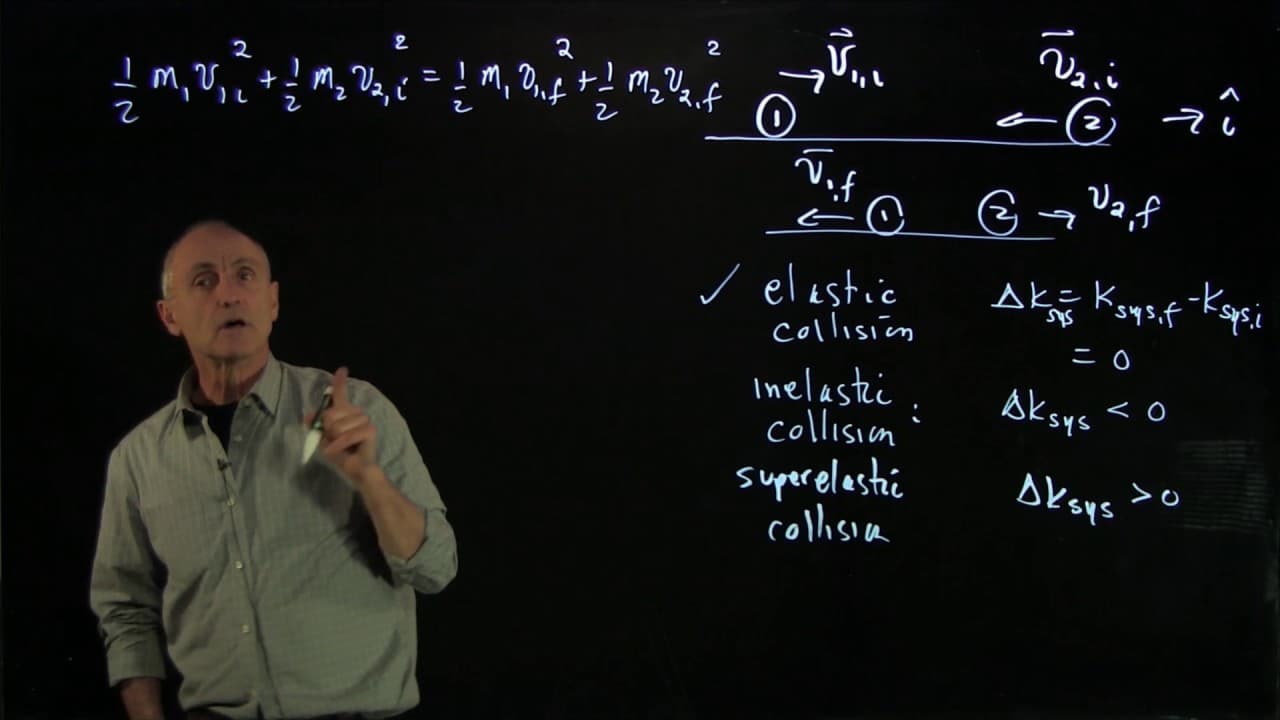
So we analyzed our one-dimensional collision where we had an object 1 moving with some initial velocity, object 2 also moving with some initial velocity. And after the collision, we just arbitrarily said object 1 is moving this way and object 2 was moving that way. And we called that our i hat direction. In this collision, we assume that it was a f... Read More
Key Insights
- 💥 One-dimensional collisions involve objects moving with different initial velocities and collide on a frictionless surface with no external forces.
- 💥 Different types of collisions have different effects on the kinetic energy of the system: elastic collisions keep it constant, inelastic collisions decrease it, and super elastic collisions increase it.
- 💥 The conservation principles of momentum and kinetic energy are crucial in understanding the behavior of one-dimensional collisions.
- ❓ By writing equations involving the masses and initial and final velocities, we can solve for the final velocities of the objects involved.
Install to Summarize YouTube Videos and Get Transcripts
Explore YouTube Video Summarizer or Get YouTube Transcript Extractor
Questions & Answers
Q: What are the main assumptions made in the analysis of one-dimensional collisions?
The main assumptions are a frictionless surface and no external forces acting on the system, leading to the conservation of momentum and the possibility of conservation or change in kinetic energy.
Q: What is the difference between elastic and inelastic collisions?
In an elastic collision, the kinetic energy of the system remains constant before and after the collision. In an inelastic collision, the kinetic energy decreases due to deformation of the objects involved.
Q: What is a super elastic collision?
A super elastic collision refers to a collision where the kinetic energy of the system increases. This can occur if there is an external energy source, such as an explosion, that adds extra kinetic energy to the system.
Q: How can we calculate the final velocities of the objects in a one-dimensional collision?
By using the conservation principles of momentum and kinetic energy, we can write equations involving the masses and initial and final velocities of the objects. Solving these equations algebraically will give us the final velocities.
Summary & Key Takeaways
-
The video discusses one-dimensional collisions, where two objects collide with different initial velocities, assuming a frictionless surface and no external forces.
-
Different types of collisions are introduced: elastic collisions with constant kinetic energy, inelastic collisions with decreased kinetic energy due to deformation, and super elastic collisions with increased kinetic energy caused by an external energy source.
-
The conservation principles of momentum and kinetic energy are explained, and equations are provided to solve for the final velocities of the objects.
Read in Other Languages (beta)
Share This Summary 📚
Summarize YouTube Videos and Get Video Transcripts with 1-Click
Try YouTube Summary with ChatGPT & Claude or YouTube Transcript Generator
Explore More Summaries from MIT OpenCourseWare 📚


Summarize YouTube Videos and Get Video Transcripts with 1-Click
Try YouTube Summary with ChatGPT & Claude or YouTube Transcript Generator