Mass Spectrometer: An Example Problem
TL;DR
Learn how a mass spectrometer works to determine atomic masses of isotopes.
Transcript
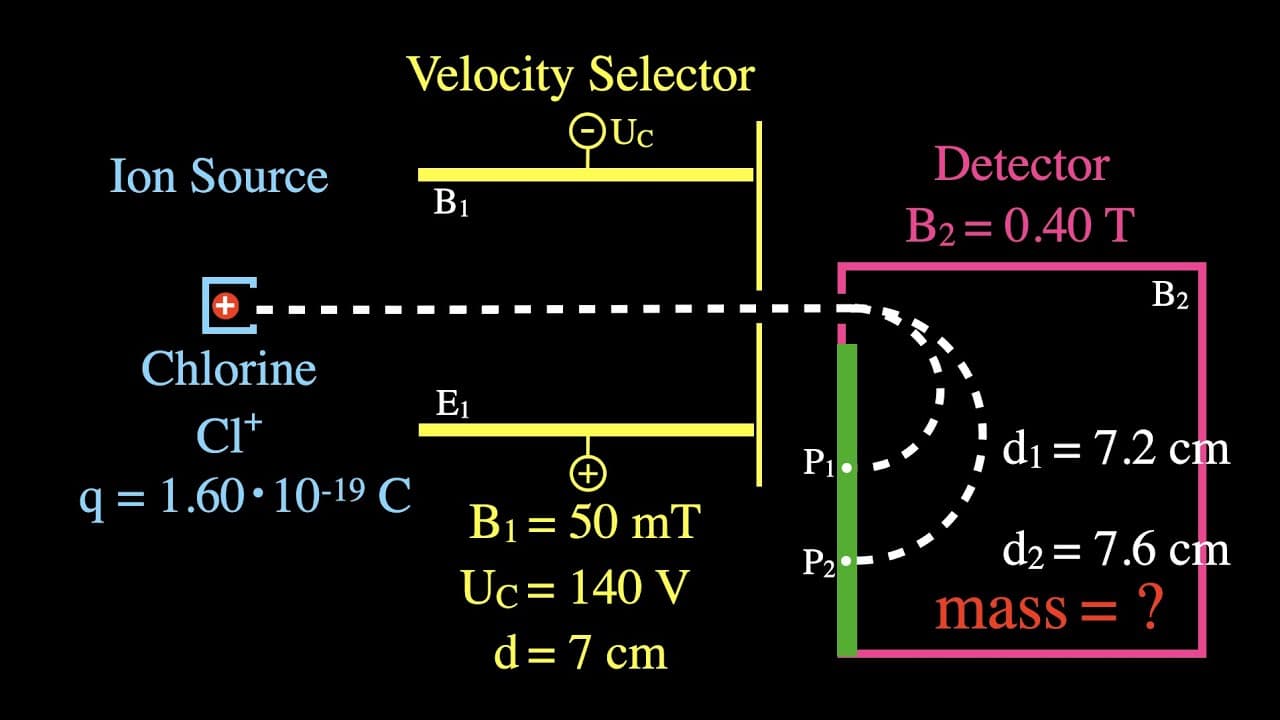
in today's video i am going to go over an example about how a mass spectrometer works and how we can use the mass spectrometer to determine the atomic masses for different isotopes of elements before we get started please don't forget to subscribe to my channel step by step science get all my excellent physics chemistry and math videos when i look ... Read More
Key Insights
- 💆 Mass spectrometry involves ionization, acceleration, velocity selection, and mass detection steps.
- 😑 The velocity selector ensures only ions with the correct velocity pass through.
- 😑 Mass is calculated by considering the charge, magnetic field strength, velocity, and radius of ions.
- 💆 The mass number is determined by dividing the total mass by the mass of protons and neutrons.
- ❓ Mass spectrometry is essential in analyzing isotopes for various scientific and practical purposes.
- 💆 Different isotopes of an element can be identified based on their distinct mass numbers.
- 🖐️ Mass spectrometry plays a crucial role in chemistry, physics, forensics, and other scientific fields.
Install to Summarize YouTube Videos and Get Transcripts
Explore YouTube Video Summarizer or Get YouTube Transcript Extractor
Questions & Answers
Q: How does a mass spectrometer separate isotopes?
A mass spectrometer separates isotopes based on their mass-to-charge ratio, detecting ions with different masses at different positions.
Q: What role does the velocity selector play in a mass spectrometer?
The velocity selector ensures ions with the correct velocity pass through by balancing magnetic and electric fields' forces.
Q: How are mass and mass number calculated in a mass spectrometer?
Mass is calculated using the charge, magnetic field strength, velocity, and radius of the ions. Mass number is determined by dividing the total mass by the mass of protons and neutrons.
Q: Why is it essential to analyze isotopes in mass spectrometry?
Analyzing isotopes helps identify different forms of an element based on their unique mass numbers, aiding in various applications such as forensic analysis and medical diagnostics.
Summary & Key Takeaways
-
The video explains how a mass spectrometer works using an example with chlorine ions.
-
It covers the process of ionization, acceleration, velocity selection, and mass detection.
-
It demonstrates how to calculate velocity, mass, and ultimately determine the isotopes of an element.
Read in Other Languages (beta)
Share This Summary 📚
Summarize YouTube Videos and Get Video Transcripts with 1-Click
Try YouTube Summary with ChatGPT & Claude or YouTube Transcript Generator
Explore More Summaries from Step by Step Science 📚

Summarize YouTube Videos and Get Video Transcripts with 1-Click
Try YouTube Summary with ChatGPT & Claude or YouTube Transcript Generator