How to Solve Ideal Gas Law Problems Step-by-Step

TL;DR
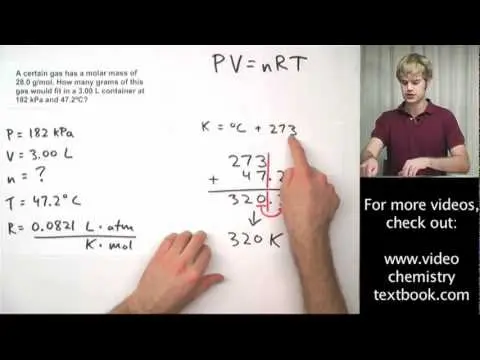
To solve ideal gas law problems, use the formula PV = nRT, rearranging as needed for the variable you want to find, such as volume or temperature. Ensure all units are consistent, convert temperatures to Kelvin, and consider significant figures in your final answers. For example, to find volume, calculate V = nRT/P using the correct values and units.
Transcript
all right let's do some practice problems with the ideal gas law PV equals NRT here's our first one two point three moles of helium gas are at a pressure of one point seven atm and the temperature is 41 degrees Celsius what is the volume of the gas the first thing that let's do is get our variables straight now here I'm going to be using R which is... Read More
Key Insights
- 🫢 The ideal gas law equation, PV = nRT, can be used to solve various gas law problems.
- 🇦🇪 Units in the equation must be consistent for accurate calculations.
- 👻 Rearranging the equation allows for solving for different variables, such as volume or temperature.
- 🫢 The gas constant, R, can be on the top or bottom of the equation, depending on the rearrangement needed.
- 🛝 Significant figures should be considered when rounding the final answer.
- 🇦🇪 Temperature conversions between Kelvin and Celsius are necessary to match the given units.
Install to Summarize YouTube Videos and Get Transcripts
Explore YouTube Video Summarizer or Get YouTube Transcript Extractor
Questions & Answers
Q: What is the ideal gas law equation?
The ideal gas law equation is PV = nRT, where P represents pressure, V represents volume, n represents the amount of gas in moles, R is the universal gas constant, and T is the temperature in Kelvin.
Q: How are units converted in gas law calculations?
Units must be consistent throughout the equation. If different units are used, they should be converted to match the units of the gas constant, R. For example, if pressure is given in kPa but R is in atm, the pressure should be converted to atm before plugging into the equation.
Q: How is the equation rearranged to solve for volume?
To solve for volume, the equation is rearranged as V = (nRT) / P. This allows for the computation of volume when pressure, amount of gas, temperature, and the gas constant are known.
Q: How is the gas constant, R, handled in the equation?
The gas constant, R, has units of liters * atm / (mol * K). When R is on the top of the fraction, it is plugged directly into the calculation. When R is on the bottom, it is flipped upside down and its reciprocal is used in the calculation.
Summary & Key Takeaways
-
The video provides step-by-step guidance on solving gas law problems using the ideal gas law equation PV = nRT.
-
The equation is rearranged to solve for the desired variable, such as volume or temperature.
-
The video demonstrates how to properly convert units to ensure consistency in calculations.
Read in Other Languages (beta)
Share This Summary 📚
Summarize YouTube Videos and Get Video Transcripts with 1-Click
Try YouTube Summary with ChatGPT & Claude or YouTube Transcript Generator
Explore More Summaries from Tyler DeWitt 📚
Summarize YouTube Videos and Get Video Transcripts with 1-Click
Try YouTube Summary with ChatGPT & Claude or YouTube Transcript Generator