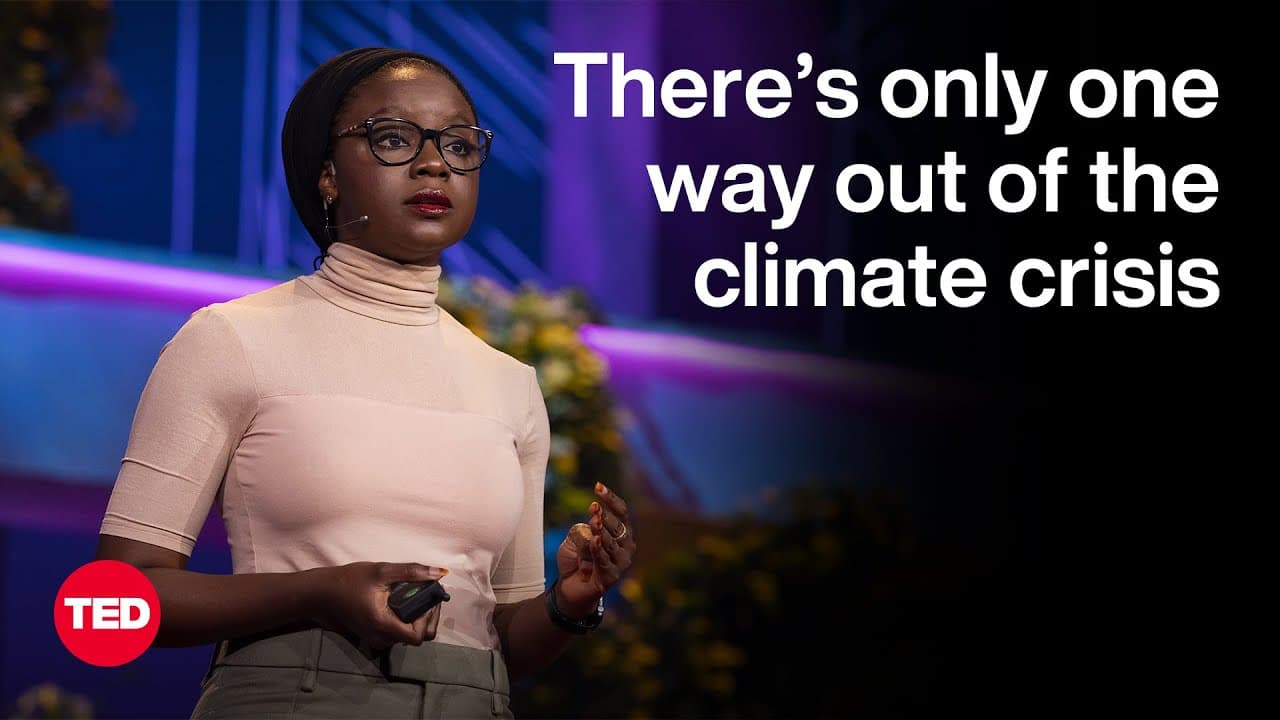
How Sci-Fi Informs Our Climate Future — and What to Do Next | Zainab Usman | TED
TL;DR
Geoeconomic blocs may hinder collective action on climate change, as competing countries prioritize their own interests over global cooperation.
Transcript
We don't have to look far to see how humanity's fight against climate change might play out. Science fiction authors from around the world, writing from different traditions, coalesce on one point. A divided world, unable to fight the common threat. In Cixin Liu's "The Three-Body Problem" trilogy, the threat of aliens from a dying planet invading t... Read More
Key Insights
- 🌍 Science fiction has often explored the consequences of a divided world failing to unite against existential threats.
- 🌐 Geoeconomic fragmentation may impede collective action on climate change, as countries prioritize their own interests over global cooperation.
- 😘 Limited innovation in low-carbon technologies and barriers to equitable deployment hinder effective climate change mitigation efforts.
Install to Summarize YouTube Videos and Get Transcripts
Explore YouTube Video Summarizer or Get YouTube Transcript Extractor
Questions & Answers
Q: Why does geoeconomic fragmentation pose a challenge for fighting climate change?
Geoeconomic blocs prioritize their own interests and hinder global cooperation, making it difficult to pool resources and expertise needed to tackle climate change collectively.
Q: What are the consequences of limited innovation in low-carbon technologies?
If innovation is concentrated in a few countries, poorer nations may struggle to access and benefit from these technologies, widening the global gap in emissions reduction and adaptation.
Q: How does commercialization of climate mitigation technologies benefit consumers?
Mass production and competition among firms result in lower prices, higher quality products, and the creation of green jobs, ultimately improving living standards for all, including in poorer countries.
Q: Why are global standards necessary in sourcing strategic materials for clean energy?
Without global standards, the race to access scarce minerals may lead to environmental destruction, exploitation of fragile ecosystems, and potential conflicts among geoeconomic blocs.
Summary & Key Takeaways
-
Science fiction authors have predicted how a divided world, driven by fear and competition for resources, fails to come together to fight common threats.
-
The International Monetary Fund warns of geoeconomic fragmentation, with the United States, China, the European Union, and other blocs hindering global efforts to combat climate change.
-
Three key problems are identified: limited innovation in low-carbon technologies, barriers to equitable deployment of clean energy solutions, and the race to access strategic minerals.
Read in Other Languages (beta)
Share This Summary 📚
Summarize YouTube Videos and Get Video Transcripts with 1-Click
Try YouTube Summary with ChatGPT & Claude or YouTube Transcript Generator
Explore More Summaries from TED 📚


Summarize YouTube Videos and Get Video Transcripts with 1-Click
Try YouTube Summary with ChatGPT & Claude or YouTube Transcript Generator