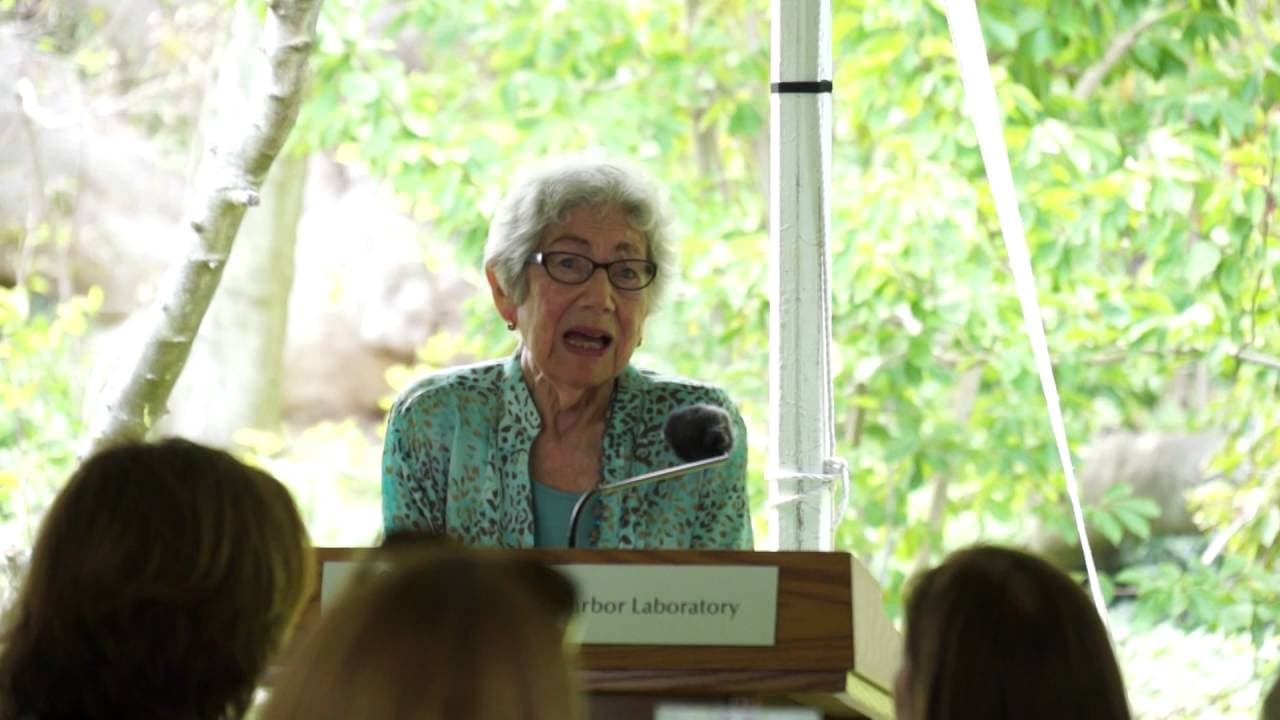
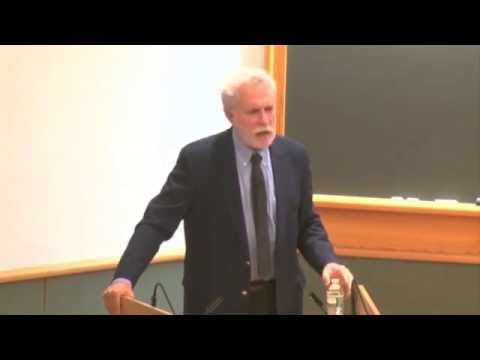
Evelyn Witkin speaks at CSHL, Summer 2016
TL;DR
Evelyn Witkin recounts her path to Cold Spring Harbor and her early activism.
Transcript
I have to say how thrilling it is for me to be here today Co spring haror is one of my favorite places in the world and just having this day here is uh beyond my my dreams for right now anyway I'm going to tell you a story about how I came to be at cspring Harbor in the summer of 1943 it's a rather strange story and it starts all the way back in th... Read More
Key Insights
- Evelyn Witkin's journey to Cold Spring Harbor began with her activism against racial discrimination at NYU, leading to her suspension and a change in her academic path.
- The protest against racial discrimination at NYU involved a campaign against the exclusion of black athletes from games in the South due to 'gentleman's agreements.'
- Witkin's suspension from NYU led her to Columbia University, where she pursued graduate studies in genetics, a field that fascinated her due to its mysteries about gene replication and mutation.
- Her interest in bacterial genetics was sparked by a groundbreaking paper by Salvador Luria and Max Delbrück, which demonstrated that bacteria have genes like other organisms.
- Witkin's first experience at Cold Spring Harbor was transformative, as she was immersed in a vibrant research environment that felt like a 'cathedral' of science.
- During her time at Cold Spring Harbor, Witkin discovered a radiation-resistant mutant of E. coli, a significant finding given the context of the atomic bomb's development.
- Witkin's career at Cold Spring Harbor spanned 11 years, during which she witnessed and contributed to the birth of molecular biology.
- In 2001, NYU acknowledged the wrongness of its past actions by honoring Witkin and her fellow activists, marking a significant moment of recognition for their early civil rights efforts.
Install to Summarize YouTube Videos and Get Transcripts
Explore YouTube Video Summarizer or Get YouTube Transcript Extractor
Questions & Answers
Q: What prompted Evelyn Witkin's suspension from NYU?
Evelyn Witkin was suspended from NYU due to her involvement in a protest against racial discrimination. She and other students opposed NYU's 'gentleman's agreement' with Southern colleges, which barred black athletes from participating in games held in the South. This activism, considered premature civil rights activism at the time, led to her suspension, altering her academic path.
Q: How did Evelyn Witkin's interest in genetics develop?
Evelyn Witkin's interest in genetics developed during her time at Columbia University, where she was fascinated by the mysteries surrounding gene replication and mutation. She was particularly intrigued by how genes control hereditary traits and the process by which they copy themselves exactly during cell division. This curiosity drove her to explore bacterial genetics, a field that was just beginning to emerge.
Q: What was the significance of the paper by Salvador Luria and Max Delbrück?
The paper by Salvador Luria and Max Delbrück was significant because it demonstrated that bacteria have genes like other organisms, challenging the prevailing belief that bacterial changes were solely environmentally dictated. This groundbreaking finding opened up new avenues in genetics research and inspired Evelyn Witkin to pursue bacterial genetics, ultimately leading her to Cold Spring Harbor.
Q: What was Evelyn Witkin's first experience at Cold Spring Harbor like?
Evelyn Witkin's first experience at Cold Spring Harbor was profoundly impactful. She described feeling starstruck and overwhelmed by the vibrant research environment, likening it to walking into a 'cathedral' of science. This setting allowed her to immerse herself in cutting-edge research, contributing to her professional growth and leading to her discovery of a radiation-resistant mutant of E. coli.
Q: What was Evelyn Witkin's discovery at Cold Spring Harbor?
At Cold Spring Harbor, Evelyn Witkin discovered a radiation-resistant mutant of E. coli, capable of withstanding significantly higher doses of ultraviolet light and x-rays compared to the parent strain. This discovery was particularly relevant during the era of atomic bomb development, as it provided insights into genetic mutations affecting radiation resistance, contributing to the broader field of molecular biology.
Q: How did Evelyn Witkin's career progress after her discovery?
Following her discovery of the radiation-resistant mutant, Evelyn Witkin's career at Cold Spring Harbor flourished. She completed her PhD in 1947, with her research on the mutant forming the basis of her thesis. She remained at Cold Spring Harbor for 11 years, eventually becoming a member of the scientific staff and contributing to the burgeoning field of molecular biology.
Q: What recognition did Evelyn Witkin receive from NYU in 2001?
In 2001, NYU recognized Evelyn Witkin and her fellow activists by inviting them as guests of honor at a banquet, effectively apologizing for their suspension in 1941. This event marked a significant acknowledgment of their early civil rights efforts, with NYU admitting that the students had been right in their protest against racial discrimination and the university had been wrong.
Q: How did Evelyn Witkin's early activism impact her later life and career?
Evelyn Witkin's early activism had a profound impact on her life and career. Her suspension from NYU redirected her path to Columbia University, where she discovered her passion for genetics. This led to her transformative experience at Cold Spring Harbor, where she made significant scientific contributions. Her activism also set a precedent for her lifelong commitment to social justice and scientific integrity.
Summary & Key Takeaways
-
Evelyn Witkin's path to Cold Spring Harbor was shaped by her early activism against racial discrimination at NYU, which led to her suspension and a pivotal change in her academic journey. Her passion for genetics was ignited at Columbia University, where she delved into the mysteries of gene replication and mutation.
-
Witkin's interest in bacterial genetics was catalyzed by a paper proving that bacteria possess genes, leading her to Cold Spring Harbor. Here, she discovered a radiation-resistant mutant of E. coli, a significant breakthrough during the era of atomic bomb development, marking her contribution to the nascent field of molecular biology.
-
Her time at Cold Spring Harbor was a period of profound professional growth, allowing her to engage with leading scientists and witness groundbreaking discoveries. In 2001, NYU acknowledged her early activism efforts, symbolizing a long-overdue recognition of her contributions to civil rights and science.
Read in Other Languages (beta)
Share This Summary 📚
Summarize YouTube Videos and Get Video Transcripts with 1-Click
Try YouTube Summary with ChatGPT & Claude or YouTube Transcript Generator
Explore More Summaries from Cold Spring Harbor Laboratory 📚
Summarize YouTube Videos and Get Video Transcripts with 1-Click
Try YouTube Summary with ChatGPT & Claude or YouTube Transcript Generator