Lecture 7.2 - Eigenvector Perturbation Lemma
TL;DR
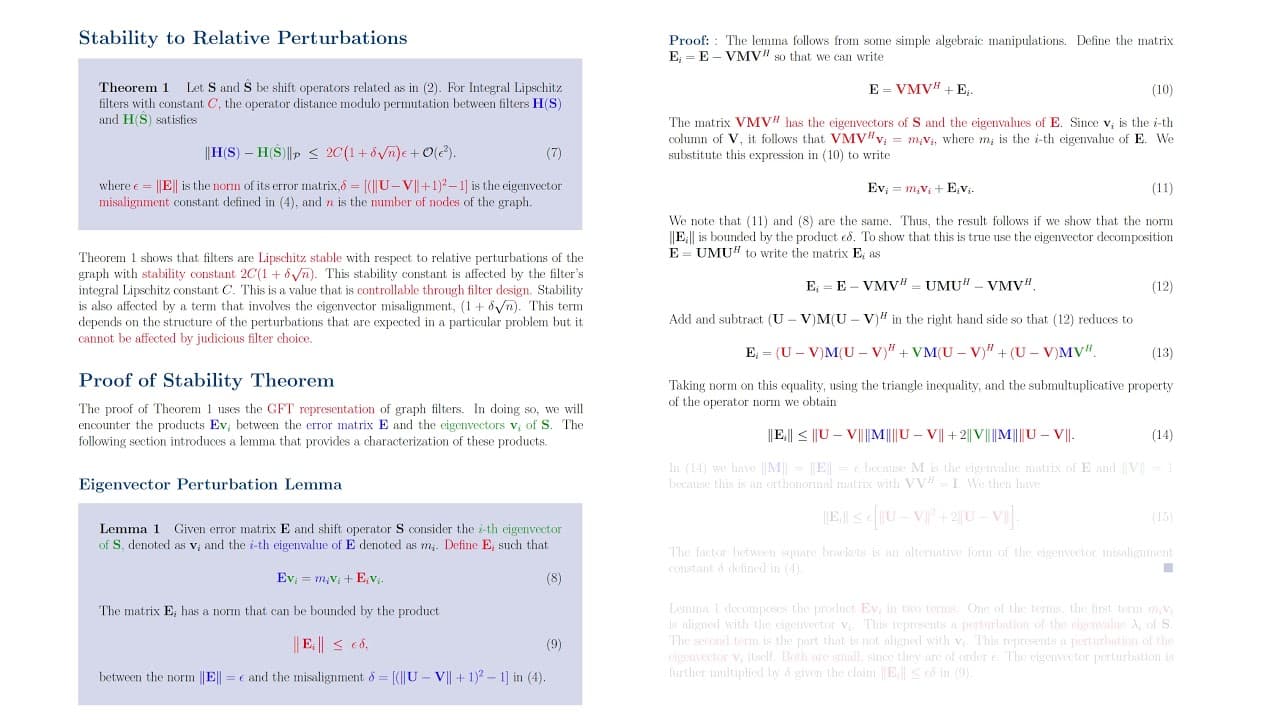
The content explains the Eigenvector Perturbation Lemma and its implications.
Transcript
muy bien work on the producto de estabilización de prove o decidieran luces de graf furia transform representation of craft filters during the analysis will en counter de productos y times by between the world metrix y aldea jan victors visa off es de folk wind section introduces alemán carl probyn carácter y 6 john of this products director pertur... Read More
Key Insights
- The Eigenvector Perturbation Lemma is a crucial mathematical tool for understanding how small changes in a matrix affect its eigenvectors.
- The lemma involves using an error matrix and a perturbation operator to assess the impact on eigenvectors.
- The analysis uses the concept of additive perturbation to derive the lemma, which is essential for further mathematical proofs.
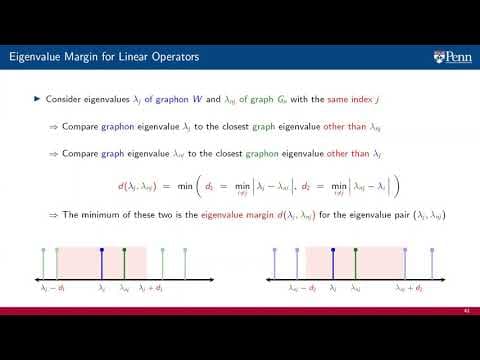
- The lemma is applied to matrices with eigenvectors, focusing on the changes in eigenvalues and eigenvectors due to perturbations.
- Key mathematical concepts such as matrix norms, triangular inequality, and operator properties are employed in the derivation of the lemma.
- The lemma shows that perturbations in matrices can lead to significant changes in eigenvectors, even if the perturbations are small.
- Understanding the lemma requires familiarity with linear algebra concepts, including eigenvalues, eigenvectors, and matrix operations.
- The lemma is foundational for more complex mathematical proofs and applications, particularly in fields that rely on matrix computations.
Install to Summarize YouTube Videos and Get Transcripts
Explore YouTube Video Summarizer or Get YouTube Transcript Extractor
Questions & Answers
Q: What is the main focus of the Eigenvector Perturbation Lemma?
The main focus of the Eigenvector Perturbation Lemma is to understand how small perturbations in a matrix can affect its eigenvectors. By analyzing these changes, the lemma provides insights into the stability and sensitivity of eigenvectors to minor adjustments in the matrix, which is crucial for mathematical proofs and applications.
Q: How does the lemma use error matrices and perturbation operators?
The lemma uses error matrices and perturbation operators to quantify the impact of small changes in a matrix on its eigenvectors. By incorporating these elements, the lemma assesses how perturbations influence the eigenvectors and eigenvalues, providing a mathematical framework for analyzing matrix stability and sensitivity.
Q: Why is the Eigenvector Perturbation Lemma important for mathematical proofs?
The Eigenvector Perturbation Lemma is important for mathematical proofs because it provides a foundational understanding of how eigenvectors respond to changes in matrices. This understanding is critical for developing more complex mathematical theories and applications, particularly those that involve matrix computations and require stability analysis.
Q: What mathematical concepts are employed in the lemma's derivation?
The lemma's derivation employs several mathematical concepts, including matrix norms, triangular inequality, and operator properties. These concepts are used to analyze the impact of perturbations on eigenvectors and to derive the mathematical framework necessary for understanding matrix stability and sensitivity.
Q: How does the lemma relate to matrix computations?
The lemma is closely related to matrix computations as it provides insights into how small perturbations in matrices can affect their eigenvectors. This understanding is crucial for applications that rely on matrix computations, as it helps predict and manage changes in eigenvectors due to matrix adjustments.
Q: What is the significance of eigenvalues in the lemma?
Eigenvalues play a significant role in the lemma as they are closely related to eigenvectors, which are the primary focus. The lemma examines how perturbations in a matrix can affect both eigenvalues and eigenvectors, thereby providing a comprehensive understanding of matrix stability and sensitivity.
Q: What role does the triangular inequality play in the lemma?
The triangular inequality is used in the lemma to help analyze the impact of perturbations on eigenvectors. It provides a mathematical basis for assessing the changes in eigenvectors and eigenvalues, contributing to the derivation of the lemma and its application in understanding matrix stability.
Q: How does the lemma address the sensitivity of eigenvectors?
The lemma addresses the sensitivity of eigenvectors by analyzing how small perturbations in a matrix can lead to significant changes in its eigenvectors. This analysis is crucial for understanding the stability of eigenvectors and for developing mathematical proofs and applications that rely on stable matrix computations.
Summary & Key Takeaways
-
The Eigenvector Perturbation Lemma is introduced as a mathematical tool to understand the effect of small changes in matrices on their eigenvectors. It uses concepts like error matrices and perturbation operators to derive insights into how these changes occur.
-
The lemma involves a detailed analysis of matrices, focusing on eigenvalues and eigenvectors. It employs mathematical techniques such as matrix norms and triangular inequality to explore the impact of perturbations on eigenvectors.
-
This lemma is crucial for mathematical proofs and applications, especially in areas that rely heavily on matrix computations. It highlights the sensitivity of eigenvectors to perturbations, even when the changes in the matrix are minor.
Read in Other Languages (beta)
Share This Summary 📚
Summarize YouTube Videos and Get Video Transcripts with 1-Click
Try YouTube Summary with ChatGPT & Claude or YouTube Transcript Generator
Explore More Summaries from Alelab Alelab 📚


Summarize YouTube Videos and Get Video Transcripts with 1-Click
Try YouTube Summary with ChatGPT & Claude or YouTube Transcript Generator