What Do Stars Sound Like?
TL;DR
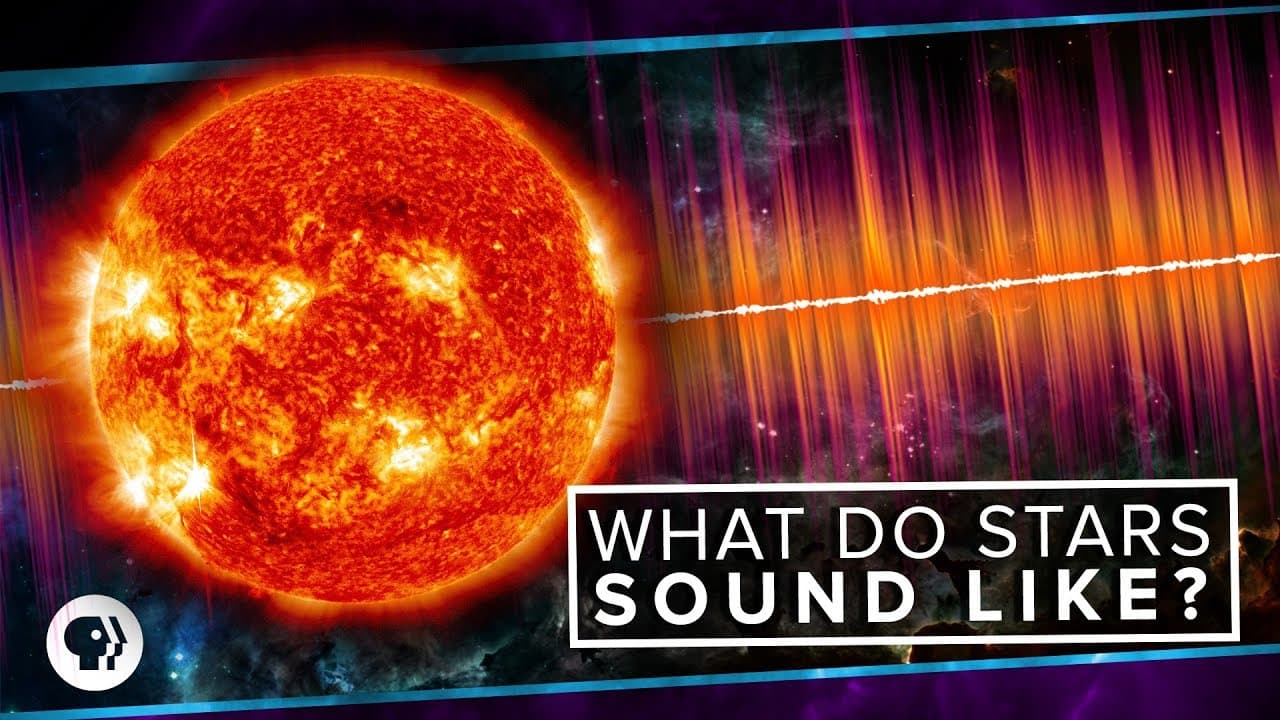
We can map star interiors by analyzing their seismic waves.
Transcript
Thanks to brilliant org for supporting PBS Digital Studios Twinkle twinkle little star how I wonder about your interior structure and dynamical properties Believe it or not we can now map the interiors of stars by Listening to their harmonies as they vibrate with seismic waves Stars are among the best understood objects in astrophysics This is impr... Read More
Key Insights
- Stars' seismic waves provide a way to map their interiors, revealing their structure and dynamics beyond what light can show.
- Astro seismology uses oscillations in stars to understand their internal properties, similar to how helioseismology studies the Sun.
- Stars resonate with pressure waves, similar to sound waves, which are generated by turbulence beneath their surfaces.
- Seismic waves in stars are analyzed using techniques like Fourier analysis, helping to deconstruct complex oscillations into simple modes.
- The study of star oscillations has improved our understanding of the Sun's internal structure, revealing details like differential rotation and magnetic field dynamics.
- Asteroseismology extends these techniques to distant stars, though it's more challenging due to the lack of detailed surface observations.
- Space missions like KEPLER, TESS, and PLATO are crucial for asteroseismology, offering precise measurements of stellar oscillations.
- Understanding stellar oscillations not only reveals current star conditions but also their evolutionary stages, including fusion activities in red giants.
Install to Summarize YouTube Videos and Get Transcripts
Explore YouTube Video Summarizer or Get YouTube Transcript Extractor
Questions & Answers
Q: How do seismic waves help in mapping the interiors of stars?
Seismic waves travel through stars and resonate in their interiors, creating oscillations that can be observed as changes in brightness or motion on the star's surface. By analyzing these oscillations, scientists can infer details about the star's internal structure, such as density, temperature, and composition, which are otherwise hidden from view.
Q: What are the main types of waves that stars support?
Stars primarily support pressure waves, or P waves, which are true sound waves that travel through their fluid interiors. Unlike solid bodies, stars do not support shear waves. Additionally, stars exhibit gravity waves, which occur below the surface and are related to gravitational equilibrium restoration when material is displaced.
Q: How does astro seismology differ from helioseismology?
Helioseismology focuses on studying the Sun's oscillations, benefiting from detailed observations of its surface. In contrast, asteroseismology applies similar principles to distant stars, but faces challenges due to the lack of resolved surface details, relying instead on global oscillation effects to infer internal properties.
Q: What role do space missions play in asteroseismology?
Space missions like KEPLER, TESS, and PLATO are vital for asteroseismology as they provide the precise measurements needed to detect faint oscillations in distant stars. These missions help identify resonant modes, allowing scientists to determine fundamental stellar properties and study their evolution and internal processes.
Q: How do scientists analyze complex oscillations in stars?
Scientists use techniques like Fourier analysis to deconstruct complex oscillations on a star's surface into simple sinusoidal modes. Each mode corresponds to a specific resonant frequency, revealing information about the star's internal structure, such as sound speed variations, which depend on temperature, density, and composition stratification.
Q: What have we learned about the Sun from helioseismology?
Helioseismology has improved our understanding of the Sun's internal structure, revealing that the inner radiative zone rotates like a solid body while the outer convective zone exhibits differential rotation. This differential rotation influences the Sun's magnetic field and sunspot cycle. It has also helped measure the Sun's core composition and fuel consumption.
Q: What challenges do asteroseismologists face when studying distant stars?
Asteroseismologists face significant challenges due to the inability to resolve the surfaces of distant stars. They must rely on global oscillation effects, such as brightness changes, to infer internal properties. Additionally, the faintness of these oscillations requires precise measurements, often necessitating observations from space-based telescopes.
Q: How does asteroseismology contribute to our understanding of stellar evolution?
Asteroseismology provides insights into the internal processes and evolutionary stages of stars, such as fusion activities in red giants. By analyzing oscillation modes, scientists can determine fundamental properties like mass and radius, helping to understand how stars evolve over time and their current state in the stellar lifecycle.
Summary & Key Takeaways
-
Astro seismology allows scientists to map the interiors of stars by analyzing their seismic waves, which travel through the stars and reveal their internal structure and dynamics.
-
Seismic waves in stars, similar to sound waves, are generated by turbulence beneath the surface, creating resonant pressure waves that can be analyzed to understand the star's properties.
-
Space missions like KEPLER and TESS are critical for asteroseismology, enabling precise measurements of stellar oscillations and helping to uncover the mysteries of star evolution and internal processes.
Read in Other Languages (beta)
Share This Summary 📚
Summarize YouTube Videos and Get Video Transcripts with 1-Click
Try YouTube Summary with ChatGPT & Claude or YouTube Transcript Generator
Explore More Summaries from PBS Space Time 📚




Summarize YouTube Videos and Get Video Transcripts with 1-Click
Try YouTube Summary with ChatGPT & Claude or YouTube Transcript Generator