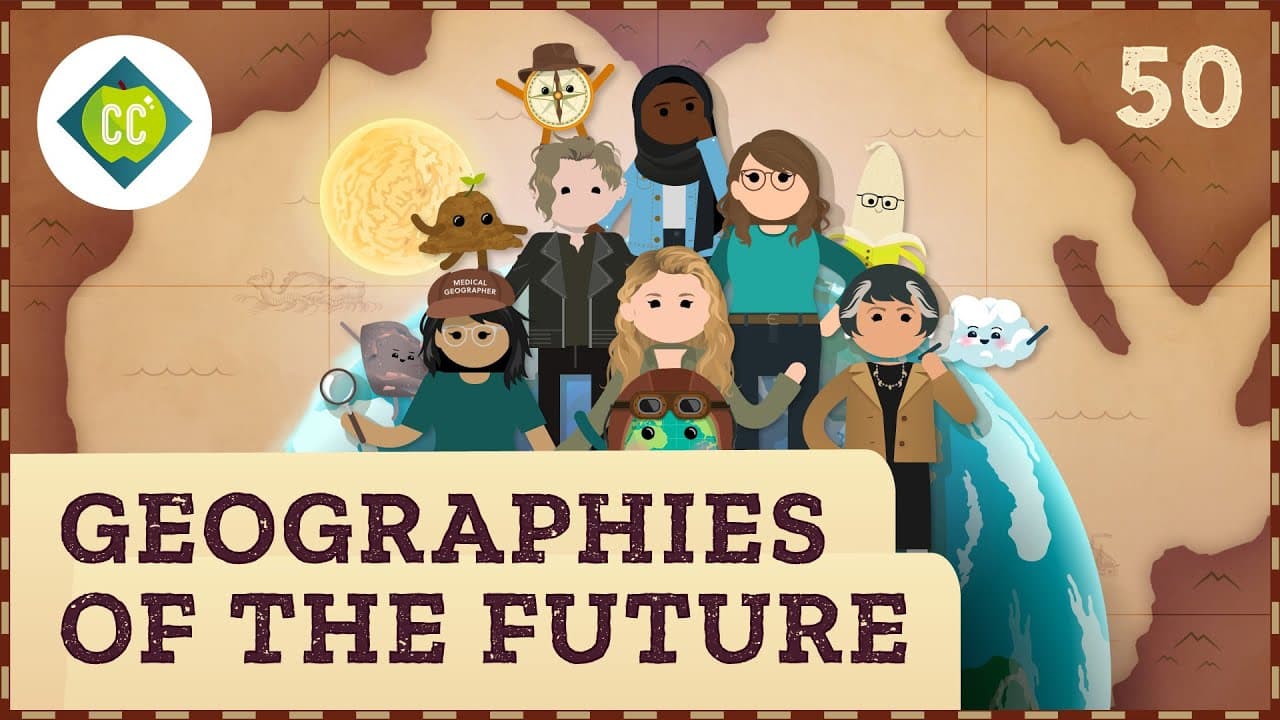
What Are the Future Geographies of Our World?
TL;DR
Space and time are increasingly merging, transforming our understanding of geography and place. Globalization enhances interconnectedness while raising concerns about local identities, data privacy, and environmental impacts. As we navigate the Anthropocene, rethinking our relationships with technology and nature is essential for equitable futures.
Transcript
hi and welcome to crash course physics today we're going to jump into the space-time continuum just kidding though science fiction writers and physicists aren't the only ones exploring space-time which is when the three dimensions we see in space are represented together with time geographers and physicists are both trying to describe the world and... Read More
Key Insights
- 👾 The merging of space and time challenges traditional notions of distance and facilitates global interconnectedness.
- 🥺 Globalization leads to a convergence of places but also sparks efforts to assert local identity and create unique futures.
- 👏 The collection and use of data in urban spaces raise ethical and equity concerns and the need for open access and communal control.
- 💢 The Anthropocene era highlights the importance of understanding the relationship between humans and the environment and the consequences of manipulating it.
Install to Summarize YouTube Videos and Get Transcripts
Explore YouTube Video Summarizer or Get YouTube Transcript Extractor
Questions & Answers
Q: How are space and time merging in the concept of space-time continuum?
In the space-time continuum, space and time are no longer separate entities but are intertwined, allowing for easier diffusion of ideas and people across different locations.
Q: How has globalization affected the concept of place?
Globalization has made places highly interconnected and interdependent, with some fearing the loss of uniqueness and others finding comfort in adapting global brands to local cultures.
Q: What are the concerns regarding data and surveillance in urban spaces?
While data collection in smart cities can improve efficiency and safety, it also raises privacy concerns and the potential for manipulation and segregation of marginalized social groups.
Q: How does the Anthropocene era impact the relationship between humans and the environment?
The Anthropocene era recognizes that human activities have significantly influenced Earth's ecosystems, posing both promises and perils. It calls for a reevaluation of our approach to nature and the consequences of altering the environment.
Summary & Key Takeaways
-
Space and time are merging, leading to a smaller world where ideas and people can easily diffuse across different locations.
-
The concept of place is evolving in a globalized world, with places becoming highly interconnected and interdependent.
-
Data and surveillance technologies have transformed urban spaces, raising concerns about privacy and equity.
-
The Anthropocene era calls for a rethinking of our relationship with the environment and the potential consequences of manipulating it.
Read in Other Languages (beta)
Share This Summary 📚
Summarize YouTube Videos and Get Video Transcripts with 1-Click
Try YouTube Summary with ChatGPT & Claude or YouTube Transcript Generator
Explore More Summaries from CrashCourse 📚




Summarize YouTube Videos and Get Video Transcripts with 1-Click
Try YouTube Summary with ChatGPT & Claude or YouTube Transcript Generator