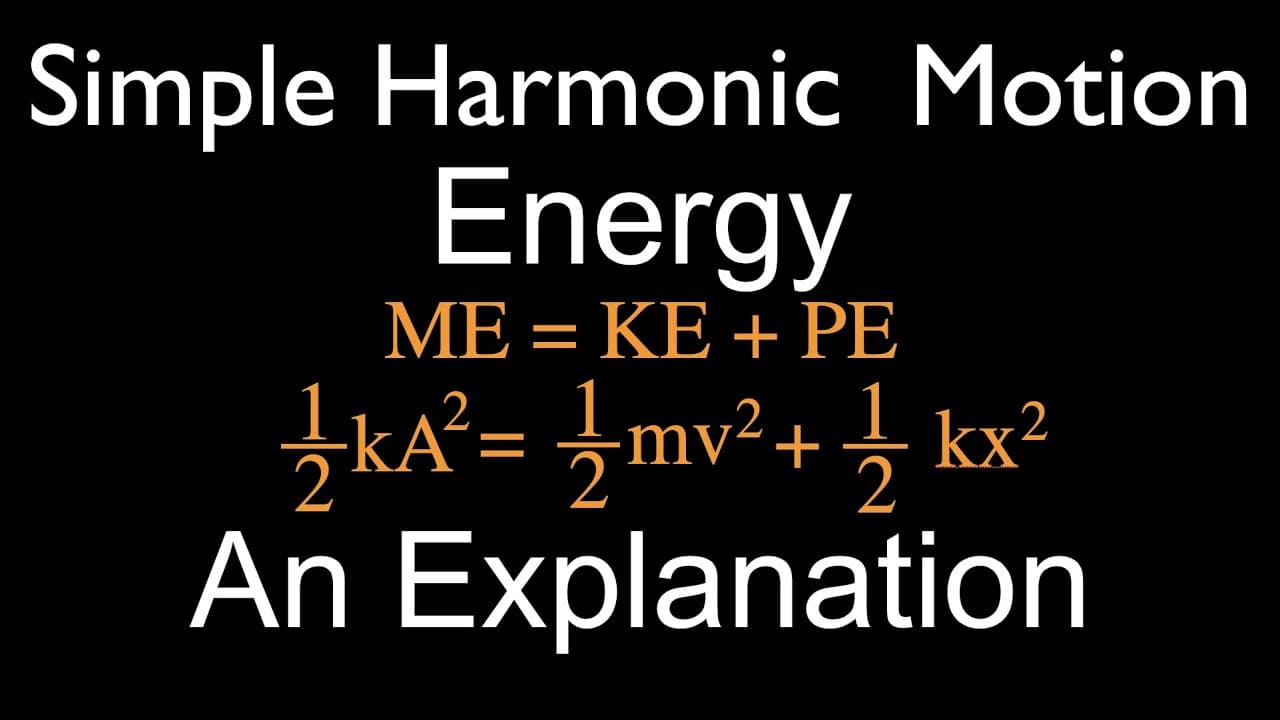
Simple Harmonic Motion (13 of 16): Kinetic & Potential Energy, An Explanation
TL;DR
Deriving equations for kinetic, potential, and total mechanical energy in a simple harmonic oscillator.
Transcript
so in today's video we're going to go over a bunch of information for calculating the energy in a simple harmonic oscillator before i get started please don't forget to subscribe to my channel step by step science get all my excellent physics chemistry and mathematics when i look at my youtube analytics i see that more than 90 percent of people who... Read More
Key Insights
- ❓ Kinetic and potential energy interplay in a simple harmonic oscillator.
- 🦾 Total mechanical energy remains constant in a system with no friction.
- 🧘 Equilibrium position signifies the transition between potential and kinetic energy.
- 🌸 Spring constant influences the maximum velocity and acceleration in the oscillator.
- 🏪 Maximum displacement (amplitude) stores all energy as potential in the oscillator.
- ❓ Derivation of equations for velocity and acceleration in a harmonic oscillator.
- ❓ Understanding the significance of maximum acceleration in the oscillator system.
Install to Summarize YouTube Videos and Get Transcripts
Explore YouTube Video Summarizer or Get YouTube Transcript Extractor
Questions & Answers
Q: What is the relationship between kinetic and potential energy in a simple harmonic oscillator?
In a simple harmonic oscillator, kinetic energy and potential energy interchange as the system oscillates. Kinetic energy is at its maximum when potential energy is zero, and vice versa.
Q: How do you derive the equation for total mechanical energy in a simple harmonic oscillator?
Total mechanical energy in a simple harmonic oscillator is the sum of kinetic and potential energy. At maximum displacement (amplitude), all energy is potential due to zero velocity.
Q: What is the significance of the equilibrium position in a simple harmonic oscillator?
The equilibrium position is where potential energy is zero and kinetic energy is at its maximum. It marks the point where the mass changes direction in the oscillator system.
Q: How is spring constant related to velocity and acceleration in a simple harmonic oscillator?
The maximum velocity in a harmonic oscillator is proportional to the square root of the spring constant divided by mass. Similarly, maximum acceleration is directly proportional to the spring constant divided by mass.
Summary & Key Takeaways
-
Explained the concept of mechanical energy in a simple harmonic oscillator, consisting of kinetic and potential energy.
-
Derived equations for kinetic, potential, and total mechanical energy in a harmonic oscillator.
-
Calculated maximum velocity and acceleration in a simple harmonic oscillator system.
Read in Other Languages (beta)
Share This Summary 📚
Summarize YouTube Videos and Get Video Transcripts with 1-Click
Try YouTube Summary with ChatGPT & Claude or YouTube Transcript Generator
Explore More Summaries from Step by Step Science 📚
Summarize YouTube Videos and Get Video Transcripts with 1-Click
Try YouTube Summary with ChatGPT & Claude or YouTube Transcript Generator