What Are RPKM, FPKM, and TPM in RNA-Seq Analysis?
TL;DR
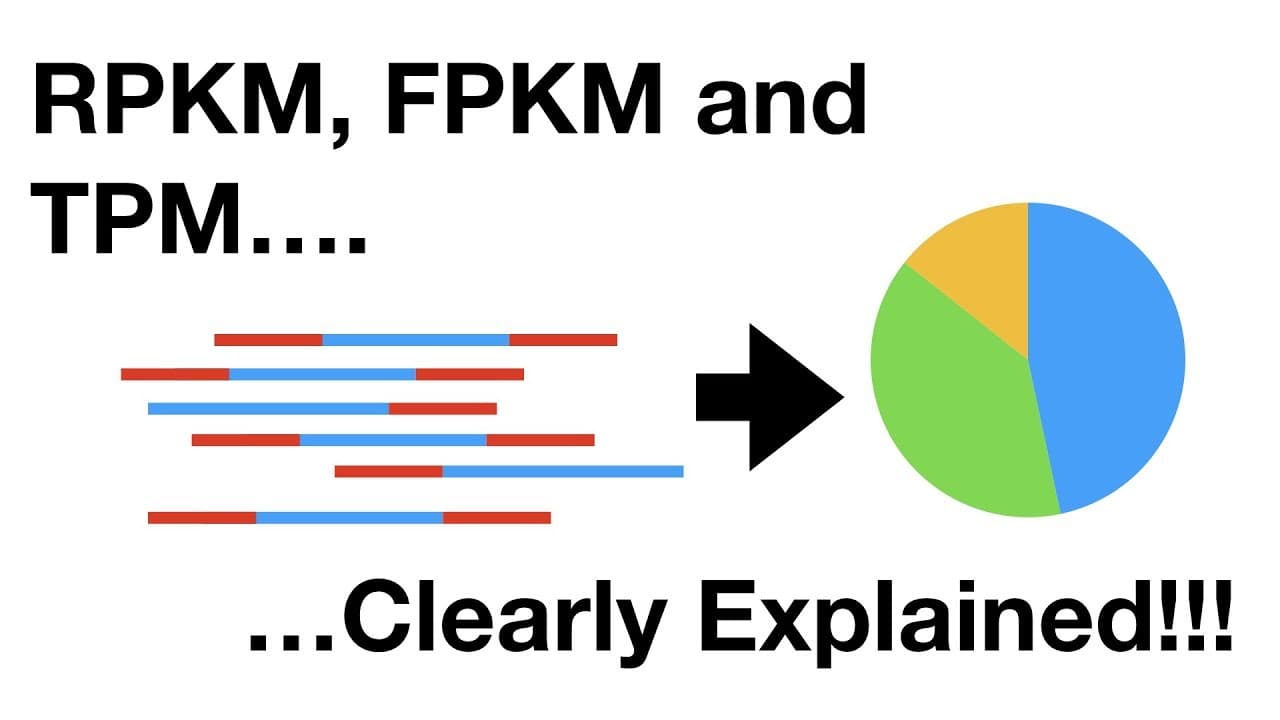
RPKM, FPKM, and TPM are metrics used to normalize read counts in RNA sequencing for gene length and sequencing depth. RPKM and FPKM differ primarily in their handling of reads, while TPM provides a consistent scaling factor across replicates, making it easier to compare relative gene expression levels across samples.
Transcript
stat quest stat quest stat quest hello and welcome to stat quest stat quest is brought to you by the friendly folks in the genetics department at the University of North Carolina at Chapel Hill today we're going to be talking about rpkm versus fpkm versus fpm in previous stat quests we've talked about topics that are broadly applicable to a variety... Read More
Key Insights
- 🫠 Rpkm, fpkm, and TPM are metrics used in RNA sequencing to normalize read counts for sequencing depth and gene length biases.
- 🪈 Rpkm normalizes for sequencing depth and gene length sequentially, while TPM reverses the order of operations.
- 😑 TPM provides a uniform scaling factor for all replicates, making it easier to compare relative gene expression levels.
- 😑 TPM is preferred in RNA-seq analysis for its ability to accurately represent gene expression levels and facilitate comparison between samples.
- 🫠 Normalizing read counts in RNA-seq analysis is essential to remove biases introduced by sequencing depth and gene length discrepancies.
- ❤️🩹 Rpkm and fpkm are closely related terms, with fpkm specific to paired-end sequencing.
- 🛀 Comparing rpkm and TPM normalized data shows that TPM yields uniform scaled values across replicates, simplifying data interpretation.
Install to Summarize YouTube Videos and Get Transcripts
Explore YouTube Video Summarizer or Get YouTube Transcript Extractor
Questions & Answers
Q: What are rpkm, fpkm, and TPM in RNA-seq analysis?
Rpkm, fpkm, and TPM are metrics used to normalize read counts in RNA sequencing to account for sequencing depth and gene length biases. Rpkm and fpkm are similar, with fpkm specific to paired-end sequencing, while TPM reverses the order of normalization steps.
Q: Why is it important to normalize read counts in RNA-seq analysis?
Normalizing read counts is crucial to remove biases introduced by differences in sequencing depth and gene length. This ensures that the data accurately reflects gene expression levels across samples.
Q: How does TPM differ from rpkm and fpkm in RNA-seq analysis?
TPM differs from rpkm and fpkm by normalizing for gene length before sequencing depth, resulting in a uniform scaling factor for all replicates. This allows for easier comparison of gene expression levels between samples.
Q: Why is TPM preferred over rpkm and fpkm in RNA-seq analysis?
TPM is preferred for RNA-seq analysis because it provides a more accurate representation of gene expression levels by ensuring uniform scaling factors across samples. This enables clearer interpretation of relative gene expression levels.
Summary & Key Takeaways
-
Rpkm, fpkm, and TPM are metrics used in RNA sequencing to normalize read counts for sequencing depth and gene length.
-
Rpkm normalizes for sequencing depth and gene length sequentially, while TPM switches the order of operations.
-
TPM provides a uniform scaling factor for all replicates, making it easier to compare relative gene expression levels.
Read in Other Languages (beta)
Share This Summary 📚
Summarize YouTube Videos and Get Video Transcripts with 1-Click
Try YouTube Summary with ChatGPT & Claude or YouTube Transcript Generator
Explore More Summaries from StatQuest with Josh Starmer 📚
Summarize YouTube Videos and Get Video Transcripts with 1-Click
Try YouTube Summary with ChatGPT & Claude or YouTube Transcript Generator