Fundamental Concepts of Matter
TL;DR
Matter is made up of atoms, which are the smallest units of matter. Elements are substances that cannot be broken down further, and molecules are made up of two or more atoms held together by chemical bonds.
Transcript
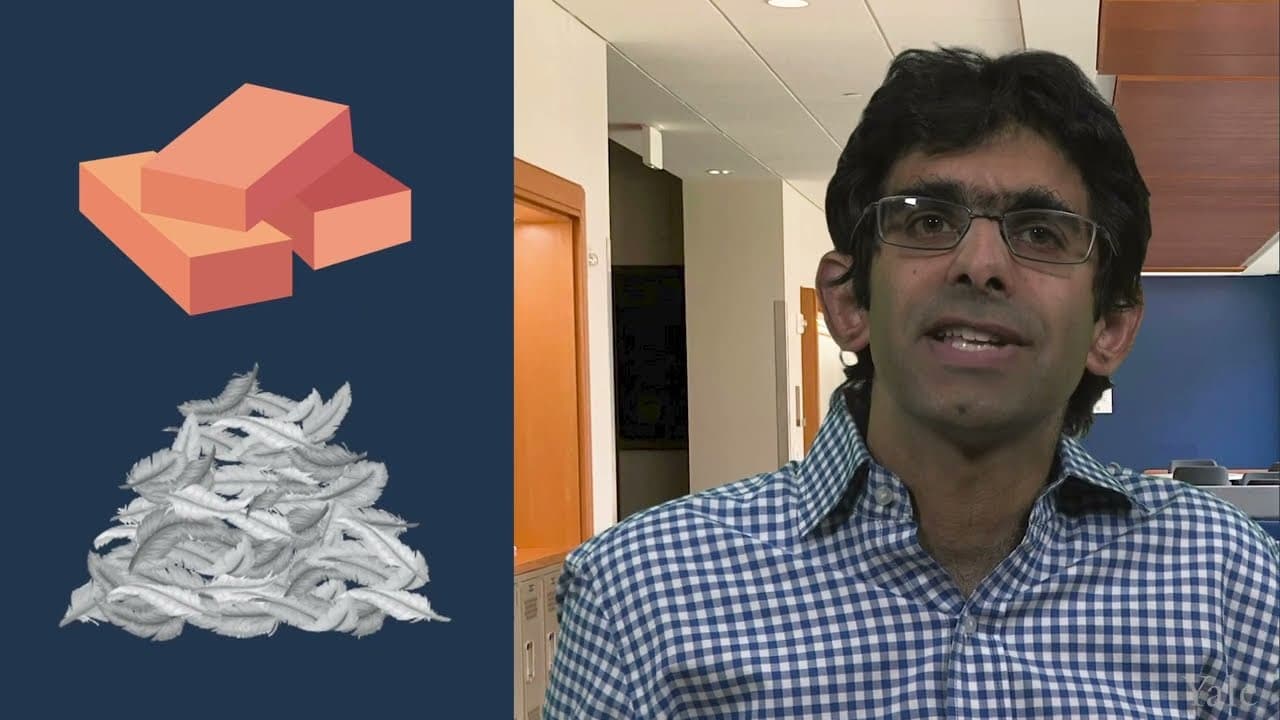
♪ Nilay's Chemistry ♪ - Let's start off with a problem. A person drops a pound of bricks and a pound of feathers down from their window, which has more matter? The bricks or the feathers? Now, you might be tempted to say feathers but let's recall what matter is. Matter is anything that occupies space and has mass. Mass defines the quantity of matte... Read More
Key Insights
- 🫀 Matter is made up of atoms, which are the smallest units of matter.
- 🍳 Elements are substances that cannot be broken down into simpler substances by chemical means.
- 🥹 Molecules are composed of two or more atoms held together by chemical bonds.
- 🅰️ Different elements make up different types of matter, giving them different properties.
- 🫀 Atoms can be thought of as the building blocks of matter, and molecules are like words made up of these atoms.
- 🫀 Chemical reactions involve breaking and forming bonds between atoms, resulting in the transformation of molecules.
- 💷 A pound of bricks and a pound of feathers have the same amount of matter, but they are made up of different elemental building blocks, giving them different properties.
Install to Summarize YouTube Videos and Get Transcripts
Explore YouTube Video Summarizer or Get YouTube Transcript Extractor
Questions & Answers
Q: What is matter made up of?
Matter is made up of atoms, which are the smallest units of matter. Atoms are building blocks that make up everything around us.
Q: How many elements are there?
There are 118 different known elements. Each element has its own unique set of properties and cannot be broken down into simpler substances by chemical means.
Q: What is an example of an element?
Hydrogen, oxygen, carbon, gold, and arsenic are all examples of different elements. They are pure substances that consist of only one type of atom.
Q: What is the difference between an atom and a molecule?
An atom is the smallest unit of matter, while a molecule is the smallest physical unit of an element or compound. Molecules are composed of two or more atoms held together by chemical bonds.
Q: Can chemical bonds be broken?
Yes, chemical bonds can be broken, allowing different atoms to bond together and form new molecules. Reactions like this can occur, transforming one molecule into another.
Summary & Key Takeaways
-
Matter is anything that occupies space and has mass, and it is made up of one or many microscopic building blocks called atoms.
-
Elements are substances that cannot be decomposed into simpler substances by chemical means.
-
Molecules are the smallest physical units of an element or compound, composed of two or more atoms held together by chemical bonds.
Read in Other Languages (beta)
Share This Summary 📚
Summarize YouTube Videos and Get Video Transcripts with 1-Click
Try YouTube Summary with ChatGPT & Claude or YouTube Transcript Generator
Explore More Summaries from YaleCourses 📚
Summarize YouTube Videos and Get Video Transcripts with 1-Click
Try YouTube Summary with ChatGPT & Claude or YouTube Transcript Generator