How to Calculate Mean, Variance, and Standard Deviation?
TL;DR
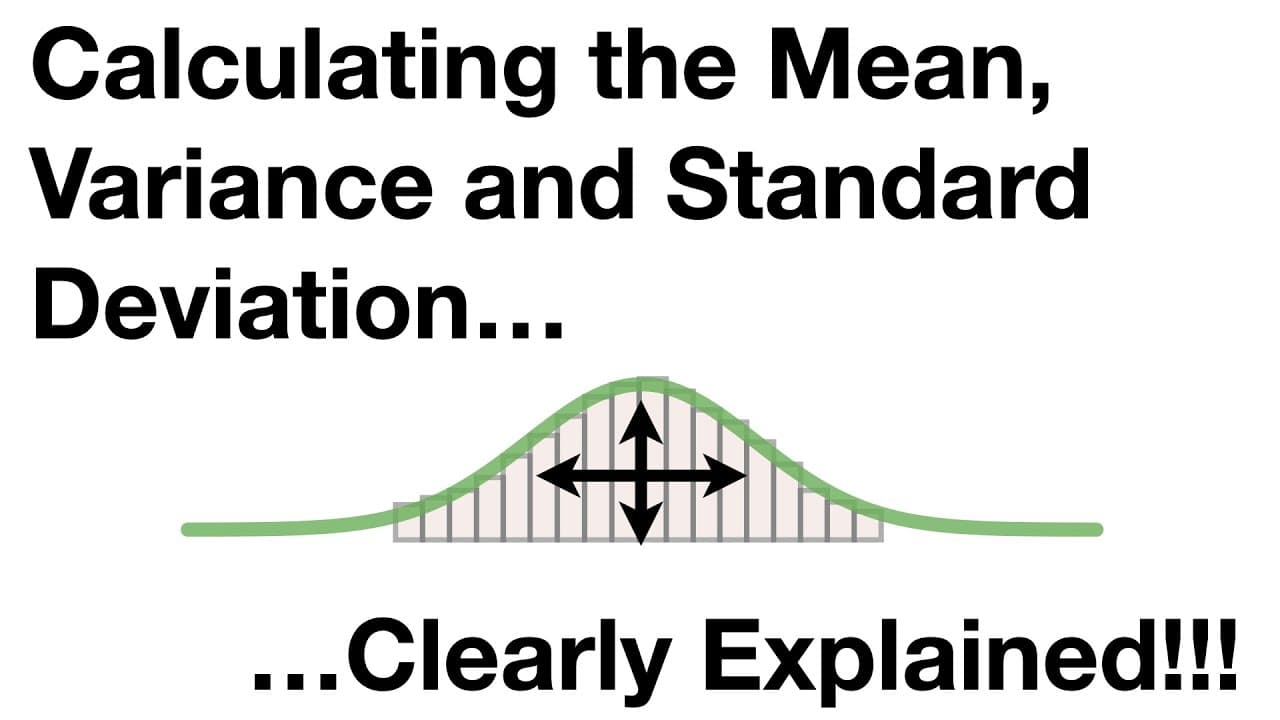
To calculate the mean, use the average of all data points. For variance, determine the average of the squared differences from the mean, and for standard deviation, take the square root of the variance. When only a sample is available, estimate these values using the sample mean and divide by n-1 for variance to account for sample size.
Transcript
I was home last night barians of standard deviation so I estimated them and its goal that quest hello I'm Josh stormer and welcome to stat quest today we're gonna continue our series on statistics fundamentals this time we're gonna talk about estimating the mean variance and standard deviation note this stat quest assumes you already know about his... Read More
Key Insights
- 😒 Population mean is calculated with all data, while estimated mean uses sample averages.
- ❎ Squaring differences in variance calculation ensures accurate data spread around the mean.
- 🛩️ Dividing by n-1 in estimating variance compensates for smaller sample sizes.
- 🫚 Estimating standard deviation involves taking the square root of the estimated variance.
- 🛩️ Population parameters are rarely available, requiring estimation from small samples.
- ❓ Microsoft Excel offers functions to calculate population variance and estimate it.
- ⌛ Accurate estimation of population parameters saves time and resources.
Install to Summarize YouTube Videos and Get Transcripts
Explore YouTube Video Summarizer or Get YouTube Transcript Extractor
Questions & Answers
Q: How is the population mean calculated versus the estimated mean using samples?
The population mean is calculated with all available data, while the estimated mean uses a sample's average to infer the population mean accurately.
Q: What is the significance of squaring differences in calculating population variance?
Squaring differences ensures positive values and prevents cancelation of positive and negative differences, leading to an accurate measure of data spread around the mean.
Q: Why do we divide by n-1 when estimating population variance?
Dividing by n-1 compensates for smaller sample sizes and results in a more accurate estimation of variance around the population mean.
Q: How does estimating standard deviation differ from calculating it for the population?
Estimating standard deviation involves taking the square root of the estimated variance, making it suitable for graphical representation and easy interpretation.
Summary & Key Takeaways
-
Estimating the population mean is done by averaging measurements from a sample, while calculating the population mean uses all data available.
-
Population variance and standard deviation are calculated using the entire dataset, but in practice, we estimate these values from small samples.
-
The difference between population and estimated parameters lies in compensating for smaller sample sizes to get accurate results.
Read in Other Languages (beta)
Share This Summary 📚
Summarize YouTube Videos and Get Video Transcripts with 1-Click
Try YouTube Summary with ChatGPT & Claude or YouTube Transcript Generator
Explore More Summaries from StatQuest with Josh Starmer 📚

Summarize YouTube Videos and Get Video Transcripts with 1-Click
Try YouTube Summary with ChatGPT & Claude or YouTube Transcript Generator