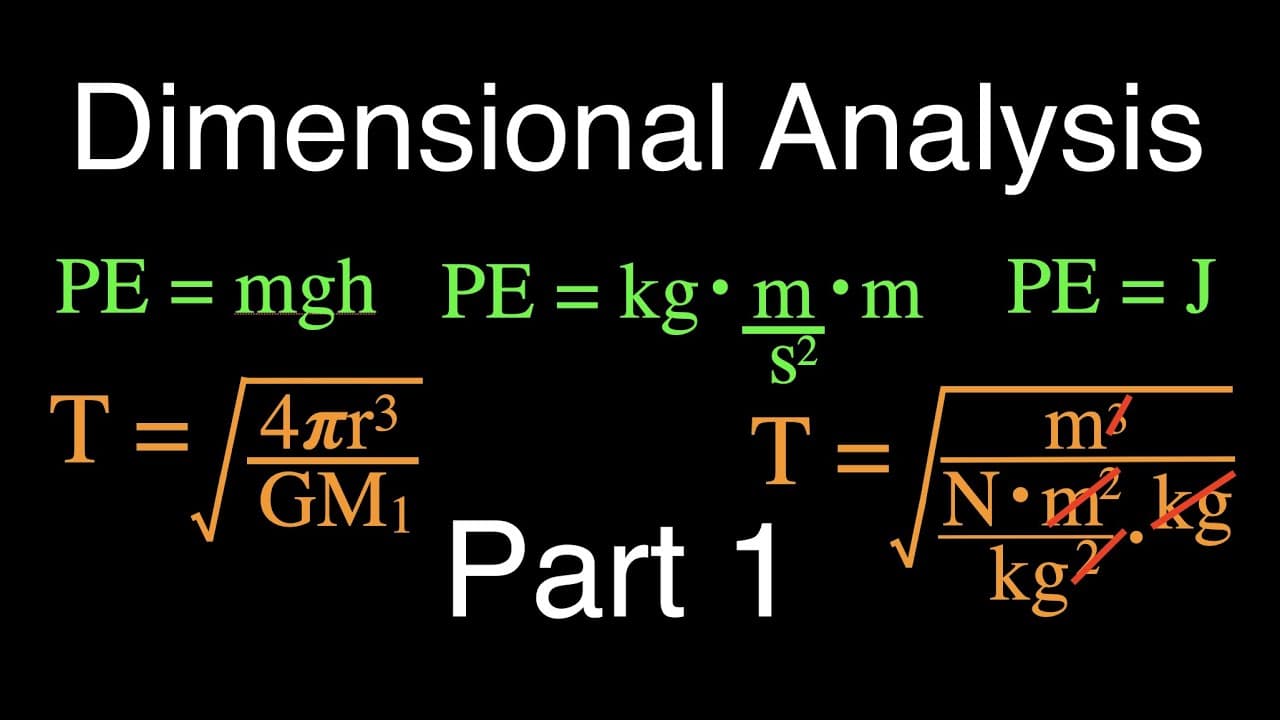
Dimensional Analysis Part 1, Units for Answers
TL;DR
Exploring unit analysis in physics through various examples for dimensional analysis.
Transcript
in today's video we are going to go over seven different examples for dimensionless analysis and we're going to be analyzing the units as they come out of the equations for seven different examples before we get started please don't forget to subscribe to our channel step by step signs get all the excellent physics chemistry and math videos when i ... Read More
Key Insights
- ⌛ Units for velocity and acceleration are derived from distance, time, and changes in velocity, showcasing the relationship between these quantities.
- 🥺 Understanding units for force illuminates the concept of force as the product of mass and acceleration, leading to the definition of a newton.
- 💦 Energy and work share the same unit, the joule, derived from force and distance, demonstrating the foundational principles in work-energy relationships.
- 👮 Newton's law of universal gravitation exemplifies the calculation of force using gravitational constant and mass units, emphasizing the universal nature of this law.
- ⌛ Kinematic equations reveal the relationship between initial and final velocities, acceleration, and time, showcasing how units are derived for velocity calculations.
- 🇦🇪 Orbital period calculations illustrate the importance of unit analysis in deriving seconds as the base unit for time in complex physical phenomena, such as planetary motions.
- 🇦🇪 Dimensionless analysis examples emphasize the significance of unit understanding in physics for accurate calculations and conceptual clarity.
Install to Summarize YouTube Videos and Get Transcripts
Explore YouTube Video Summarizer or Get YouTube Transcript Extractor
Questions & Answers
Q: How are units for velocity and acceleration derived in physics equations?
Units for velocity (meters per second) come from dividing distance (meters) by time (seconds), while units for acceleration (meters per second squared) arise from dividing velocity (meters per second) by time (seconds), showcasing change in velocity per second.
Q: What is the significance of understanding units in dimensional analysis?
Understanding units in physics equations allows for a deeper conceptual grasp of the underlying concepts, aiding in accurate calculations and interpretations of physical phenomena.
Q: How is force defined in physics and what are the units for force?
Force is defined as the product of mass (kilograms) and acceleration (meters per second squared), with the resulting unit being the newton, which signifies the force required to accelerate a one-kilogram mass by one meter per second squared.
Q: How are energy and work related in physics equations and what are their units?
Energy and work exhibit the same unit, the joule, which is a newton-meter. The unit originates from multiplying force (newtons) by distance (meters), representing the amount of work done when applying a force over a distance.
Summary & Key Takeaways
-
Demonstrates dimensional analysis through examples of velocity, acceleration, force, energy, work, and orbital period.
-
Explains how units are derived in equations for velocity, acceleration, force, energy, and work.
-
Emphasizes the importance of understanding units in physics calculations for a deeper conceptual grasp.
Read in Other Languages (beta)
Share This Summary 📚
Summarize YouTube Videos and Get Video Transcripts with 1-Click
Try YouTube Summary with ChatGPT & Claude or YouTube Transcript Generator
Explore More Summaries from Step by Step Science 📚
Summarize YouTube Videos and Get Video Transcripts with 1-Click
Try YouTube Summary with ChatGPT & Claude or YouTube Transcript Generator