Nuclear Physics Challenge | Space Time | PBS Digital Studios
TL;DR
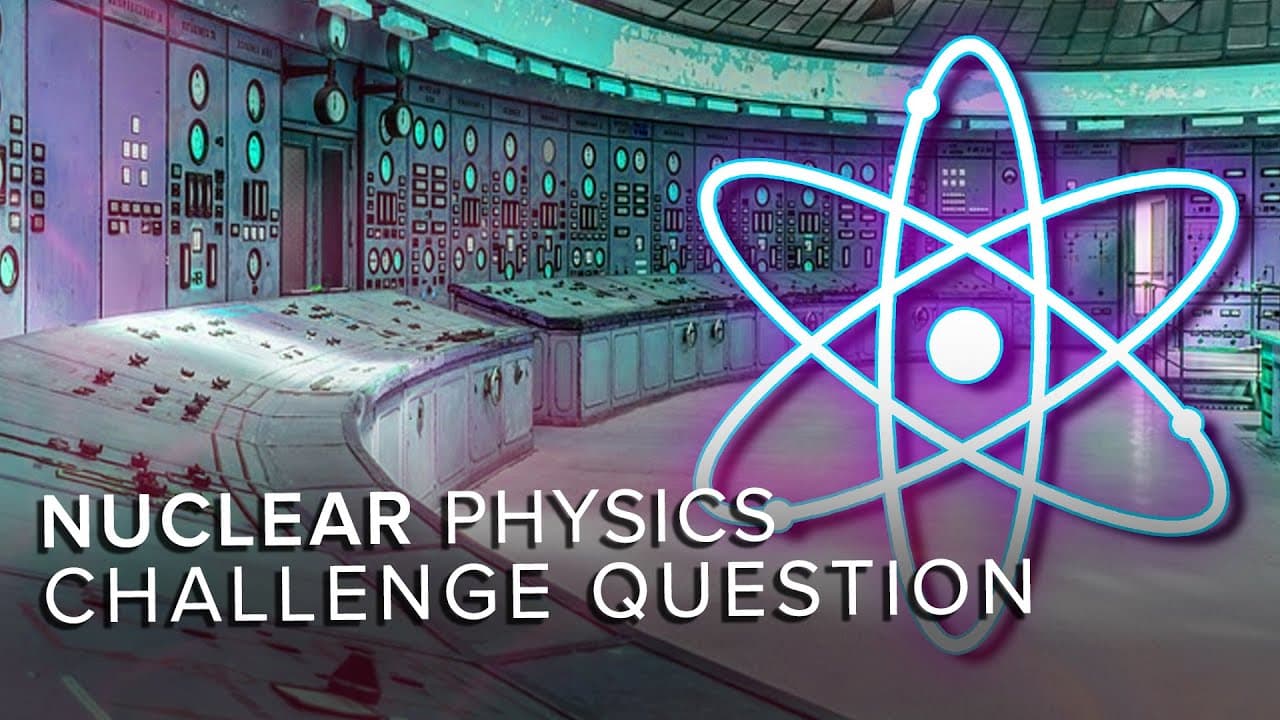
Explore quantum tunneling in polonium 212's alpha decay.
Transcript
Hey, guys. I have a challenge question for you today. We've been talking about quantum mechanics recently, and I think we're ready to do a bit of recreational nuclear physics. A few episodes ago, we delved into quantum tunneling. I recommend you go watch it if you haven't already. But here's TL;DR. Particles of matter have wave-like properties. The... Read More
Key Insights
- Quantum mechanics reveals that particles exhibit wave-like properties, leading to phenomena such as quantum tunneling, where particles can pass through barriers they typically couldn't.
- Polonium is an extremely radioactive element, with its isotopes lacking stability. Polonium 212, in particular, has a very short half-life of 0.3 microseconds.
- The challenge involves calculating the probability of an alpha particle tunneling out of a polonium 212 nucleus, using concepts like nuclear radius and particle velocity.
- Alpha decay occurs when alpha particles tunnel out of the nucleus, driven by the strong nuclear force's short-range nature and the particle's kinetic energy.
- Participants are encouraged to calculate the number of encounters an alpha particle has with the nucleus wall in 0.3 microseconds to determine the tunneling probability.
- The kinetic energy of an alpha particle ejected from polonium 212 is 8.78 MEV, which is crucial for calculating its velocity and tunneling probability.
- The extra credit challenge is to determine how far an alpha particle teleports from the nucleus upon successful tunneling, considering energy states.
- Submissions for the challenge must include detailed work and be sent by a specified deadline for a chance to win a themed t-shirt.
Install to Summarize YouTube Videos and Get Transcripts
Explore YouTube Video Summarizer or Get YouTube Transcript Extractor
Questions & Answers
Q: What is the main focus of the challenge presented in the video?
The main focus of the challenge is to calculate the tunneling probability of an alpha particle escaping from a polonium 212 nucleus. Participants need to consider factors such as the number of wall encounters within the 0.3-microsecond half-life and the velocity of the alpha particle to solve the problem.
Q: Why is polonium considered highly radioactive?
Polonium is considered highly radioactive due to its isotopes' lack of stability, with none being stable. Polonium 212, for instance, has a half-life of just 0.3 microseconds, meaning it decays rapidly. This rapid decay results in the emission of alpha particles, contributing to its extreme radioactivity.
Q: What role does quantum tunneling play in alpha decay?
Quantum tunneling allows alpha particles to escape from the nucleus despite the strong nuclear force that typically confines them. This phenomenon occurs because particles exhibit wave-like properties, enabling them to tunnel through potential barriers. In the context of polonium 212, tunneling leads to alpha decay as particles exit the nucleus.
Q: How can participants calculate the number of wall encounters in 0.3 microseconds?
Participants can calculate the number of wall encounters by determining the size of the polonium 212 nucleus using the nuclear radius relationship. Additionally, they need to calculate the velocity of the alpha particle using its kinetic energy and mass. This information helps in estimating how often the particle encounters the nucleus wall within the given time frame.
Q: What is the significance of the kinetic energy value provided in the video?
The kinetic energy value of 8.78 MEV is crucial for calculating the velocity of the alpha particle ejected from polonium 212. This velocity, in turn, is essential for determining the frequency of wall encounters and the probability of tunneling. It provides a quantitative measure needed to solve the challenge.
Q: What is the extra credit challenge mentioned in the video?
The extra credit challenge involves calculating how far an alpha particle teleports from the nucleus when it successfully tunnels out. This requires understanding the energy state transition, where the particle reaches a lower energy state, balancing potential and kinetic energy, to determine the tunneling distance.
Q: What instructions are given for submitting challenge answers?
Participants are instructed to submit their answers, complete with detailed work, to the provided email address by a specific deadline. They must use the subject line 'Nuclear Physics Challenge' to ensure their submission is considered. Successful entries have a chance to win a 'Space Time' t-shirt.
Q: Why is the concept of quantum tunneling important in nuclear physics?
Quantum tunneling is important in nuclear physics because it explains how particles can escape from atomic nuclei, leading to phenomena such as radioactive decay. It challenges classical physics' limitations by demonstrating that particles can overcome energy barriers, thus playing a critical role in understanding nuclear processes and reactions.
Summary & Key Takeaways
-
The video explores the concept of quantum tunneling, particularly in the context of polonium 212's alpha decay, and presents a challenge to calculate tunneling probabilities.
-
Participants are tasked with using nuclear radius and kinetic energy concepts to determine how frequently an alpha particle encounters the nucleus wall and its tunneling probability.
-
The episode highlights the radioactive nature of polonium, the role of the strong nuclear force, and offers an extra credit challenge on the tunneling distance.
Read in Other Languages (beta)
Share This Summary 📚
Summarize YouTube Videos and Get Video Transcripts with 1-Click
Try YouTube Summary with ChatGPT & Claude or YouTube Transcript Generator
Explore More Summaries from PBS Space Time 📚



Summarize YouTube Videos and Get Video Transcripts with 1-Click
Try YouTube Summary with ChatGPT & Claude or YouTube Transcript Generator