Isotopes | Atomic structure and properties | AP Chemistry | Khan Academy
TL;DR
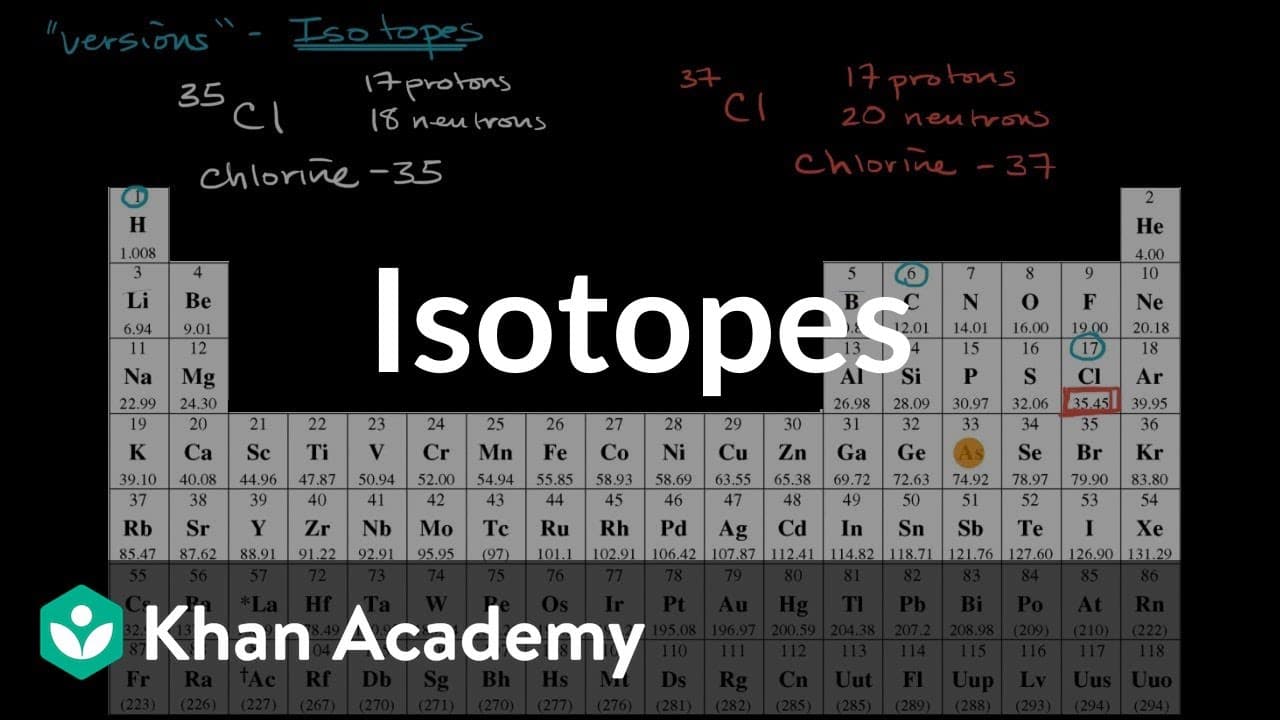
Different versions of the same element, called isotopes, can exist due to varying numbers of neutrons in the nucleus.
Transcript
- [Instructor] In other videos we have talked about that the type of element that we are dealing with is defined by the number of protons in an atom's nucleus. So for example, any atom with exactly one proton in its nucleus is by definition hydrogen. Any atom with six protons in its nucleus is by definition carbon, any atom with 17 protons in its n... Read More
Key Insights
- #️⃣ Isotopes are different versions of the same element that have varying numbers of neutrons.
- #️⃣ The atomic number of an element is determined by the number of protons in its nucleus.
- 🫀 Isotopes have identical chemical properties but may differ in atomic mass.
- 🫀 The average atomic mass of an element takes into account the abundance of each isotope.
Install to Summarize YouTube Videos and Get Transcripts
Explore YouTube Video Summarizer or Get YouTube Transcript Extractor
Questions & Answers
Q: What determines the type of element an atom is?
The number of protons in an atom's nucleus, known as the atomic number, defines the type of element.
Q: How do isotopes differ from regular elements?
Isotopes are versions of an element that have different numbers of neutrons, which can result in variations in atomic mass.
Q: Are isotopes of the same element chemically different?
Isotopes of the same element have identical chemical properties since the number of protons, which determines chemical behavior, remains the same.
Q: How is the average atomic mass of an element calculated?
The average atomic mass is calculated by considering the abundance (percentage) of each isotope and multiplying it by its atomic mass, then summing these values.
Summary & Key Takeaways
-
The number of protons in an atom's nucleus defines the type of element it is.
-
Isotopes are different versions of an element that have varying numbers of neutrons.
-
Examples of isotopes include chlorine-35 (17 protons and 18 neutrons) and chlorine-37 (17 protons and 20 neutrons).
Read in Other Languages (beta)
Share This Summary 📚
Summarize YouTube Videos and Get Video Transcripts with 1-Click
Try YouTube Summary with ChatGPT & Claude or YouTube Transcript Generator
Explore More Summaries from Khan Academy 📚




Summarize YouTube Videos and Get Video Transcripts with 1-Click
Try YouTube Summary with ChatGPT & Claude or YouTube Transcript Generator