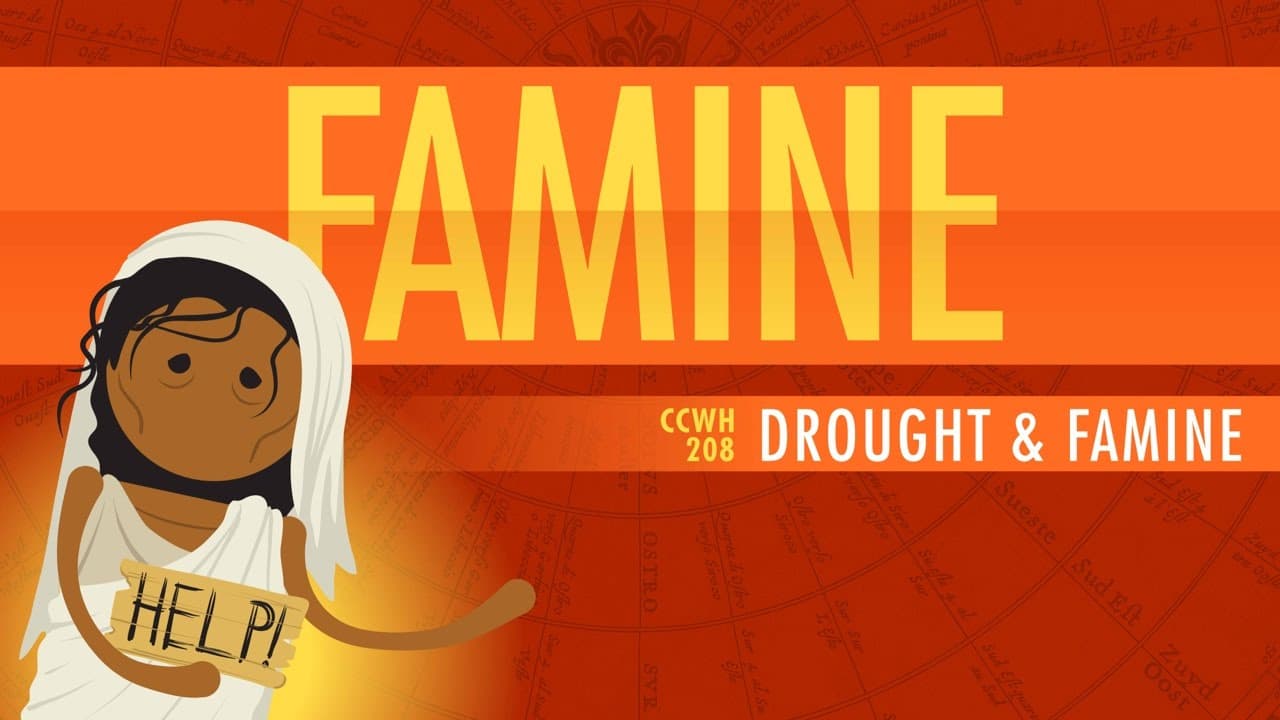
Drought and Famine: Crash Course World History #208
TL;DR
Famine is often man-made, not just natural.
Transcript
Hi, I'm John Green. This is Crash Course World History. Today we're going to talk about drought and famine. Really, Stan? When are we going to talk about, like, peace and happiness? I feel like we've been on kind of a sad run here at Crash Course. You know what, actually I'm gonna talk about peace and happiness, but not until the very end. In the m... Read More
Key Insights
- Famines are largely man-made disasters, often caused by poor access to resources rather than their absence.
- Government policies can exacerbate famines, as seen in historical examples like Stalin's collectivization and Mao's Great Leap Forward.
- Market forces in capitalist systems can also lead to famines when people cannot afford available food.
- El Niño affects weather patterns, contributing to droughts and famines, particularly in the global south.
- British colonial policies in India worsened famines by forcing peasants into cash crops, reducing food production.
- Railroads in colonial India, meant to alleviate famine, often worsened it by facilitating resource extraction.
- Victorian British ideology justified inaction during famines, seeing them as natural population control.
- Modern agricultural technologies have reduced global starvation, showing that famine is not an inevitable outcome of drought.
Install to Summarize YouTube Videos and Get Transcripts
Explore YouTube Video Summarizer or Get YouTube Transcript Extractor
Questions & Answers
Q: What is the main argument regarding famines in the video?
The main argument is that famines are largely man-made disasters, not simply natural occurrences. They result from poor access to resources, exacerbated by government policies, market forces, and inadequate distribution systems, rather than a lack of food availability.
Q: How do government policies contribute to famines?
Government policies contribute to famines by failing to provide adequate relief or by implementing harmful policies. Examples include Stalin's collectivization and Mao's Great Leap Forward, where deliberate policies led to mass starvation. In colonial India, British tax policies forced peasants into cash crops, reducing food production and worsening famines.
Q: What role does El Niño play in famines?
El Niño affects global weather patterns, contributing to droughts and famines, especially in the global south. It influences wind and rain patterns, leading to weak monsoons and droughts in regions like Asia, Africa, and South America, which can devastate agriculture and lead to food shortages.
Q: How did British colonial policies worsen famines in India?
British colonial policies in India worsened famines by imposing taxes that forced peasants into the market economy, prioritizing cash crops like cotton over food production. This reduced food availability during droughts, and the railroads, meant to alleviate famine, often facilitated resource extraction instead of bringing in food relief.
Q: What was the Victorian British ideology regarding famines?
Victorian British ideology often justified inaction during famines by referring to Thomas Malthus's concept that population growth outstrips resources. They viewed famines as natural population control, ignoring the man-made factors contributing to starvation, and feared that providing too much relief would lead to dependency.
Q: How do modern agricultural technologies impact global starvation?
Modern agricultural technologies have significantly reduced global starvation, proving that famine is not an inevitable outcome of drought. These advances have improved food security and distribution, showing that with proper management and technology, the world can address food shortages effectively.
Q: What is the role of market forces in causing famines?
Market forces in capitalist systems can lead to famines when people cannot afford available food. During shortages, prices rise, leading to hoarding by those who can afford it, while those who cannot are left starving, demonstrating that economic systems can exacerbate food distribution issues.
Q: What is the video's perspective on the relationship between famine and natural disasters?
The video argues that while natural disasters like droughts can contribute to food shortages, famines are primarily man-made due to failures in resource access and distribution. It emphasizes that famines are not simply natural occurrences but are influenced by human actions and policies.
Summary & Key Takeaways
-
Famines are often man-made disasters resulting from poor resource access, exacerbated by government and market failures. Historical examples include Stalin's policies and Mao's Great Leap Forward.
-
El Niño affects global weather patterns, contributing to droughts and famines, particularly in the global south. British colonial policies worsened famines in India by prioritizing cash crops over food.
-
Modern agricultural advances have reduced global starvation, highlighting that famine is not inevitable. Government and market policies play significant roles in either causing or alleviating famines.
Read in Other Languages (beta)
Share This Summary 📚
Summarize YouTube Videos and Get Video Transcripts with 1-Click
Try YouTube Summary with ChatGPT & Claude or YouTube Transcript Generator
Explore More Summaries from CrashCourse 📚


Summarize YouTube Videos and Get Video Transcripts with 1-Click
Try YouTube Summary with ChatGPT & Claude or YouTube Transcript Generator