Growth Factor, Decay Factor, Growth Rate, and Rate of Decay - Precalculus
TL;DR
This video discusses the concepts of growth and decay factors and rates in exponential functions.
Transcript
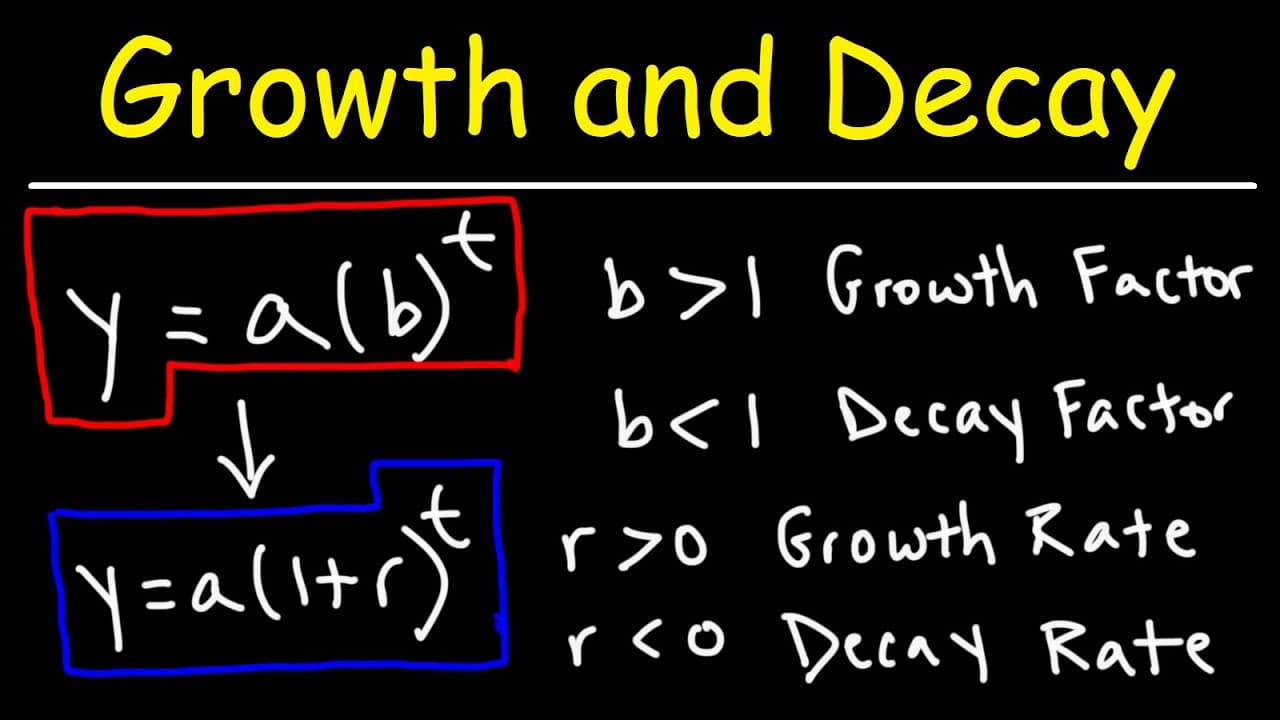
for each function shown below determine the growth or the Decay Factor as well as the growth rate or the Decay rate so let's say if we have some exponential function y is equal to a * B raised to some variable it could be X or it could be t b if B is greater than one what we have is exponential growth so B represents the growth factor now if B is a... Read More
Key Insights
- ⚾ The base (B) of an exponential function determines whether it represents growth or decay.
- 😃 The growth factor (B) is greater than one in exponential growth and between 0 and 1 in exponential decay.
- ☠️ The growth rate (R) represents the rate of increase in exponential growth and the rate of decrease in exponential decay.
- ☠️ The decay rate is determined by subtracting one from the decay factor.
- ☠️ The video provides examples and calculations to illustrate the concepts of growth and decay factors and rates.
- 🍻 Related video content on logarithms, graphing, and solving exponential functions is available through the provided links.
Install to Summarize YouTube Videos and Get Transcripts
Explore YouTube Video Summarizer or Get YouTube Transcript Extractor
Questions & Answers
Q: What is the difference between a growth factor and a growth rate in exponential functions?
The growth factor (B) determines whether an exponential function represents growth or decay. The growth rate (R), on the other hand, represents the rate of increase or decrease in the function.
Q: How can we determine whether an exponential function represents growth or decay?
If the base (B) of the function is greater than one, it represents growth. If B is between 0 and 1, it represents decay.
Q: What does a positive growth rate indicate?
A positive growth rate (R) represents an exponential function that is experiencing growth. It indicates the rate at which the function is increasing.
Q: How is the decay rate determined in exponential decay?
In exponential decay, if the base (B) is between 0 and 1, the decay rate (R) is determined by subtracting one from B. It represents the rate at which the function is decreasing.
Summary & Key Takeaways
-
The video explains that if the base (B) of an exponential function is greater than one, it represents exponential growth, while if it is between 0 and 1, it represents exponential decay.
-
The growth factor (B) is the value that determines the growth or decay.
-
The growth rate (R) represents the rate of increase or decrease, depending on whether it is positive or negative.
Read in Other Languages (beta)
Share This Summary 📚
Summarize YouTube Videos and Get Video Transcripts with 1-Click
Try YouTube Summary with ChatGPT & Claude or YouTube Transcript Generator
Explore More Summaries from The Organic Chemistry Tutor 📚




Summarize YouTube Videos and Get Video Transcripts with 1-Click
Try YouTube Summary with ChatGPT & Claude or YouTube Transcript Generator