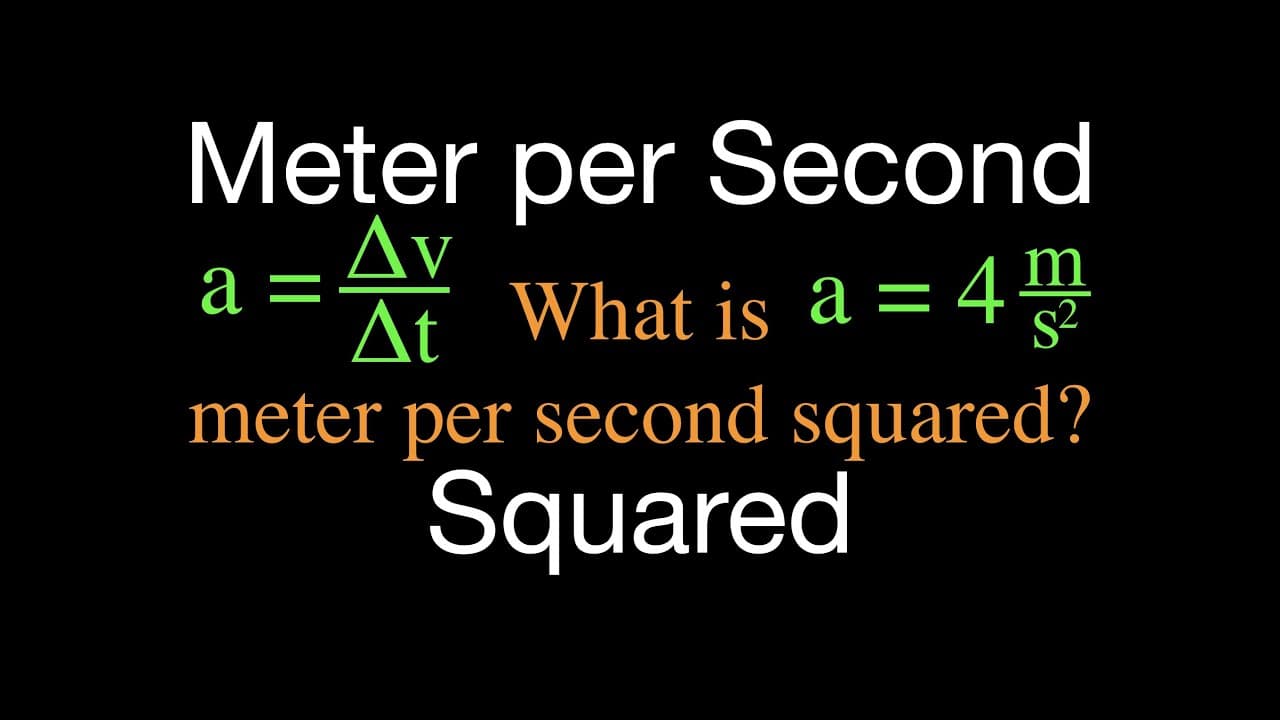
Kinematics, What Does Meters per Second Squared Mean? (Best Explanation Ever)
TL;DR
Explaining the meaning of acceleration in m/s squared, breaking down the concept step by step.
Transcript
in today's video we're gonna try and answer a common question I get when we're talking about kinematics motion speed velocity and cell eration acceleration and the question really is what does that mean m/s squared now before we do that please don't forget subscribe to my channel step by step science get all my excellent physics chemistry and math ... Read More
Key Insights
- 🤒 Change in position is like distance in one dimension, measured in meters.
- 🤒 Velocity measures how fast position changes, in meters per second.
- 🤒 Acceleration shows how velocity changes every second, measured in meters per second squared.
- 💱 Calculating acceleration involves dividing velocity change by time change.
- 🐎 Acceleration is crucial for understanding how speed changes over time.
- 🆘 Understanding units like m/s^2 helps in comprehending motion in physics.
- 💄 Simplifying units like m/s^2 makes calculations and explanations clearer.
Install to Summarize YouTube Videos and Get Transcripts
Explore YouTube Video Summarizer or Get YouTube Transcript Extractor
Questions & Answers
Q: What is the relationship between change in position and distance in one dimension?
In one dimension, change in position is similar to distance, representing the final position minus the initial position. It is a vector quantity measured in meters.
Q: How is velocity calculated and what does it signify?
Velocity is calculated by dividing the change in position by the change in time, giving meters per second. It measures how fast position changes over time.
Q: Define acceleration and why is it measured in meters per second squared?
Acceleration is the rate of change of velocity, indicating how velocity changes every second. It is measured in m/s^2 to represent how much velocity changes per second.
Q: Can you provide an example of calculating acceleration using velocity changes over time?
By subtracting initial velocity from final velocity and dividing by time, you can calculate acceleration. For example, if a plane accelerates from 35 m/s to 45 m/s in 4 seconds, the acceleration is 2.5 m/s^2.
Summary & Key Takeaways
-
Explains the concept of change in position as the distance in one dimension.
-
Defines velocity as the rate of change of position in meters per second.
-
Describes acceleration as the rate of change of velocity in meters per second squared.
Read in Other Languages (beta)
Share This Summary 📚
Summarize YouTube Videos and Get Video Transcripts with 1-Click
Try YouTube Summary with ChatGPT & Claude or YouTube Transcript Generator
Explore More Summaries from Step by Step Science 📚
Summarize YouTube Videos and Get Video Transcripts with 1-Click
Try YouTube Summary with ChatGPT & Claude or YouTube Transcript Generator