How To Derive The Formula For The Sum of an Arithmetic Series
TL;DR
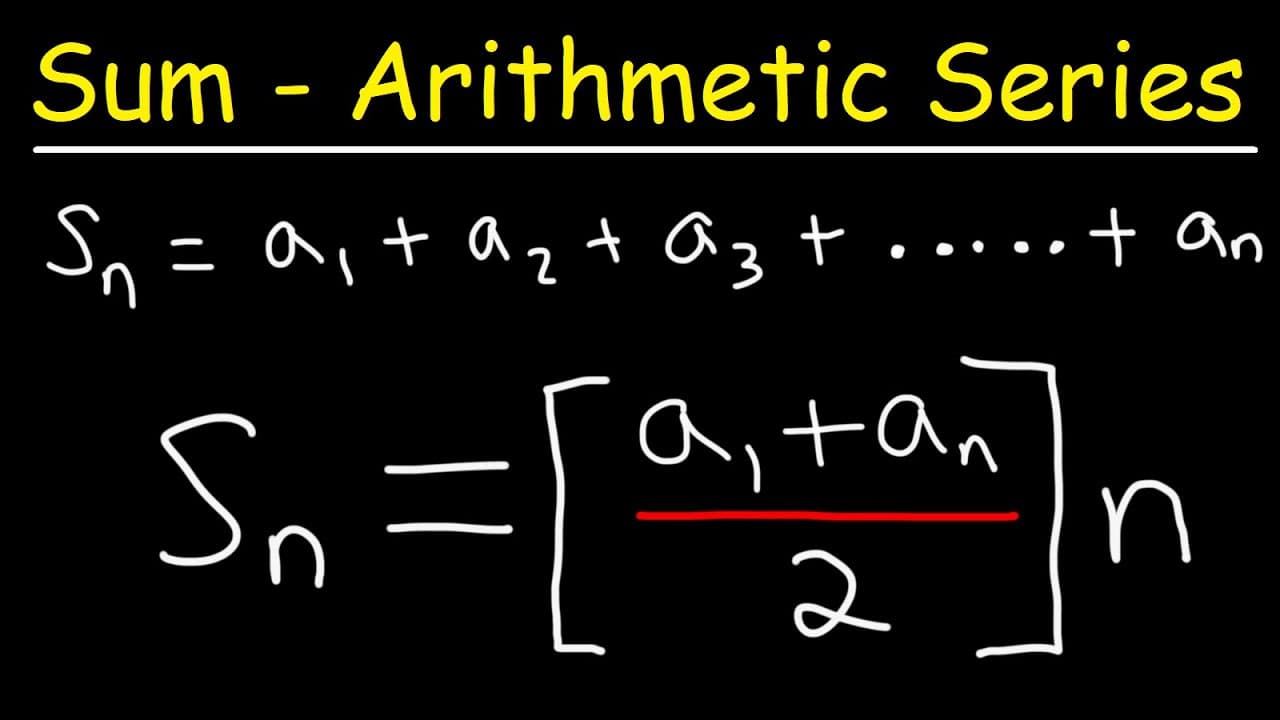
This lesson explains how to derive and prove the formula for the sum of an arithmetic series.
Transcript
in this lesson we're going to talk about how to prove the formula that gives you the sum of an arithmetic series now before we do that let's talk about an arithmetic sequence versus an arithmetic series example of an arithmetic sequence the numbers 5 8 11 14 17 and so forth the first term a sub 1 is 5. the second term a sub 2 is 8. the common diffe... Read More
Key Insights
- 🍉 An arithmetic sequence has a common difference between its terms.
- 🍉 The sum of an arithmetic series can be calculated using the formula: (first term + last term) / 2 * n.
- 🍉 The formula for the sum of an arithmetic series is derived by expressing the series in terms of the first and last terms, combining equations, and factoring out common terms.
- 🍉 The gcf, which is the sum of the first and last terms, appears n times in the derived formula.
- 🧑🏭 Factoring out common terms helps simplify and derive the formula.
- 🍉 The derived formula is useful for quickly calculating the sum of an arithmetic series without manually adding the terms.
- 🍉 The formula provides an efficient method for finding the sum of a large number of terms in an arithmetic series.
Install to Summarize YouTube Videos and Get Transcripts
Explore YouTube Video Summarizer or Get YouTube Transcript Extractor
Questions & Answers
Q: What is the difference between an arithmetic sequence and an arithmetic series?
An arithmetic sequence is a list of numbers with a common difference, while an arithmetic series is the sum of those numbers.
Q: How can the sum of the first six terms in an arithmetic series be calculated?
The sum can be calculated using the formula: (first term + last term) / 2 * n. In this case, the first term is 5, the last term is 17, and n is 5.
Q: How can the formula for the sum of an arithmetic series be derived?
The formula can be derived by expressing the series in terms of the first and last terms, combining equations, canceling out common differences, factoring out the common terms, and dividing both sides by two.
Q: What is the significance of the gcf (greatest common factor) in the derived formula?
The gcf, which is the sum of the first and last terms (a sub 1 + a sub n), appears n times in the formula, representing the number of terms in the arithmetic series.
Summary & Key Takeaways
-
An arithmetic sequence is a list of numbers with a common difference. Adding these numbers gives an arithmetic series.
-
The sum of the first six terms (s sub 6) in an arithmetic series can be calculated using the formula: (first term + last term) / 2 * n.
-
The formula for the sum of an arithmetic series is derived by expressing the series in terms of the first and last terms, combining equations, and factoring out the common terms.
Read in Other Languages (beta)
Share This Summary 📚
Summarize YouTube Videos and Get Video Transcripts with 1-Click
Try YouTube Summary with ChatGPT & Claude or YouTube Transcript Generator
Explore More Summaries from The Organic Chemistry Tutor 📚
Summarize YouTube Videos and Get Video Transcripts with 1-Click
Try YouTube Summary with ChatGPT & Claude or YouTube Transcript Generator