Criteria for Tool Wear - Tool Life and Machining Economics - Machining Sciences and Tool Design
TL;DR
Tool life in machining is the time between re-sharpenings, and indications of tool failure include poor surface finish, high power consumption, dimensional inaccuracies, overheating of the cutting tool, and burnishing marks on the workpiece. Criteria for measuring tool life depend on factors such as flank wear, crater depth, and material type.
Transcript
hello students my name is santosh kumar and i am the course instructor for machining sciences and tool design we are discussing module number four that is true life and machining economics in this video we'll be discussing about criteria for tool failure first we will define what is true life which we have already defined in the other video so to l... Read More
Key Insights
- 🔨 Tool life in machining is the time between re-sharpenings, indicating the effectiveness of the cutting tool.
- 💋 Indications of tool failure include poor surface finish, high power consumption, dimensional inaccuracies, overheating, and burnishing marks.
- 😩 Criteria for measuring tool life depend on factors such as flank wear, crater depth, and material type.
- 🚄 High-speed steel and ceramic tools have specific criteria for tool life defined by ISO standards.
- 😩 The length and depth of flank wear and crater wave help determine when tool life has ended.
- 😘 Tool failure can result in lower productivity, decreased accuracy, and increased costs.
- 🔨 Regular maintenance and monitoring of tool wear are essential to ensure optimal tool life and performance.
Install to Summarize YouTube Videos and Get Transcripts
Explore YouTube Video Summarizer or Get YouTube Transcript Extractor
Questions & Answers
Q: What is tool life in machining?
Tool life in machining refers to the time between two successive re-sharpenings of the cutting tool, indicating its effectiveness before it loses sharpness.
Q: What are the indications of tool failure?
Indications of tool failure include poor surface finish on the workpiece, higher power consumption, dimensional inaccuracies compared to the required specifications, overheating of the cutting tool due to friction forces, and burnishing marks on the workpiece surface.
Q: How can tool life be measured?
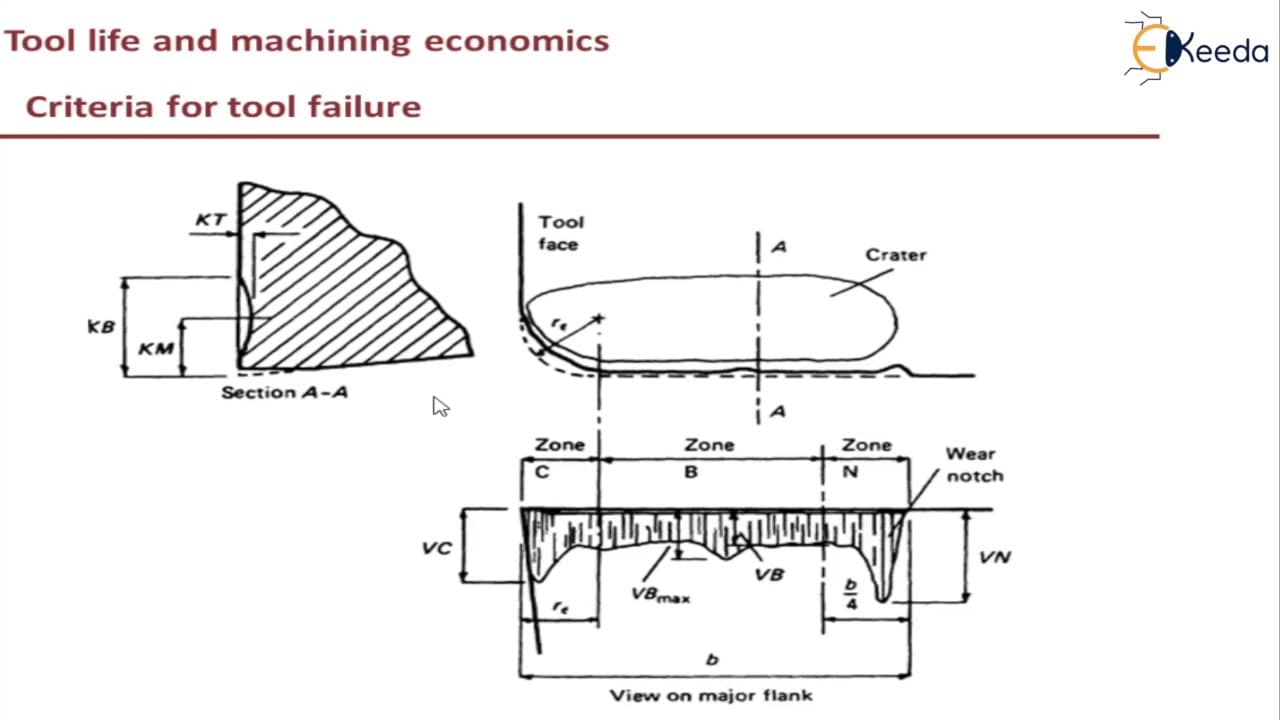
Tool life can be measured based on criteria such as flank wear, crater depth, and material type. For high-speed steel or ceramic tools, criteria like vb = 0.3, vb max = 0.6 indicate the end of tool life. Sintered carbide tools have similar criteria, and crater depth is determined by the equation kt = 0.06 + 0.3f, where f is the feed.
Q: What are the different zones and regions of flank wear?
Flank wear is divided into zones B and C, with vb and vb max indicating the wear in these zones. The length of the crater wave is represented by kb, and km is the average length. These measurements help determine the extent of wear on the cutting tool.
Summary & Key Takeaways
-
Tool life is the time between re-sharpenings, indicating the effectiveness of the cutting tool.
-
Indications of tool failure include poor surface finish, high power consumption, dimensional inaccuracies, overheating, and burnishing marks.
-
Criteria for measuring tool life depend on factors such as flank wear, crater depth, and material type.
Read in Other Languages (beta)
Share This Summary 📚
Summarize YouTube Videos and Get Video Transcripts with 1-Click
Try YouTube Summary with ChatGPT & Claude or YouTube Transcript Generator
Explore More Summaries from Ekeeda 📚






Summarize YouTube Videos and Get Video Transcripts with 1-Click
Try YouTube Summary with ChatGPT & Claude or YouTube Transcript Generator