What Are the Different Types of Network Topologies?
TL;DR
Network topologies define how computers are connected, with key types including bus, star, tree, ring, and mesh. Bus topology uses a single cable, while star topology connects to a central hub, making it prone to single points of failure. Mesh topology offers redundancy with each computer linked to every other, though it is complex and costly to implement.
Transcript
hello students today we are going to study about when we talk about network we need to understand how and in what world order the computers are connected but topology defines the way in which the computers are connected like you can see in the diagram there is one topology which is called the bus topology this is a circular form of topology quantal... Read More
Key Insights
- 🤩 Network topologies define the way computers are connected in a network, such as bus, star, tree, ring, and mesh.
- 👨💼 Bus topology connects all computers through a common cable, but a failure can disrupt communication.
- 😒 Star topology uses a central hub, with redundancy measures to ensure sustainability.
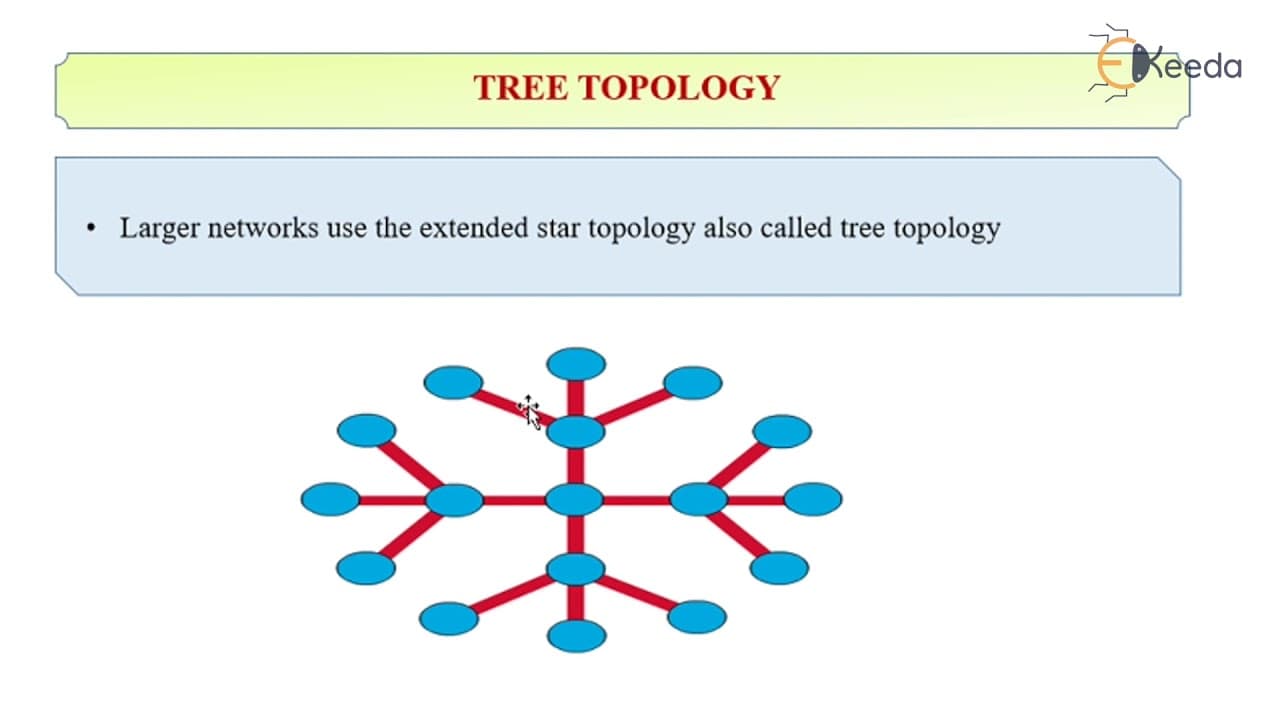
- 🤩 Tree topology is an extension of star topology, enabling multiple levels of connections.
- 😋 Ring topology passes tokens along a circular ring, with single and dual ring variations.
Install to Summarize YouTube Videos and Get Transcripts
Explore YouTube Video Summarizer or Get YouTube Transcript Extractor
Questions & Answers
Q: What is the main disadvantage of bus topology?
The main disadvantage of bus topology is that if the backbone cable fails, communication between computers will be disrupted, affecting the entire network.
Q: How does the star topology ensure the working and sustainability of the central hub?
In star topology, the network is designed to ensure the working and sustainability of the central hub. Redundancy measures like backup hubs or failover mechanisms are implemented to maintain continuity if the central hub fails.
Q: What is the difference between a single ring and a dual ring in ring topology?
In a single ring topology, all devices share a single cable for communication. In a dual ring topology, data can be sent in both directions, providing additional flexibility and resilience in case of cable failures.
Q: Why is mesh topology expensive and difficult to implement?
Mesh topology requires a unique cable connection between each computer, creating a one-to-one connection. This increases the cost and complexity of implementation, making it less practical for large networks.
Summary & Key Takeaways
-
The video introduces different network topologies, such as bus topology, where all computers are connected through a common cable, but a failure can disrupt communication.
-
It explains the star topology, where computers are connected to a central hub, but if the hub fails, the entire network is affected.
-
The video discusses tree topology, an extension of star topology, with multiple levels of connections, and mentions ring and mesh topologies, explaining their characteristics and challenges.
Read in Other Languages (beta)
Share This Summary 📚
Summarize YouTube Videos and Get Video Transcripts with 1-Click
Try YouTube Summary with ChatGPT & Claude or YouTube Transcript Generator
Explore More Summaries from Ekeeda 📚






Summarize YouTube Videos and Get Video Transcripts with 1-Click
Try YouTube Summary with ChatGPT & Claude or YouTube Transcript Generator