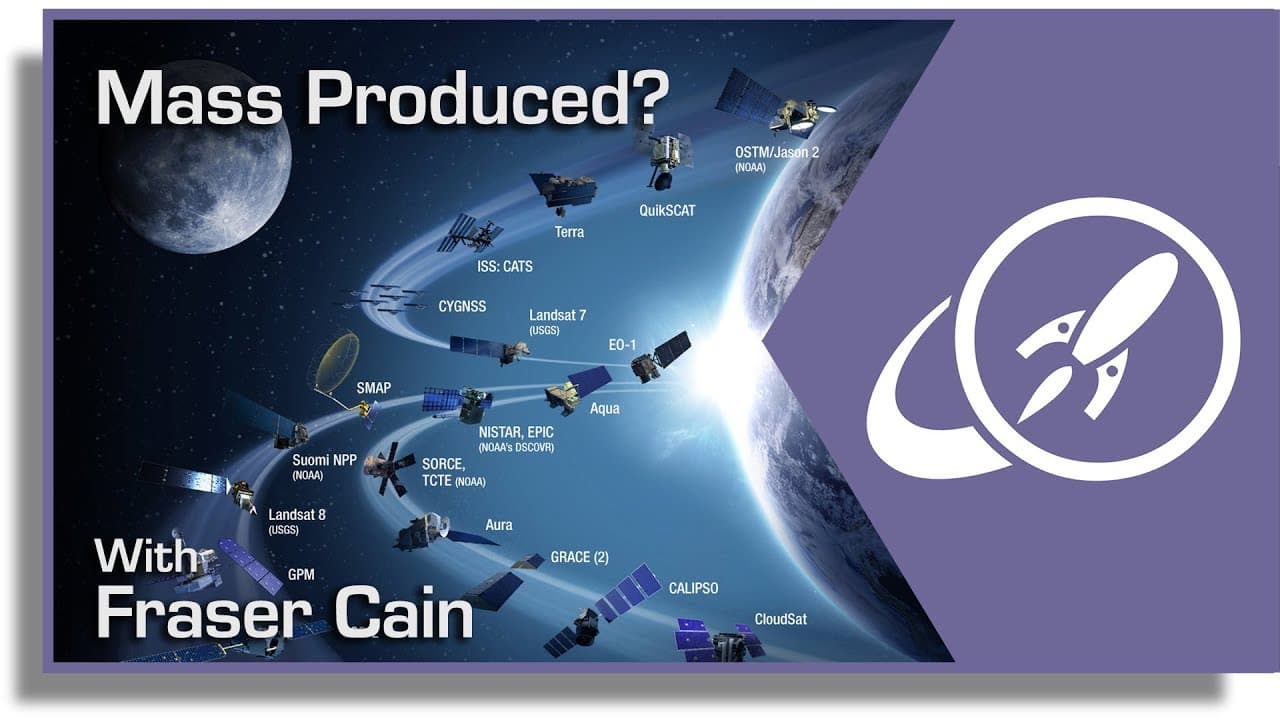
Q&A 54: Why Doesn't NASA Mass Produce Spacecraft? and More...
TL;DR
Tips for boosting subscribers & insights on spacecraft technology and astronomy.
Transcript
all right question show time your questions my answers wherever you are anyone on the channel if a question pops in your brain just write it down I'll gather a bunch of them up and I'll answer them here all right let's get into it guru of technologies you make awesome videos but why do you have very less subscribers I mean you must have more subscr... Read More
Key Insights
- ⌚ Boosting subscribers: Engagement and watch time increase channel visibility.
- 🎟️ NASA spacecraft design: Balancing mission objectives with cost and functionality.
- 🧑🦼 Astronomy methods: Leveraging reaction wheels, transit methods, and exoplanet imaging challenges.
- ❓ Impact of gravitational slingshots on spacecraft velocity.
- ❓ Frequency of asteroid flybys between Earth and the Moon.
- 💥 Andromeda-Milky Way collision timeline and possible galaxy collision scenarios.
- ❓ The Great Attractor's gravitational influence on galaxies in the universe.
Install to Summarize YouTube Videos and Get Transcripts
Explore YouTube Video Summarizer or Get YouTube Transcript Extractor
Questions & Answers
Q: How can viewers help creators gain more subscribers?
Viewers can boost subscriber count by engaging, watching videos fully, and watching multiple videos on a channel, signaling value to YouTube's algorithm.
Q: Why do spacecraft designers opt to build new satellites rather than duplicating them?
NASA considers cost, unique mission requirements, and potential for modifications when choosing to build new spacecraft instead of duplicates.
Q: How do astronomers differentiate sunspots from transiting planets in star observations?
By tracking brightness changes over time, astronomers confirm regular dimming patterns to identify transiting planets, eliminating potential false positives like sunspots.
Q: When can we expect detailed images of exoplanets beyond our solar system?
Current telescopes offer minimal resolution, but future technological advancements must occur for detailed images, potentially through space-based lensing or advanced telescopic methods.
Summary & Key Takeaways
-
Advice on boosting subscribers: Consistency, watch time, and engagement.
-
NASA's spacecraft design strategy: Balancing cost and mission objectives.
-
Astronomy insights: Understanding reaction wheels, transit methods, and exoplanet imaging challenges.
Read in Other Languages (beta)
Share This Summary 📚
Summarize YouTube Videos and Get Video Transcripts with 1-Click
Try YouTube Summary with ChatGPT & Claude or YouTube Transcript Generator
Explore More Summaries from Fraser Cain 📚
Summarize YouTube Videos and Get Video Transcripts with 1-Click
Try YouTube Summary with ChatGPT & Claude or YouTube Transcript Generator