Correlation for Binary Variables: Tetrachoric Correlations in R
TL;DR
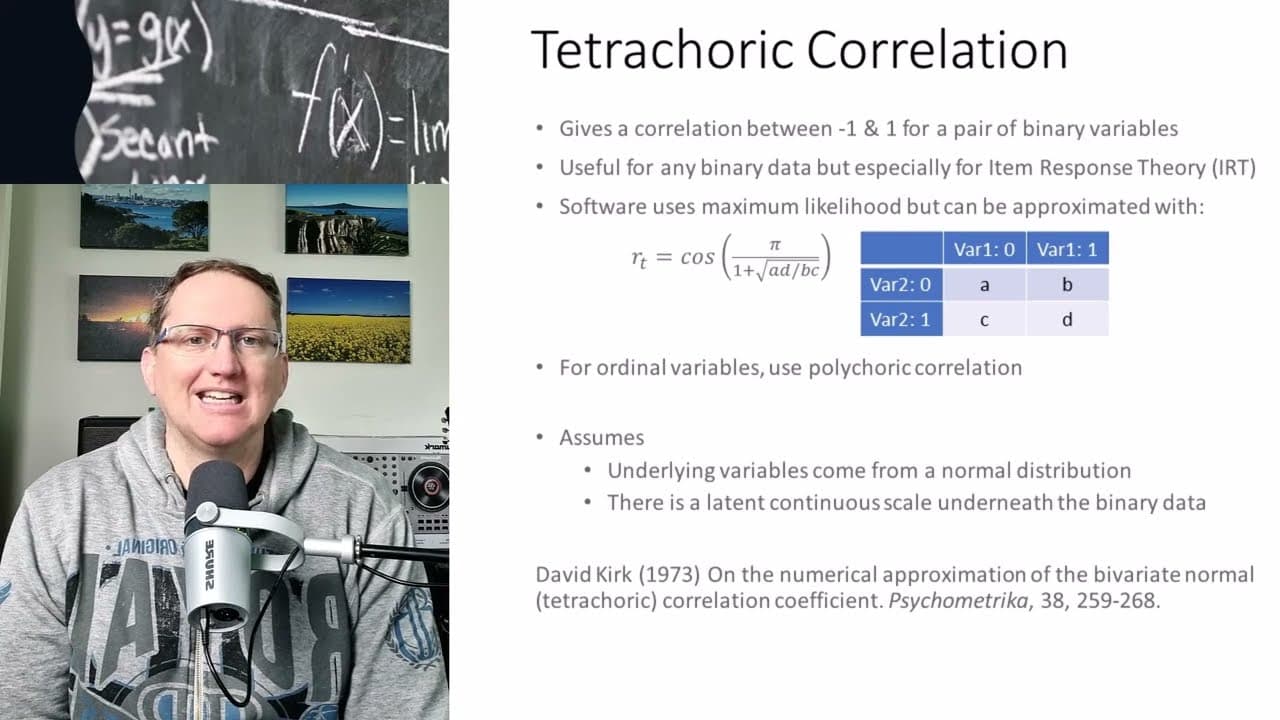
Tetrachoric correlation measures relationships between two binary variables using R programming.
Transcript
hi friends today I wanted to do slightly different video where we look at a statistic and then jump into R to see how to work with it so the statistic that we're looking at today is the tetrachoric correlation so this is a correlation that we can use where we have two binary variables normally we think about correlation as a measure between two num... Read More
Key Insights
- 🤝 Tetrachoric correlation serves as a valuable tool for quantifying relationships when dealing with binary variables, particularly in psychometric contexts.
- 🫥 The method's reliance on the latent normality assumption allows researchers to explore deeper constructs not immediately visible in binary data.
- ♿ R software facilitates tetrachoric correlation analysis efficiently, promoting accessibility for statisticians.
- 0️⃣ The integration of maximum likelihood calculations ensures accurate estimations, albeit with adjustments for anomalies like zeros.
- 🚨 Notable patterns in binary variable relationships, such as correlations between militaristic experience and job callbacks, can emerge from thorough analysis.
- ❓ Researchers must be cautious about the assumptions made regarding data distributions to maintain the integrity of tetrachoric correlation interpretations.
- 💁 The pragmatic applications of tetrachoric correlation extend beyond academia, informing practices in business, human resources, and data-driven decision-making.
Install to Summarize YouTube Videos and Get Transcripts
Explore YouTube Video Summarizer or Get YouTube Transcript Extractor
Questions & Answers
Q: What is the tetrachoric correlation and its significance?
Tetrachoric correlation quantifies the relationship between two binary variables, typically in psychometrics. Unlike standard correlation measures that apply to numerical data, tetrachoric correlation assumes an underlying normal distribution even for binary data, providing insight into latent constructs behind observed binary outcomes.
Q: How does R compute tetrachoric correlation?
R computes tetrachoric correlation using functions from specialized packages like "psy" and "tidyverse", allowing users to input a data frame or a contingency table. The function processes the binary variables, applying maximum likelihood estimation, and generates correlation values along with warnings for potential adjustments needed when zeros are encountered in the data.
Q: Why is a correction made to the tetrachoric correlation calculation?
A correction is made in tetrachoric correlation calculations to address instances where there are zeros in the contingency table, which can skew results. Typically, a small value (commonly 0.5) is added to enable the computation to proceed smoothly and yield a meaningful correlation figure in these situations.
Q: What are some practical applications of tetrachoric correlation?
Tetrachoric correlation is widely used in psychometrics for analyzing binary survey responses. It helps researchers understand associations in dichotomous data such as yes/no questions, thereby elucidating underlying patterns related to behaviors, preferences, or characteristics inferred from binary responses.
Q: What insights can be gained from the relationships observed through tetrachoric correlation?
Insights derived from tetrachoric correlations can reveal meaningful associations between binary variables, such as the potential impact of demographic factors on behavioral outcomes. This understanding supports effective decision-making in fields such as social sciences, job market studies, and psychology.
Summary & Key Takeaways
-
The tetrachoric correlation is a statistical measure used to determine the relationship between two binary variables, functioning within a range of -1 to 1, similar to traditional correlation methods.
-
This correlation is typically computed using maximum likelihood and involves a specific formula that calculates the ratio of the diagonals to the off-diagonals in a contingency table.
-
In practical application, R software can be used to perform tetrachoric correlation analysis on binary data, with considerations for potential adjustments when zeros are present in the data.
Read in Other Languages (beta)
Share This Summary 📚
Summarize YouTube Videos and Get Video Transcripts with 1-Click
Try YouTube Summary with ChatGPT & Claude or YouTube Transcript Generator
Explore More Summaries from Dr Lyndon Walker 📚






Summarize YouTube Videos and Get Video Transcripts with 1-Click
Try YouTube Summary with ChatGPT & Claude or YouTube Transcript Generator